


1. Introduction
Biodiversity loss is an important business resilience and supply chain risk. According to research by the World Economic Forum, more than half of global GDP ($44 trillion) depends moderately or highly on healthy ecosystems, from pollination and clean water to fertile soil and raw materials. When natural systems degrade, supply chains destabilize, raw material costs surge, and commercial risks multiply.
This article isn’t only for companies legally in scope of the CSRD. It is for any organization that wants to report credibly on its environmental impact: EU or non-EU, listed or private, big or small.
Even if the CSRD does not apply to you directly, it affects you through your business relationships. Large corporate buyers are required to audit nature-related risks across their value chains, meaning suppliers face increasing customer questionnaires, procurement requirements, and banking scrutiny on nature loss.
I use European Sustainability Reporting Standard ESRS E4 as a clear and practical blueprint for biodiversity disclosure. Because its architecture aligns closely with international frameworks—such as the market-led TNFD, science-based target setting under SBTN, and the UN Kunming-Montreal Global Biodiversity Framework—you can use this guide as a universal blueprint to structure your nature reporting, protect supply continuity, and satisfy customer demands.
The standard establishes how companies disclose biodiversity-related impacts, risks, and opportunities, along with the strategies, operational actions, and metrics used to manage them. It is designed to align corporate reporting with the EU Biodiversity Strategy for 2030, the EU Nature Restoration Law, and global science-based nature targets.
In this article, you will learn:
✅ What biodiversity encompasses in a sustainability reporting framework
✅ The core regulatory objectives and scope of the standard
✅ How biodiversity connects with climate (E1), pollution (E2), water (E3), and affected communities (S3)
✅ The key disclosure requirements (E4-1 to E4-5), from transition plans to site-level species metrics
✅ Foundational scientific and regulatory acronyms
By the end, you’ll gain a clear, structured understanding of biodiversity reporting and ESRS E4.

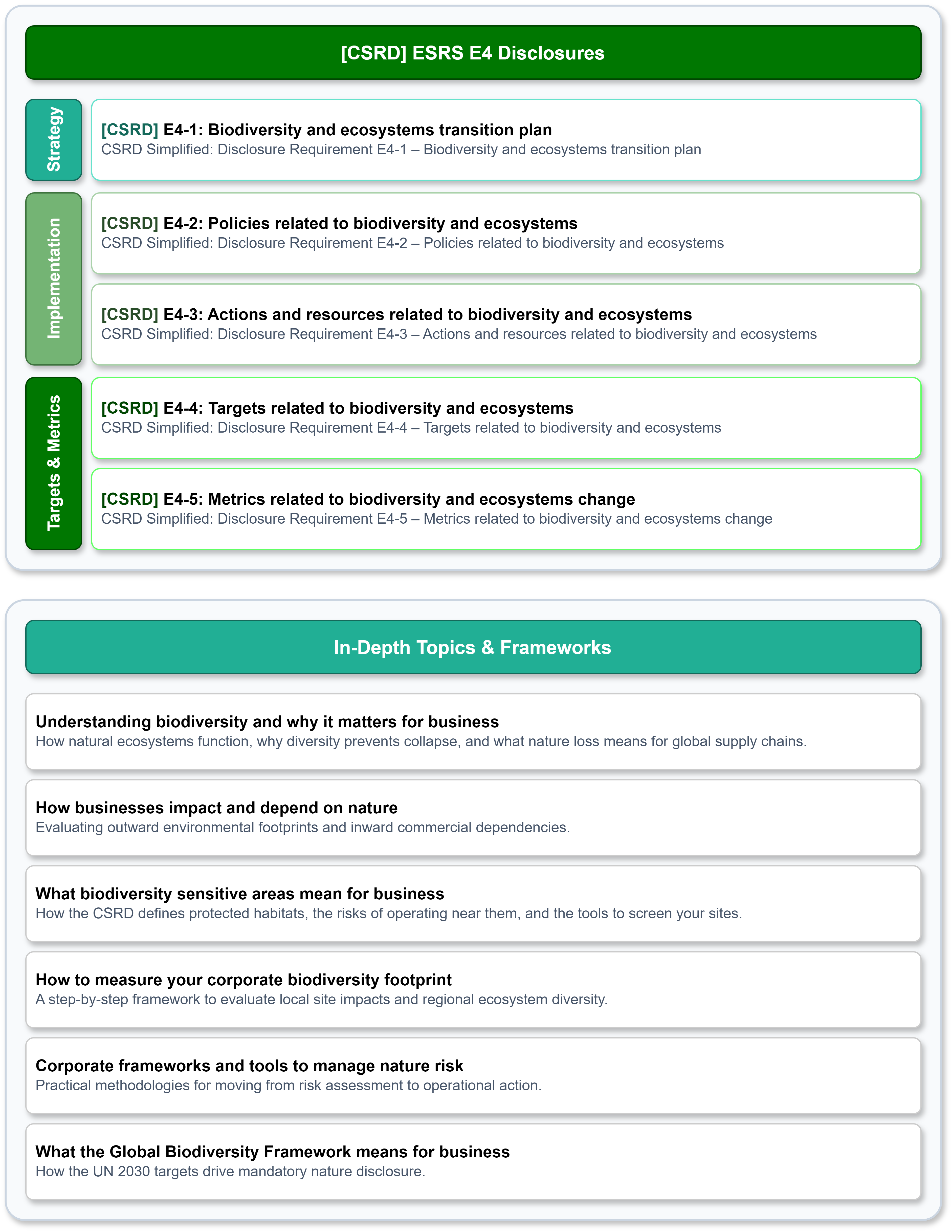
Before we dive into the guide, here is an overview of all articles that are currently available.
Missing something? Please send me a message or place a comment.
You can find any of these articles by navigating to sustainabilitysimplified.eu/
and using the search button.
2. Short introduction to biodiversity and ecosystems
First of all, it is important to know what biodiversity actually encompasses in a reporting context.
Under the revised European Sustainability Reporting Standards (Revised ESRS E4, paragraph 7 and Annex II Glossary)—anchored in the foundational principles of the UN Convention on Biological Diversity (CBD, Article 2)—biodiversity is formally defined as:
“The variability among living organisms from all sources including, inter alia, terrestrial, freshwater, marine and other aquatic ecosystems and the ecological complexes of which they are part; this includes diversity within species (genetic diversity), between species, and of ecosystems.”
In today’s economy, nature loss has reached an alarming scale. According to the Stockholm Resilience Centre, humanity has breached the planetary boundary for biosphere integrity. Furthermore, scientific findings from the UN IPBES Global Assessment show that species extinction rates are currently tens to hundreds of times higher than the natural baseline average over the past 10 million years, destabilizing the living systems that regulate climate, water cycles, and food production.
This degradation creates direct, measurable business hazards. As documented by the World Economic Forum, over $44 trillion of economic value generation—more than half of global GDP—is moderately or highly dependent on nature. Companies face operational disruption from depleted natural capital, acute physical risks when natural coastal or watershed defenses collapse, and sudden transition risks as regulators enforce strict land-use and nature-restoration mandates.
Because biodiversity loss represents such a severe threat to planetary stability and economic continuity, it is addressed by the fourth environmental standard (ESRS E4) in the CSRD.
Here follows a brief timeline of foundational biodiversity frameworks that ESRS E4 directly builds upon (ESRS E4, paragraph 5):
May 1992 (The Habitats Directive): The EU adopted Directive 92/43/EEC, establishing the Natura 2000 network of protected areas to conserve Europe’s most vulnerable species and natural habitats.
May 2020 (EU Biodiversity Strategy for 2030): The European Commission published its core roadmap under the European Green Deal, committing to protect at least 30% of EU land and sea areas by 2030.
December 2022 (Kunming-Montreal Global Biodiversity Framework): Adopted at the UN Biodiversity Conference (COP15), the historic GBF established 23 global targets for 2030 to halt and reverse nature loss, including Target 15 mandating corporate disclosure.
August 2024 (EU Nature Restoration Law): Regulation (EU) 2024/1991 entered into force, enacting legally binding restoration targets that require member states to establish restoration measures covering at least 20% of the EU’s land and sea areas by 2030.
3. Understanding the objective of ESRS E4
The objective of ESRS E4 is for companies to disclose information on biodiversity and ecosystems whenever it represents a material impact, risk, or opportunity (IRO).
Biodiversity materiality is a two-way street. Companies must assess not only how their operations degrade habitats (impacts), but also which ecosystem services their business model depends on to generate revenue (dependencies). This ensures investors and stakeholders understand how nature loss disrupts supply chains, raw material availability, and financial continuity.
The standard defines five primary direct drivers of biodiversity change:
Land-use, freshwater-use, and sea-use change: Converting natural habitats into commercial agriculture, timber plantations, or urban infrastructure.
Direct exploitation of natural organisms: Overharvesting timber, overfishing marine species, or depleting wild populations.
Climate change: Temperature shifts, extreme weather events, and changing biomes driving species loss.
Pollution: Releasing excess nitrogen, phosphorus, toxic chemicals, and plastics into soil and water systems.
Invasive alien species: Introducing non-native organisms that outcompete native wildlife and destabilize ecosystems.
To help you gain a broader perspective beyond the regulatory disclosure equirements, I have published several deep-dive articles breaking down key biodiversity concepts, risk assessments, and measurement frameworks.
Articles about understanding foundational ecosystems and corporate dependencies
How natural ecosystems function, why diversity prevents collapse, and what nature loss means for global supply chains:

Evaluating outward environmental footprints and inward commercial dependencies:
Articles about location screening and footprint measurement
How the CSRD defines protected habitats, the risks of operating near them, and the tools to screen your sites:

A step-by-step framework to evaluate local site impacts and regional ecosystem diversity:
Articles about risk management tools and international policy
Practical methodologies for moving from risk assessment to operational action:
How the UN 2030 targets drive mandatory nature disclosure:
Interaction with other topics (ESRS Standards)
ESRS E4 interacts closely with several other sustainability standards:
ESRS E1 Climate Change: E1 tracks corporate greenhouse gas emissions, while E4 examines climate change as a direct driver of species displacement. Healthy ecosystems also serve as essential carbon sinks.
ESRS E2 Pollution: E2 focuses on the volume and chemical nature of pollutants released, while E4 measures how toxic runoff and nutrient loading degrade local habitats and wildlife populations.
ESRS E3 Water and Marine Resources: E3 measures volumetric water consumption and withdrawal, whereas E4 evaluates the health and ecological status of aquatic ecosystems.
ESRS E5 Resource Use and Circular Economy: E5 governs circular material flows and waste reduction, while E4 covers the upstream extraction of virgin biotic raw materials from sensitive ecosystems.
ESRS S3 Affected Communities: S3 addresses social impacts on indigenous peoples and local communities whose cultural heritage and livelihoods depend directly on local ecosystems.
4. The different components of ESRS E4
While ESRS E2 and E3 are structured into two pillars (Implementation and Targets & Metrics), ESRS E4 mirrors ESRS E1 by spanning all three pillars: Strategy (transition plans), Implementation (policies, actions, and resources), and Targets & Metrics (measurable commitments and ecological indicators).
Because biodiversity impacts are strictly location-dependent, ESRS E4 places heavy emphasis on geographic disaggregation. Companies cannot rely on corporate-wide averages. They must disclose site-level details for facilities and supplier nodes located in or near biodiversity-sensitive areas.
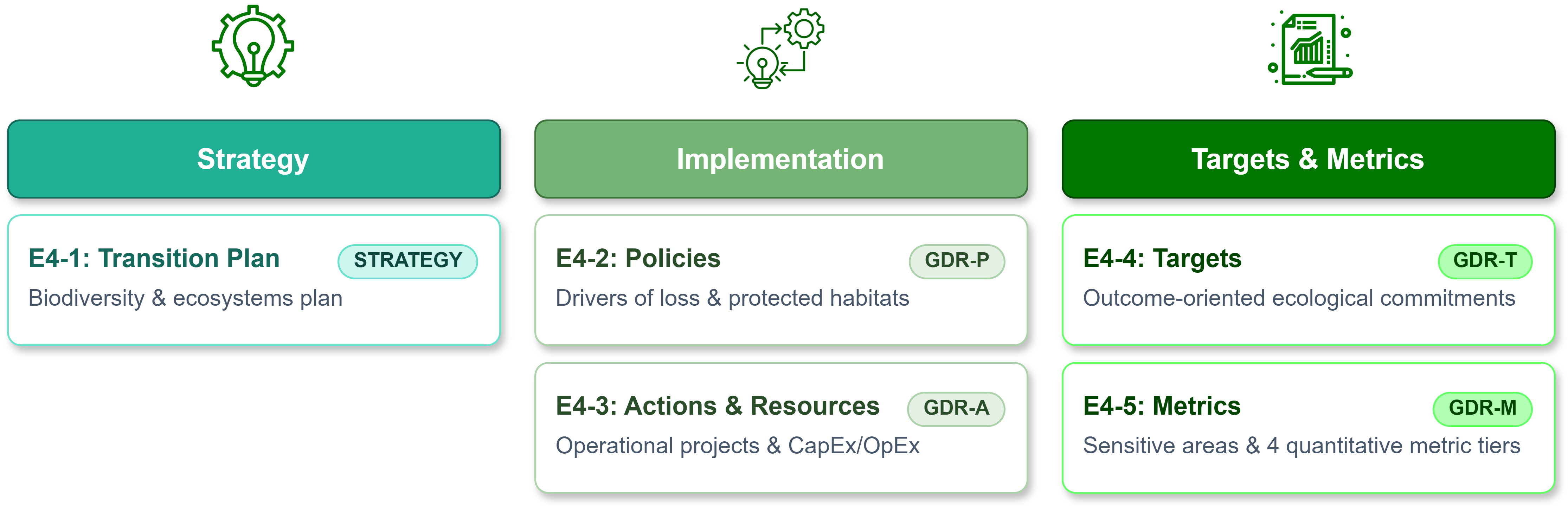
Read more below to explore each disclosure requirement in detail. I've also linked to my deep-dive articles below, where you can examine each specific requirement from E4-1 through E4-5.

E4-1: Biodiversity and ecosystems transition plan
Think of E4-1 as your high-level roadmap. It outlines how your business model and capital allocation adapt to halt and reverse nature loss by 2030.
Under the revised standards, reporting is strictly conditional: you only disclose a transition plan if you have actually adopted one. The CSRD creates no legal obligation to invent a plan if none exists.
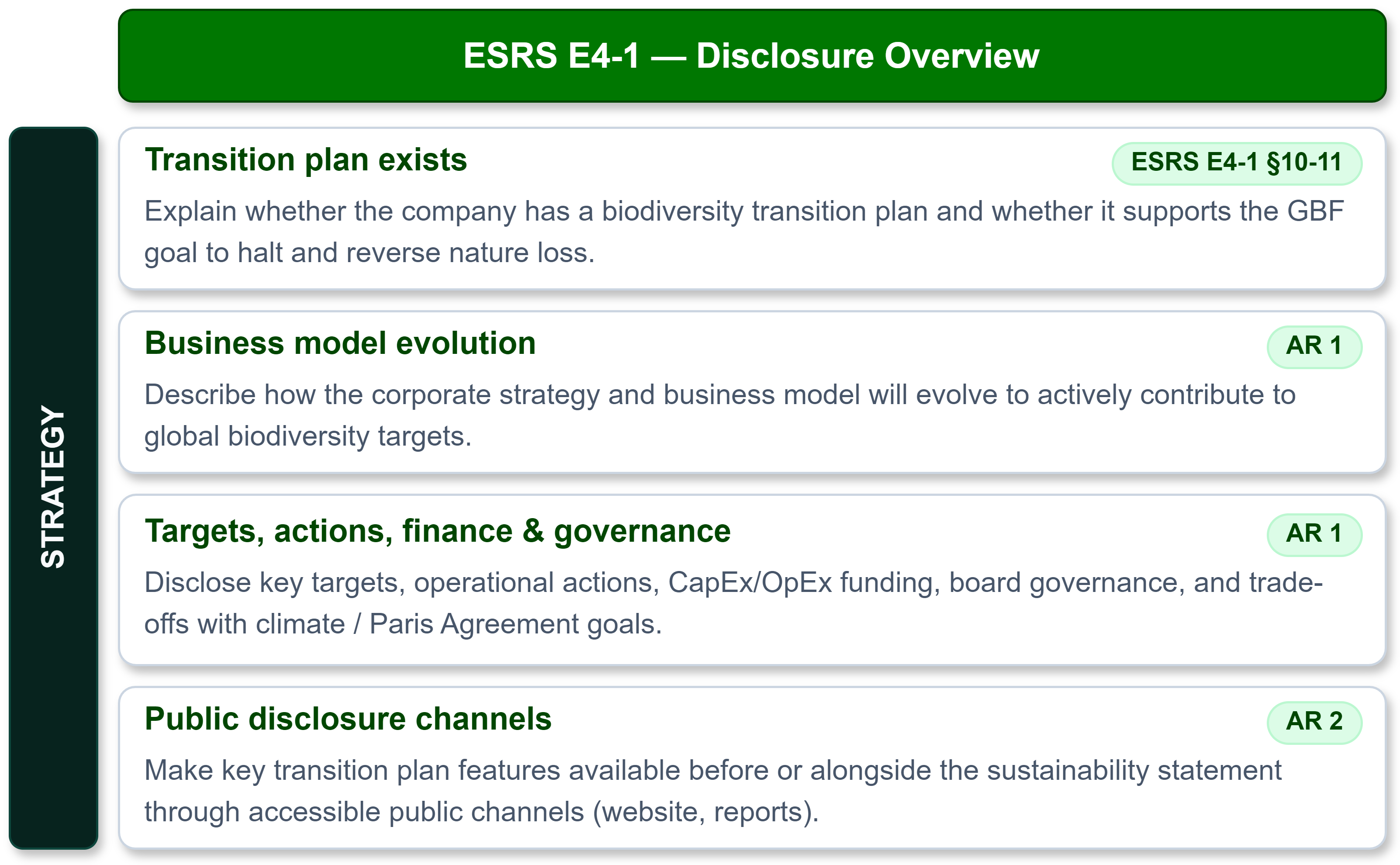
Read more about ESRS E4-1 here:

E4-2: Policies related to biodiversity and ecosystems
Policies act as your internal rulebook. E4-2 asks how your company sets operational boundaries to prevent environmental harm across your sites and supply chain.
The primary emphasis is on avoiding ecological damage first rather than trying to fix it later, alongside respecting the rights of indigenous peoples and local communities.
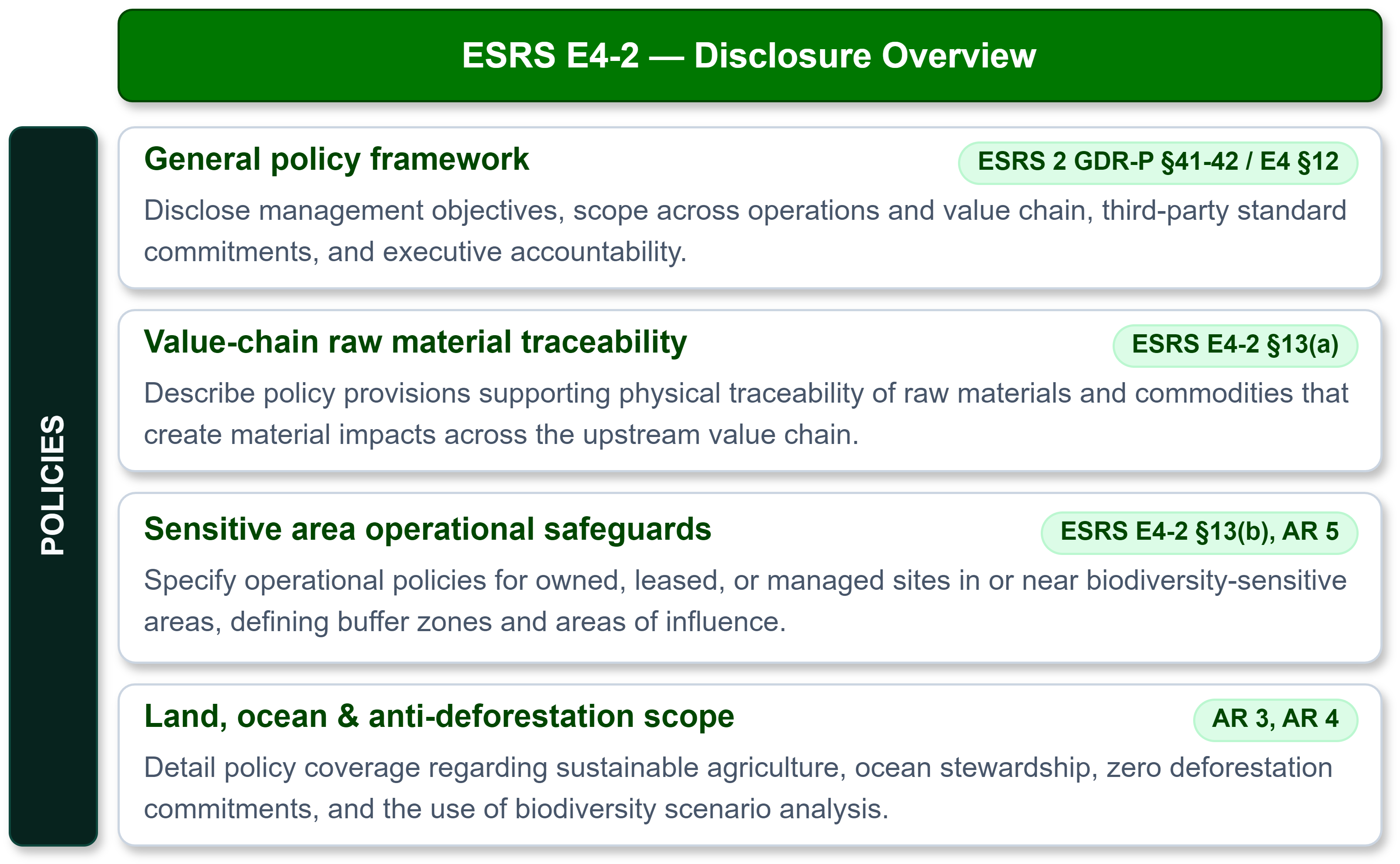
Read more about ESRS E4-2 here:
E4-3: Actions and resources related to biodiversity and ecosystems
This is where commitments meet real money. E4-3 requires companies to disclose the concrete operational projects and dedicated CapEx and OpEx backing their nature policies.
From an audit perspective, this is a major test: announcing ambitious nature commitments with zero allocated budget is an immediate red flag.
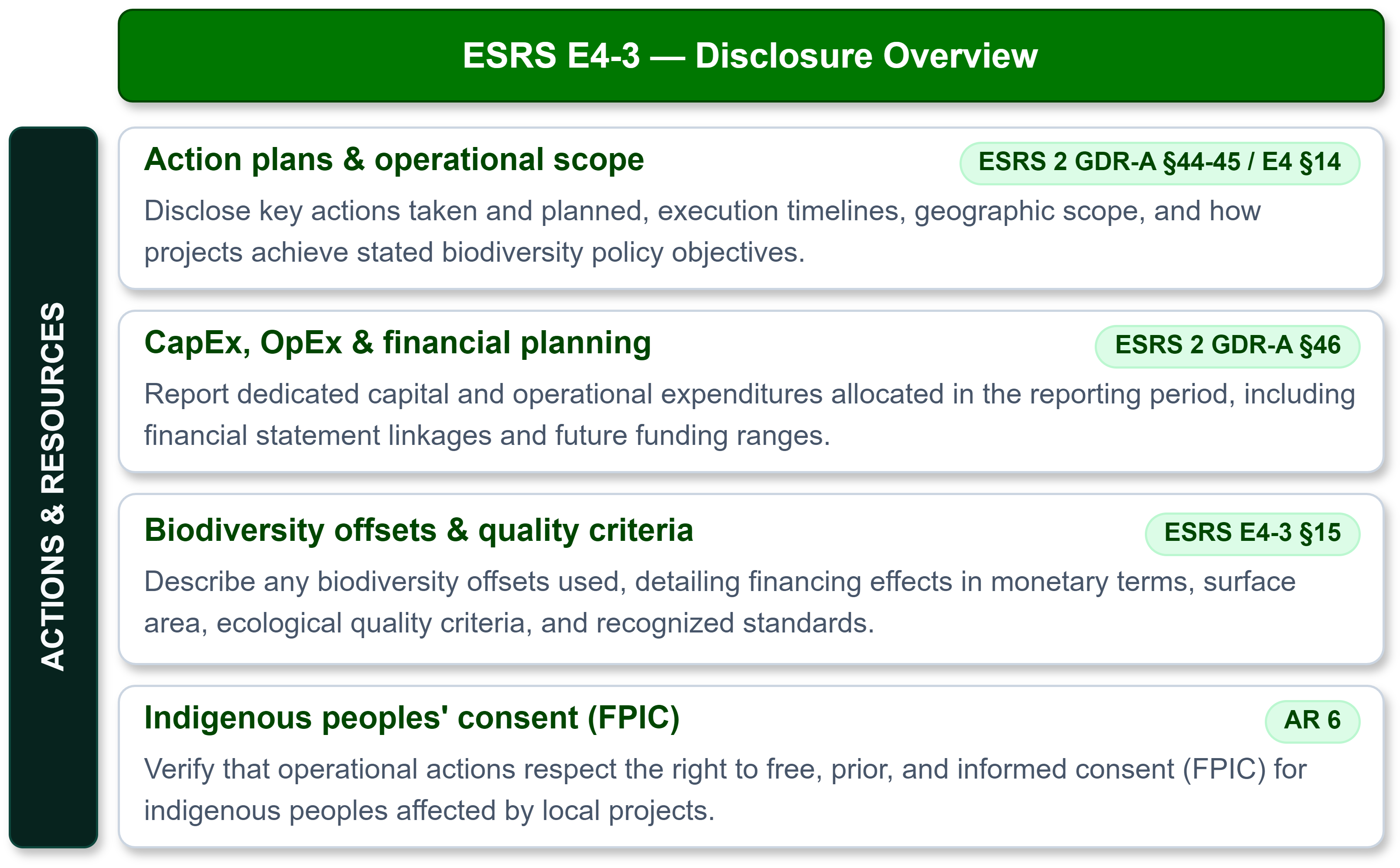
Read more about ESRS E4-3 here:

E4-4: Targets related to biodiversity and ecosystems
Targets define your destination. E4-4 requires measurable, time-bound goals rather than vague, aspirational statements.
Companies must set targets that are grounded in ecological science and tailored to what local ecosystems can sustain, moving beyond generic corporate averages.
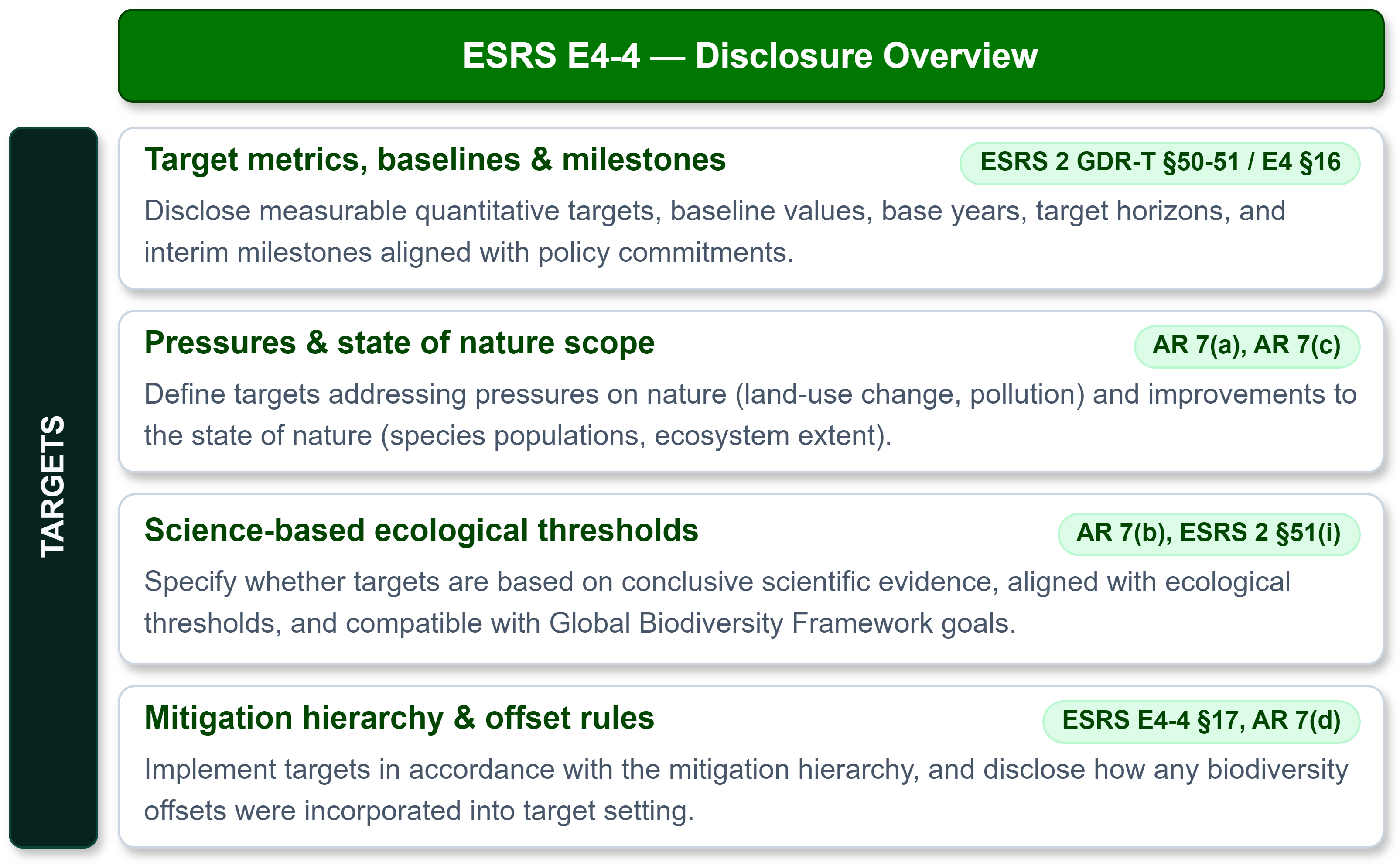
Read more about ESRS E4-4 here:
E4-5: Metrics related to biodiversity and ecosystems change
Metrics serve as your quantitative scorecard. E4-5 provides the hard numbers showing whether your actions are actually delivering results.
Reporting begins with screening operations in or near biodiversity-sensitive areas, followed by tracking site-specific pressures across land use, resource extraction, and ecosystem condition.
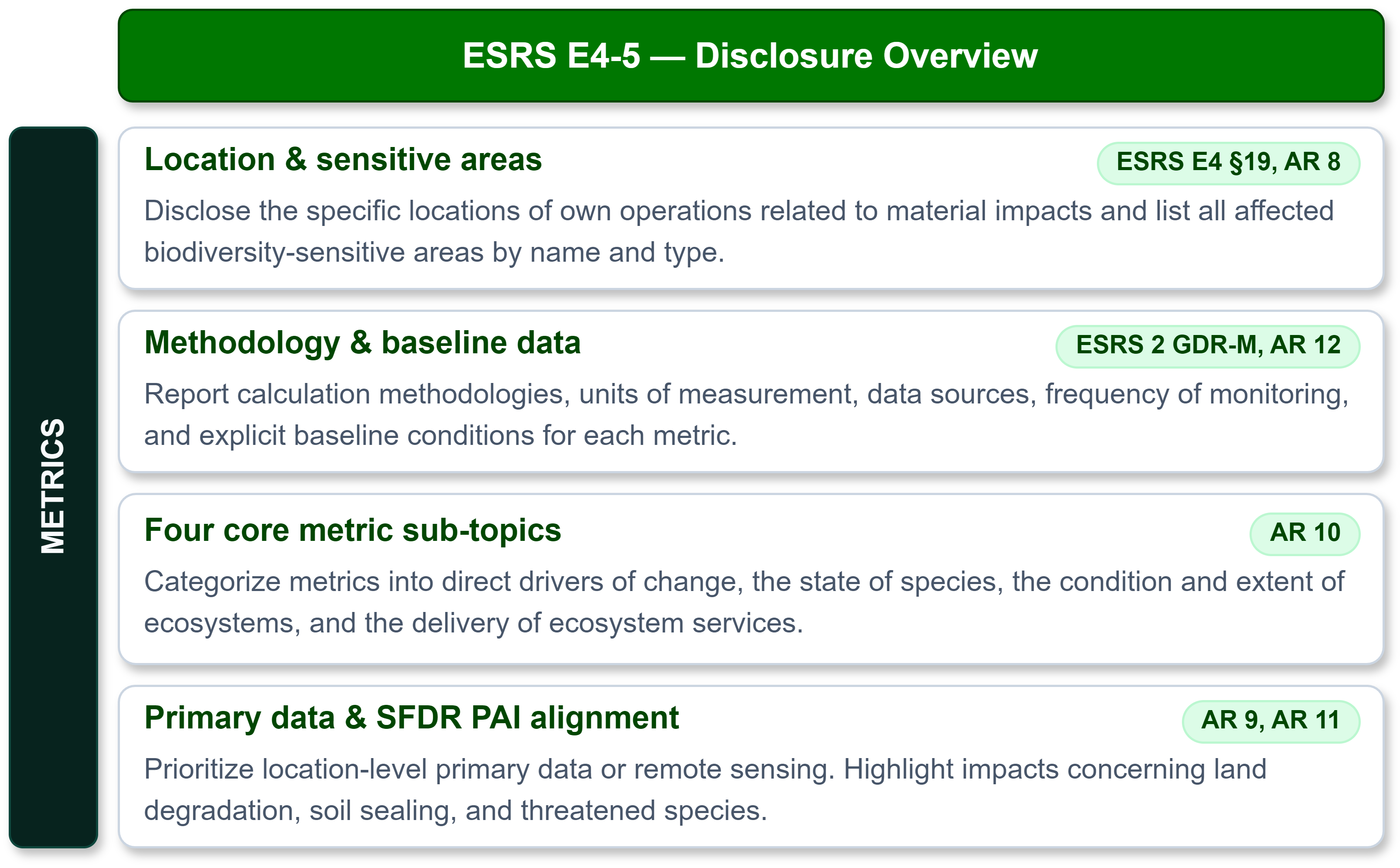
Read more about ESRS E4-5 here:
4. Acronyms and terms
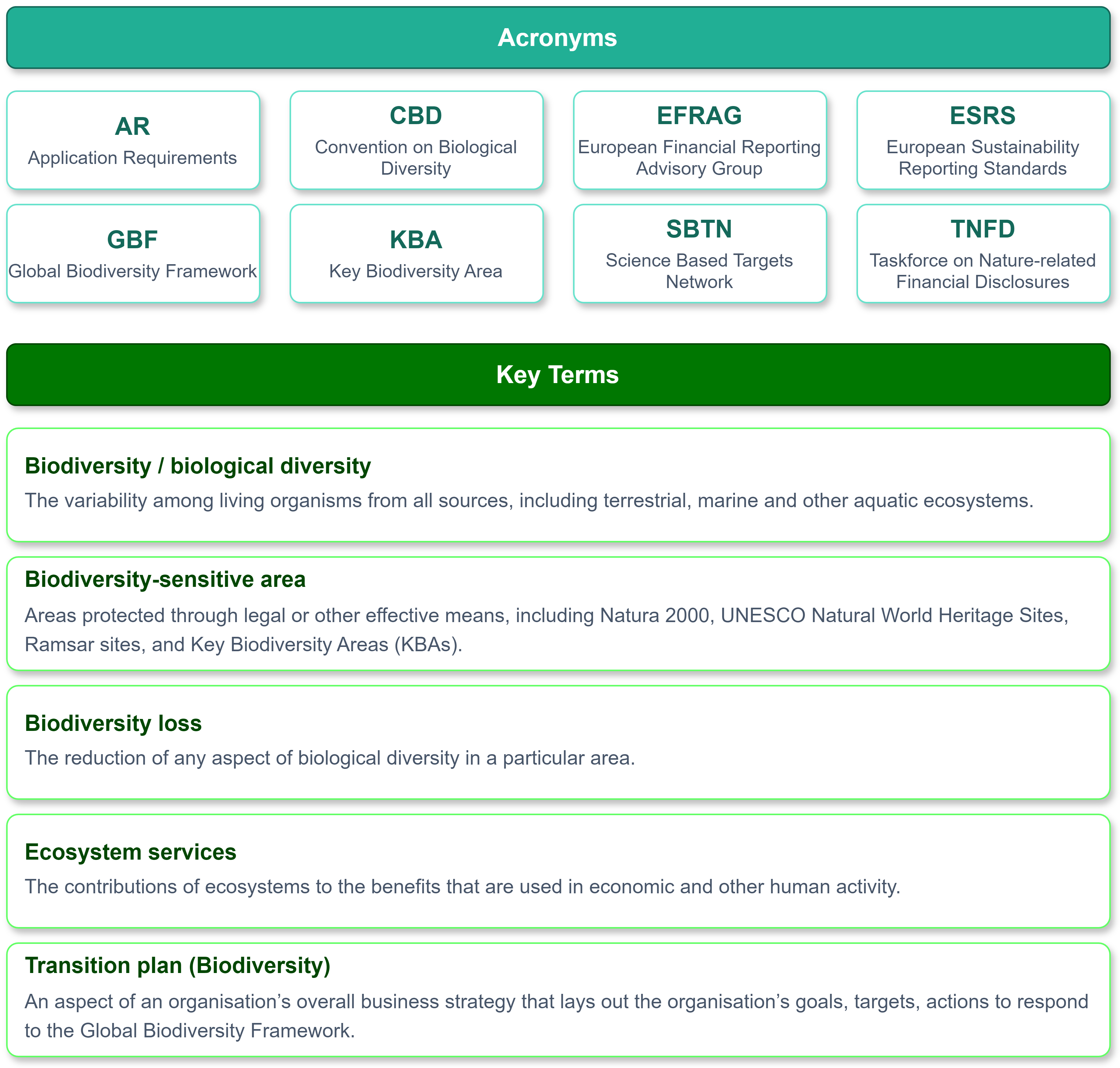
Relevant Sources
Nature Risk Rising: Why the Crisis Engulfing Nature Matters for Business and the Economy - World Economic Forum & PwC (2020)
Global Assessment Report on Biodiversity and Ecosystem Services - IPBES (2019)
Planetary boundaries research - Stockholm Resilience Centre
EU Biodiversity Strategy for 2030 - European Commission
EU Nature Restoration Law - European Commission
Kunming-Montreal Global Biodiversity Framework - UN Convention on Biological Diversity (CBD)
Sustainable Finance Disclosure Regulation (SFDR) - European Commission