


1. Introduction
If policies set the rules and actions describe the work, then targets define the destination. Without measurable, time-bound targets, corporate biodiversity initiatives lack direction and accountability.
ESRS E4-4 requires companies to disclose the specific, outcome-oriented targets they have set to manage material biodiversity impacts, risks, and opportunities. It demands clear evidence on base years, interim milestones, scientific thresholds, and the distinction between reducing environmental pressures and restoring the physical state of nature.
I will briefly explain the requirements for disclosing biodiversity and ecosystems targets
More elaborate articles are, or will become available, which can be found on: Sustainability Simplified.

2. What are biodiversity and ecosystems targets?
Biodiversity targets are measurable, time-bound commitments adopted by a company to reduce negative environmental impacts, preserve intact habitats, or improve ecological conditions.
Because ecosystems operate within strict planetary and regional boundaries, nature targets cannot be treated as arbitrary corporate goals. They must reflect local ecological thresholds, specific river basin capacities, and defined species protection priorities across operational sites and supply chains.
Examples of operational biodiversity targets include:
Deforestation-free supply chains: Achieve 100% verified deforestation-free sourcing across all high-risk agricultural commodities (soy, palm oil, cocoa) by 2028 from a 2022 baseline.
Ecosystem habitat restoration: Restore and re-vegetate 1,500 hectares of degraded coastal wetlands adjacent to operating facilities by 2030.
Pesticide chemical reduction: Reduce active synthetic pesticide application by 50% across 25,000 hectares of contracted cropland by 2027 compared to a 2023 baseline.
Species population recovery: Increase local nesting pair populations of endangered bird species by 25% within concession boundaries by 2030 based on a 2023 biological survey.
ESRS 2 GDR-T establishes the rules for setting and tracking sustainability targets. E4-4 applies this mechanism directly to biodiversity and ecosystems. It requires outcome-oriented, measurable benchmarks rather than vague process promises.
To ensure regulatory alignment, corporate targets must translate external environmental benchmarks into quantifiable corporate commitments. Key reference frameworks include the Kunming-Montreal Global Biodiversity Framework (GBF) (specifically Targets 2, 3, and 10), the Science Based Targets Network (SBTN) for Nature, the EU Nature Restoration Law, and the Mitigation Hierarchy (Avoid ➔ Minimise ➔ Restore ➔ Offset).
The ESRS standard formally defines a sustainability target as:
“Measurable, outcome-oriented and time-bound goals that the undertaking aims to achieve in relation to material impacts, risks or opportunities. They may be set voluntarily by the undertaking or derive from legal requirements on the undertaking. A target can encompass not only improvements but also the maintenance of achieved results or the preservation of consistent performance levels.”
Source: ESRS 2, Annex II Glossary
3. ESRS E4-4 at a glance
ESRS E4-4 specifically requires companies to disclose measurable, time-bound targets for managing their nature impacts. The standard focuses on two core operational priorities: setting science-based benchmarks grounded in ecological thresholds and tracking pressure reductions against the physical state of nature.
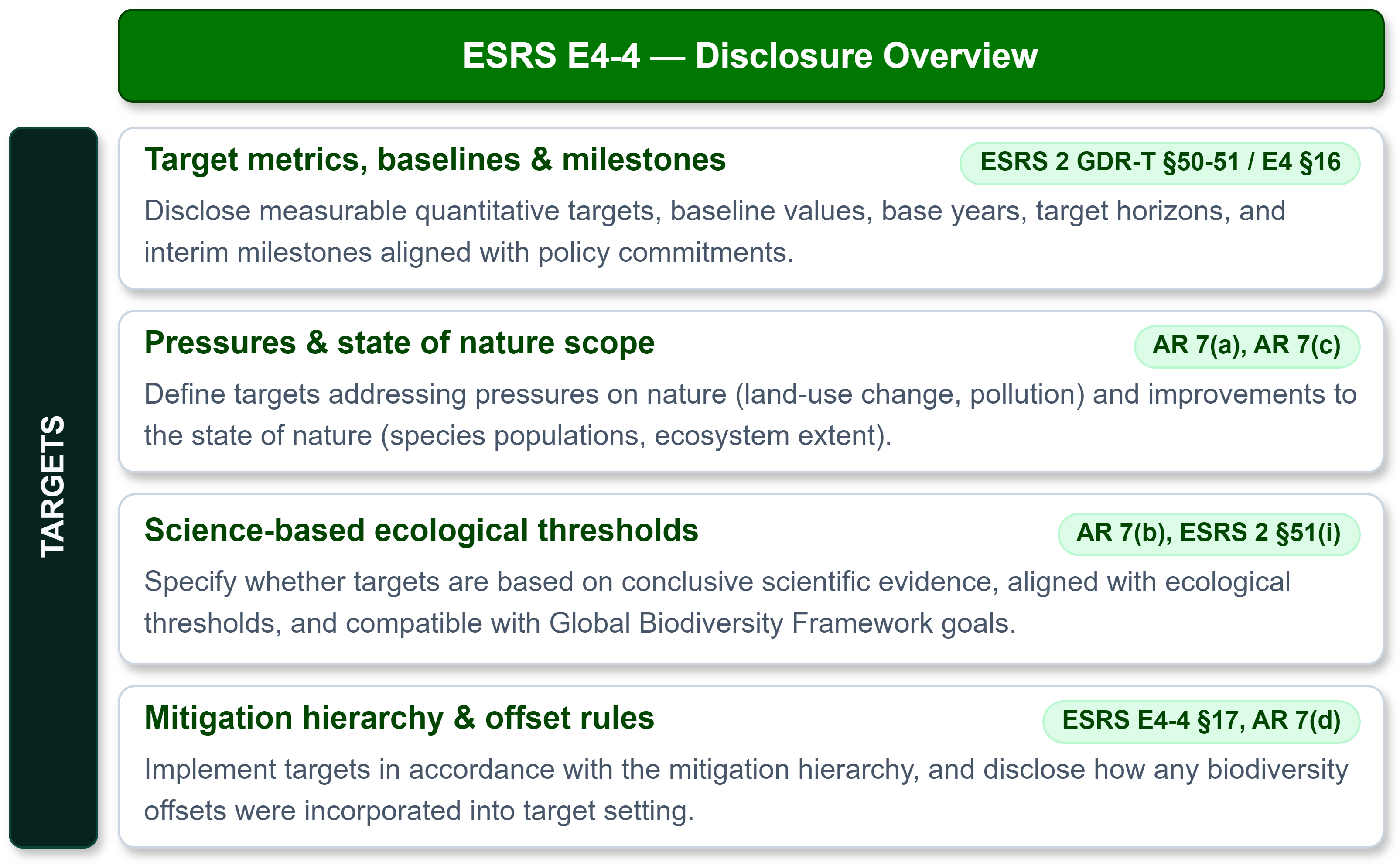
To comply with ESRS E4-4 (aligned with the 2026 Revised Standards), the disclosure checklist requires:
Disclose measurable quantitative target values, units of measurement, base years, and target completion dates.
Establish interim milestones to track progress across medium- and long-term planning horizons.
Clarify whether targets address direct pressure drivers (e.g., land conversion) or ecological state improvements (e.g., habitat restoration).
State whether targets rely on conclusive scientific evidence and align with ecological thresholds defined by the Global Biodiversity Framework.
Disclose the geographical and value-chain scope of each target, covering both facility-level operations and regional catchment areas.
Explain whether biodiversity offsets were used in setting target ambition, in direct alignment with the mitigation hierarchy.
Non-adoption / PAT rule: If the company has determined biodiversity to be a material topic but has not adopted biodiversity-related policies, it must explicitly disclose this fact, explain the reasons for non-adoption, and specify whether and when it intends to adopt one (in accordance with ESRS 2 §39).
4. How E4-4 links to the rest of ESRS E4
This disclosure establishes the measurable ambition in the 5-part topical governance chain: Transition Plan (E4-1) → Policy (E4-2) → Action (E4-3) → Target (E4-4) → Metric (E4-5). While actions deploy resources, targets define the exact benchmarks required to evaluate whether those investments succeed.
Consider a corporate example:
A food retailer operating near ecologically sensitive regions adopts a biodiversity transition plan to align its business model with the Global Biodiversity Framework [E4-1].
Under this plan, it adopts a mandatory sustainable sourcing policy banning deforestation-linked commodities and establishing buffer zones near sensitive wetlands [E4-2].
To execute the policy, it invests €3M in satellite supply-chain monitoring, supplier audits, and regenerative farming assistance [E4-3].
It sets a target to achieve 100% certified deforestation-free sourcing by 2028 [E4-4].
Finally, it reports monthly metrics on the percentage of verified spend and hectares screened for biodiversity risk [E4-5].
Setting targets without allocated budgets in E4-3 signals unbacked ambition during assurance reviews. Similarly, reporting metrics in E4-5 without comparative targets leaves stakeholders unable to evaluate whether corporate performance meets legal or scientific thresholds.
5. Bottom line
Anchor targets in science: Ground corporate targets in verifiable ecological thresholds and global frameworks such as SBTN and the Global Biodiversity Framework.
Balance pressures with state of nature: Combine pressure-reduction goals (such as zero deforestation) with direct habitat-condition targets (such as wetland hectare restoration).
Define explicit baselines: Always publish clear base years, baseline values, and interim milestone dates to demonstrate continuous progress.
Respect the mitigation hierarchy: Prioritize avoidance and minimization targets before factoring in compensation or biodiversity offsets.
Rigorous biodiversity targets turn high-level policy intent into enforceable operational milestones that stand up to regulatory and assurance scrutiny.