


1. Introduction
If policies, actions, and targets establish ambition, metrics provide the quantitative evidence and scorecard. Without reliable data, corporate biodiversity claims remain unverified and disconnected from actual ecological outcomes.
ESRS E4-5 requires companies to report the specific quantitative indicators used to evaluate their material impacts on nature. It requires clear location-level data, explicit tracking of pressure drivers, and transparent reporting on the physical state of ecosystems and species.
I will briefly explain the requirements for disclosing biodiversity and ecosystems metrics.
More elaborate articles are, or will become available, which can be found on: Sustainability Simplified.

2. What are biodiversity and ecosystems metrics?
Biodiversity metrics are standardized quantitative measurements that a company uses to track its environmental footprint and evaluate the effectiveness of its conservation actions.
Unlike greenhouse gas emissions, which can be measured in a universal equivalent (CO2e) regardless of where they are emitted, biodiversity impacts are highly localized. Therefore, E4-5 prioritizes location-specific data. The standard requires companies to disclose the direct operating sites linked to material impacts and list the exact biodiversity-sensitive areas affected.
Examples of operational biodiversity metrics include:
Ecosystem extent tracking: Measure the total hectares of converted natural forest across high-risk agricultural supply chain regions.
Species population monitoring: Track percentage changes in the population size of endangered species within corporate concessions against baseline surveys.
Pressure driver quantification: Calculate the total volume and application intensity of synthetic nitrogen fertilizers per hectare across contracted cropland.
Ecosystem service valuation: Quantify cubic meters of freshwater withdrawn from high water-stress catchment areas critical to local communities.
ESRS 2 GDR-M establishes the framework for measuring sustainability performance. E4-5 applies this reporting structure directly to biodiversity and ecosystems. It requires standardized quantitative data to verify whether policies and actions achieve their targets.
To ensure regulatory alignment, E4-5 prioritizes primary data collected at the location level or through remote sensing, especially when operating in or near biodiversity-sensitive areas. It also directly serves financial market reporting under the EU Sustainable Finance Disclosure Regulation (SFDR) by requiring explicit metrics on land degradation, soil sealing, and threatened species.
The ESRS standard formally defines a sustainability metric as:
“Qualitative and quantitative indicators that the undertaking uses to measure and report on the effectiveness of the delivery of its sustainability-related policies and against its targets over time. Metrics also support the measurement of the undertaking’s results in respect of affected people, the environment and the undertaking.”
Source: ESRS 2, Annex II Glossary
3. ESRS E4-5 at a glance
ESRS E4-5 specifically requires that companies disclose measurable indicators tracking both their negative pressures on nature and the resulting physical state of local ecosystems. The standard prioritizes primary data and strict methodological transparency.
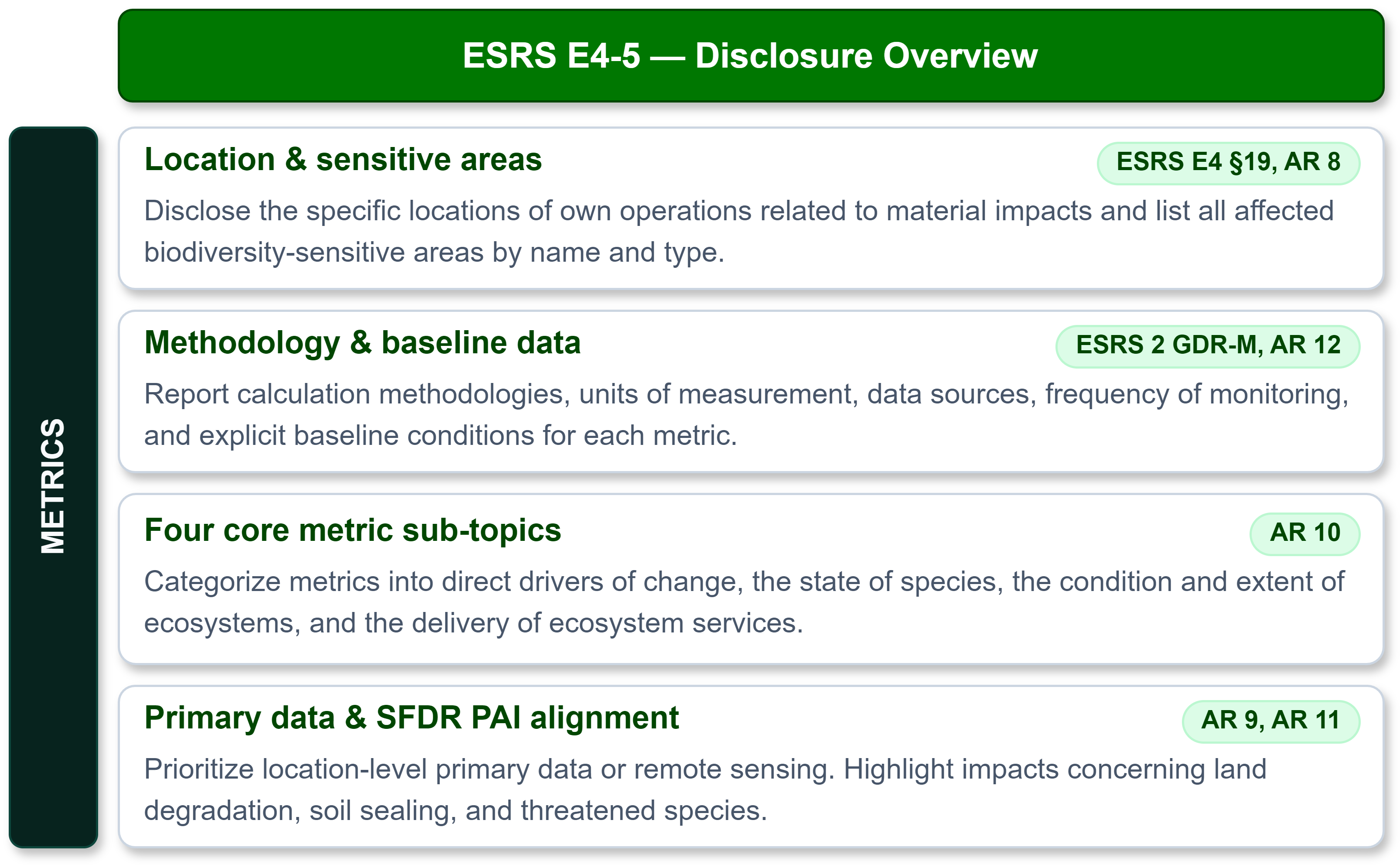
To comply with ESRS E4-5 (aligned with the 2026 Revised Standards), the disclosure checklist requires:
Identify the specific locations within own operations related to material biodiversity impacts.
List all biodiversity-sensitive areas affected by corporate activities and specify the name and ecological type of each area.
Disclose quantitative metrics across the four mandatory sub-topics: drivers of change, state of species, ecosystem extent/condition, and ecosystem services.
Detail the calculation methodology, measurement units, data sources, and baseline years for every reported metric in accordance with ESRS 2 GDR-M.
Flag any operations that directly contribute to land degradation, desertification, soil sealing, or affect threatened species to satisfy SFDR Principal Adverse Impact (PAI) requirements.
Specify whether the reported metrics rely on primary location-level data, remote sensing, or secondary data estimations.
Materiality & metric scope: If biodiversity is determined to be material, reporting quantitative metrics under ESRS E4-5 is mandatory for all identified material sub-topics. If a company identifies negative impacts on biodiversity-sensitive areas, location-level disclosures are strictly required under paragraph 19.
4. How E4-5 links to the rest of ESRS E4
This disclosure completes the 5-part topical governance chain: Transition Plan (E4-1) → Policy (E4-2) → Action (E4-3) → Target (E4-4) → Metric (E4-5). Metrics provide the quantitative feedback required to adjust actions and track progress against targets.
Consider a corporate example:
A food retailer operating near ecologically sensitive regions adopts a biodiversity transition plan to align its business model with the Global Biodiversity Framework [E4-1].
Under this plan, it adopts a mandatory sustainable sourcing policy banning deforestation-linked commodities and establishing buffer zones near sensitive wetlands [E4-2].
To execute the policy, it invests €3M in satellite supply-chain monitoring, supplier audits, and regenerative farming assistance [E4-3].
It sets a target to achieve 100% certified deforestation-free sourcing by 2028 [E4-4].
Finally, it reports monthly metrics on the percentage of verified spend and the number of hectares monitored via remote sensing [E4-5].
Reporting metrics without a defining policy or target reduces sustainability disclosures to an arbitrary data exercise. Setting ambitious biodiversity targets without disclosing the precise metrics used to track them creates an audit risk and exposes the company to greenwashing accusations.
5. Bottom line
Demand geographic precision: Move away from global averages and disclose primary data tied directly to specific operating sites and biodiversity-sensitive areas.
Categorize impacts clearly: Distinguish between metrics that measure pressures on nature (such as chemical application rates) and metrics that measure the physical state of nature (such as species populations).
Ensure methodological transparency: Always document the exact calculation methods, measurement units, and baseline conditions used to derive the reported figures.
Align with financial regulations: Structure environmental metrics to automatically fulfill the reporting needs of financial market participants under the SFDR.
Grounding biodiversity disclosures in location-level metrics gives auditors and stakeholders the verifiable data needed to evaluate environmental performance.