


1. Introduction
If policies set the rules and actions describe the work, then a transition plan shows how a company changes its business model to match the goal. ESRS E4-1 asks companies to explain whether they have a biodiversity and ecosystems transition plan and, if they do, to disclose the key features of that plan.
The standard asks for a roadmap that shows how the company intends to contribute to the global goal of halting and reversing biodiversity loss under the Kunming-Montreal Global Biodiversity Framework. This is where strategy becomes a decision on capital, sourcing, and site management.
I will briefly explain the requirements for disclosing a biodiversity and ecosystems transition plan.
More elaborate articles are, or will become available, which can be found on: Sustainability Simplified.

2. What is a biodiversity and ecosystems transition plan?
A biodiversity and ecosystems transition plan is a company roadmap for changing how it operates to actively help halt and reverse global biodiversity loss. It explains how the business model and strategy will evolve, which parts of the value chain are most exposed to ecological risks, and how the company will turn environmental risk into structured action.
Context-specific and geographic considerations are particularly important here because biodiversity impacts are inherently location-bound (such as operations near protected areas, key biodiversity areas, or vulnerable water basins).
Examples of a credible transition plan include:
Procurement & sourcing shift: Switch purchasing contracts to exclude deforestation-linked commodities like soy, palm oil, or timber.
Site-level infrastructure: Adjust factory expansions and limit water withdrawal near protected wetlands and nature reserves.
Traceability & spend controls: Audit suppliers to track raw materials back to their physical origins.
Habitat remediation: Allocate dedicated budget (CapEx) to restore damaged ecosystems near operational sites.
ESRS 2 sets company-wide rules for governance and strategy. E4-1 applies those rules directly to biodiversity. It requires companies to back their nature commitments with board oversight, risk controls, and capital allocation.
“Biodiversity can also be part of an undertaking’s broader transition plan that, for instance, addresses climate change. Biodiversity and ecosystems transition plans, or plans that integrate biodiversity, contain information on targets, key actions, financial planning and governance. They are also expected to include a clear explanation of how the undertaking’s strategy and business model will evolve to contribute to the global goal of halting and reversing global biodiversity loss set out in the GBF and can include the identification and management of synergies and trade-offs with other transition plan objectives, including any response and contribution to the transition implied by the Paris Agreement.”
Source: ESRS E4, paragraph AR 1
3. ESRS E4-1 at a glance
ESRS E4-1 specifically requires that the company explain its response and contribution to the transition implied by the Kunming-Montreal Global Biodiversity Framework if it has a biodiversity and ecosystems transition plan and has made public the key features of that plan.
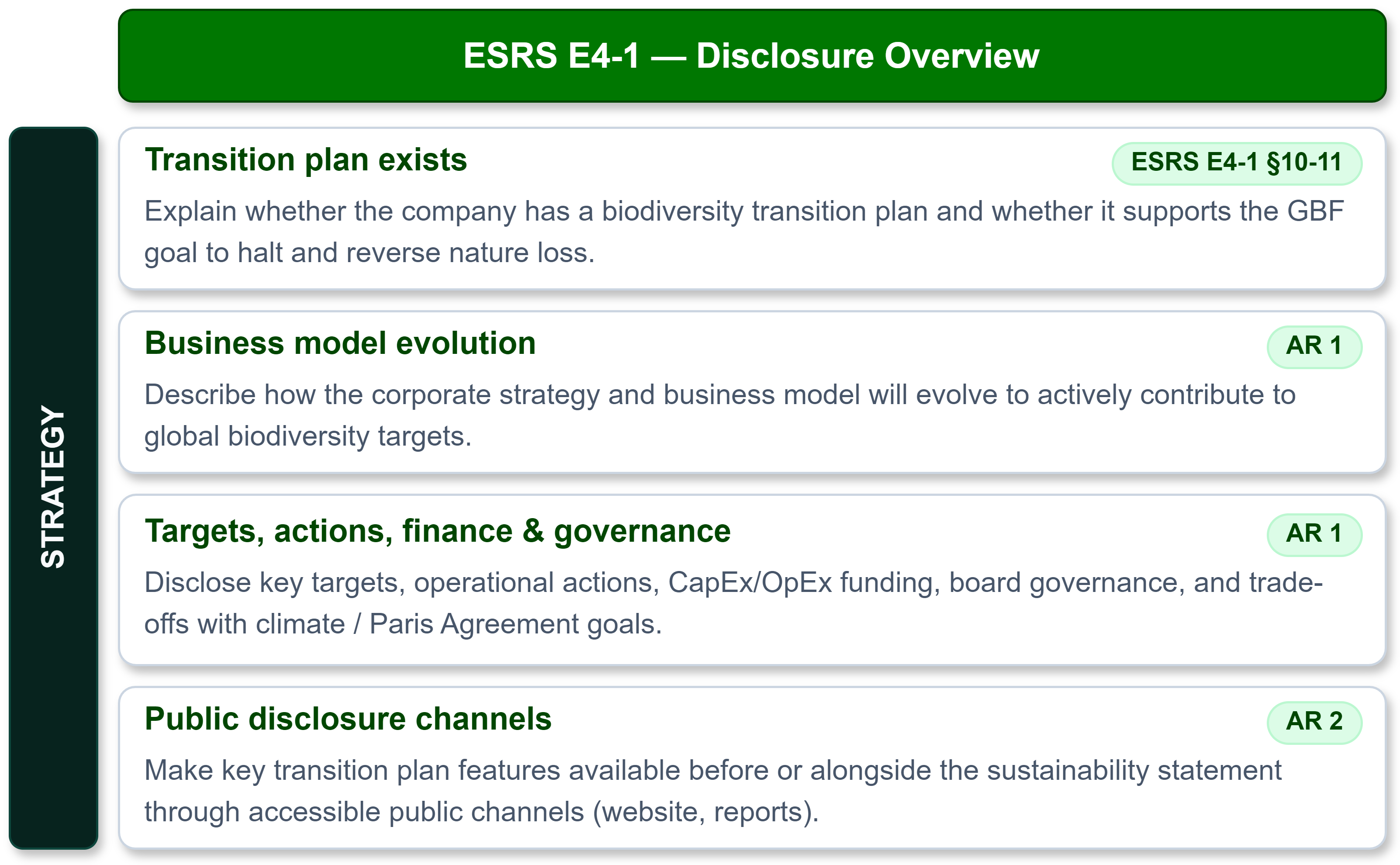
To comply with ESRS E4-1 (aligned with the 2026 Revised Standards), the disclosure checklist requires:
Explain whether the company has a biodiversity and ecosystems transition plan.
If it has one, disclose the key features of that plan (targets, key actions, financial planning, governance).
Show how the plan changes the business model and strategy to contribute to the GBF goal.
Reference the identification and management of synergies and trade-offs with wider transition objectives such as climate change and the Paris Agreement.
Explain whether the key features of the plan are made public before or at the time of the sustainability statement.
Conditional disclosure: Unlike climate transition plans (ESRS E1-1 §13) or policies, actions, and targets (ESRS 2 §39), ESRS E4-1 is strictly conditional. Disclosures are only required if the company has established a biodiversity transition plan and made its key features public. If no plan exists, E4-1 does not mandate a formal disclosure of non-adoption.
4. How E4-1 links to the rest of ESRS E4
This disclosure sits at the very top of the 5-part topical governance chain: Transition Plan (E4-1) → Policy (E4-2) → Action (E4-3) → Target (E4-4) → Metric (E4-5). E4-1 establishes the strategic roadmap so that individual policies and operational projects do not exist as isolated statements.
Consider a corporate example:
A food retailer operating near ecologically sensitive regions adopts a biodiversity transition plan [E4-1] to align its business model with the Global Biodiversity Framework.
Under this plan, it adopts a mandatory sustainable sourcing policy [E4-2] that bans deforestation-linked commodities across its supply chain.
To execute the policy, it invests €3M in satellite supply-chain monitoring, supplier audits, and regenerative farming assistance [E4-3].
It sets a target to achieve 100% certified deforestation-free sourcing by 2028 [E4-4], and reports monthly metrics on the percentage of verified spend and hectares screened for biodiversity risk [E4-5].
Without E4-1, policy commitments lack strategic direction. Without E4-3 actions and budget, a transition plan remains an empty promise. The governance chain ensures that ambition, investment, and reported outcomes align.
5. Bottom line
Map exposure first: Identify the activities, sites, and value-chain links that affect biodiversity and ecosystems before drafting a plan.
Budget the change: A transition plan should show financial planning, not just a narrative statement about intent.
Make the public version usable: The key features must be available before or at the time of the sustainability statement through accessible public channels.
Connect the chain: A plan is credible only when policy, action, target, and metric all point in the same direction.
A credible transition plan links corporate strategy, capital allocation, and operational metrics to deliver verifiable environmental progress.