


1. Introduction
While targets and metrics measure output, policies provide the governance framework dictating how results are achieved. Without clear policies, corporate biodiversity commitments remain aspirational rather than enforceable operational rules.
ESRS E4-2 requires companies to disclose the specific policies they have adopted to manage their material impacts, risks, and opportunities related to biodiversity and ecosystems. It bridges corporate governance with environmental science by mandating clear rules on raw material traceability, operational safeguards near sensitive habitats, sustainable agricultural practices, and deforestation prevention.
I will briefly explain the requirements for disclosing biodiversity and ecosystems policies.
More elaborate articles are, or will become available, which can be found on: Sustainability Simplified.

2. What is a biodiversity and ecosystems policy?
A biodiversity policy is a structured set of operational principles, rules, and governance commitments designed to prevent, mitigate, and remediate harm to living species, natural habitats, and ecosystems.
Because biodiversity impacts depend directly on location, corporate policies cannot rely solely on generic group-level statements. They must address local operational realities, such as facilities within or adjacent to protected areas, high-biodiversity conservation zones, vulnerable water basins, or agricultural sourcing from deforestation hotspots.
Examples of operational biodiversity policies include:
Deforestation-free procurement: Mandate zero gross deforestation and land conversion across all primary commodity supply chains (such as soy, palm oil, beef, and cocoa) with strict cut-off dates.
Buffer zone safeguards: Enforce mandatory 5-kilometer operational buffer zones and strict discharge limits around manufacturing facilities located near Natura 2000 or Ramsar wetland sites.
Regenerative agricultural standards: Require contract growers to phase out synthetic pesticides and maintain at least 10% ecological focus areas on agricultural land.
Ocean & marine stewardship: Restrict maritime transport routes during marine mammal migration seasons and ban destructive seabed dredging within coastal concessions.
ESRS 2 GDR-P sets the mandatory format for corporate sustainability policies. E4-2 applies this framework directly to biodiversity and ecosystems. It requires companies to define clear management rules, scope of application, and executive accountability.
To ensure regulatory alignment, corporate policies must translate external environmental benchmarks into internal operating rules. Key reference frameworks include the Kunming-Montreal Global Biodiversity Framework (GBF), the EU Deforestation Regulation (EUDR), the EU Habitats and Birds Directives, and principal adverse impact (PAI) indicators under the EU Sustainable Finance Disclosure Regulation (SFDR).
The ESRS standard formally defines a sustainability policy as:
“A set or framework of general objectives and management principles that the undertaking uses for decision-making. A policy implements the undertaking’s strategy or management decisions to prevent, mitigate, bring to an end, minimise and/or remediate material actual and potential impacts, address material risks and pursue material opportunities, either individually or at a higher level (i.e. groups of them or related topics). Each policy is under the responsibility of defined person(s), specifies its perimeter of application, and includes one or more objectives (linked when applicable to measurable targets). A policy is validated and reviewed following the undertakings’ applicable governance rules. A policy is implemented through actions or action plans.”
Source: ESRS 2, Annex II Glossary (and ESRS E4, paragraph 12).
3. ESRS E4-2 at a glance
ESRS E4-2 specifically requires companies to disclose how their biodiversity policies work in practice. The standard focuses on two core operational priorities: tracking raw materials across the supply chain and protecting sites located near sensitive natural habitats.
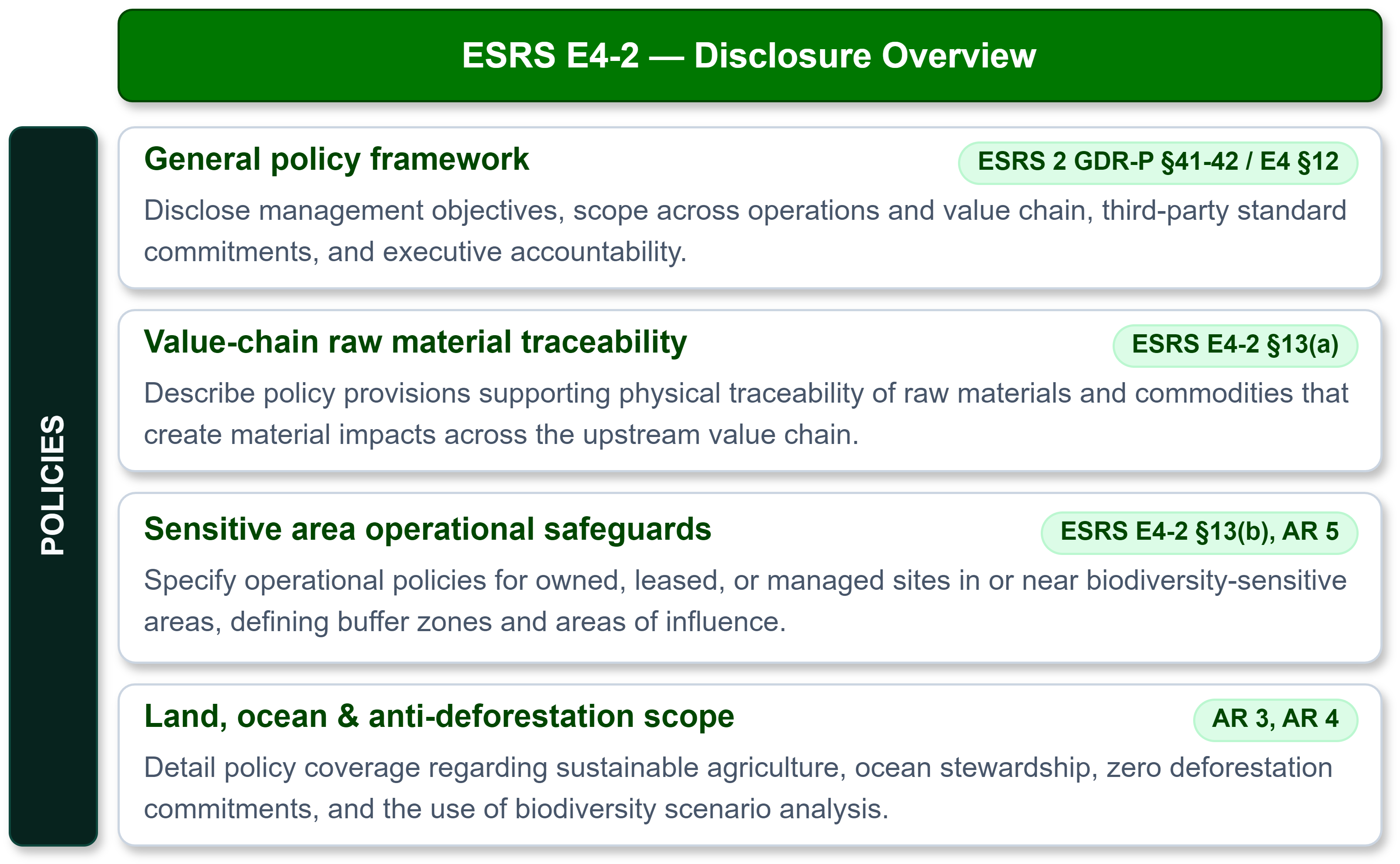
To comply with ESRS E4-2 (aligned with the 2026 Revised Standards), the disclosure checklist requires:
Disclose the general content and objectives of biodiversity policies in line with ESRS 2 GDR-P.
Detail how policies ensure the physical traceability of products, components, and raw materials with material biodiversity impacts in the value chain.
Specify policy rules and safeguards for operational sites located in or adjacent to biodiversity-sensitive areas, with explicit buffer zone determinations.
Disclose whether policies explicitly cover sustainable land/agricultural practices, ocean/marine practices, and deforestation.
Explain whether biodiversity scenario analysis was used to inform policy formulation.
Non-adoption / PAT rule: If the company has determined biodiversity to be a material topic but has not adopted biodiversity-related policies, it must explicitly disclose this fact, explain the reasons for non-adoption, and specify whether and when it intends to adopt one (in accordance with ESRS 2 §39).
4. How E4-2 links to the rest of ESRS E4
This disclosure forms the mandatory governance layer of the 5-part topical governance chain: Transition Plan (E4-1) → Policy (E4-2) → Action (E4-3) → Target (E4-4) → Metric (E4-5). While E4-1 provides the strategic roadmap, E4-2 establishes the binding corporate rules that authorize operational actions and resource allocation.
Consider a corporate example:
A food retailer operating near ecologically sensitive regions adopts a biodiversity transition plan to align its business model with the Global Biodiversity Framework [E4-1].
Under this plan, it adopts a mandatory sustainable sourcing policy banning deforestation-linked commodities and establishing buffer zones near sensitive wetlands [E4-2].
To execute the policy, it invests €3M in satellite supply-chain monitoring, supplier audits, and regenerative farming assistance [E4-3].
It sets a target to achieve 100% certified deforestation-free sourcing by 2028 [E4-4].
Finally, it reports monthly metrics on the percentage of verified spend and hectares screened for biodiversity risk [E4-5].
A policy without dedicated actions and budget (E4-3) is merely a statement of intent. This disconnect triggers immediate greenwashing scrutiny during third-party CSRD assurance. Conversely, executing biodiversity projects without an overarching policy results in fragmented spend that fails to deliver measurable environmental outcomes.
5. Bottom line
Enforce upstream traceability: Ensure your policy specifies verifiable traceability mechanisms for high-impact raw materials down to the farm, concession, or plantation level.
Define sensitive buffer zones: Do not just identify whether sites sit inside protected areas; establish clear scientific buffer distances for facilities operating adjacent to sensitive habitats.
Align with EUDR & SFDR: Frame zero-deforestation and land-use commitments to satisfy overlapping mandates under EUDR and SFDR PAI indicators.
Anchor executive oversight: Explicitly assign board or senior executive accountability for policy enforcement and regular performance reviews.
A clear, enforceable biodiversity policy turns high-level corporate ambition into systematic, audit-ready operational standards across the entire value chain.