


1. Introduction
Biodiversity loss is often framed as an environmental issue, but is also a profound economic and business risk. Nature provides essential material, regulating, and non-material contributions that underpin global well-being and economic activity. Yet 14 of the 18 categories of nature’s contributions to people are declining, especially those that regulate climate, water, and ecological stability. As these systems deteriorate, companies face rising operational, financial, and strategic exposure.
Biodiversity is not a distant concept: it affects supply chains, infrastructure, raw materials, workforce stability, insurance, finance, and social license to operate. And companies, in turn, play a direct role in driving biodiversity loss through land conversion, overexploitation, pollution, climate emissions, and global transport networks that spread invasive species — all recognized by IPBES as the five direct drivers.
Understanding this two-way relationship is increasingly important for regulations such as the Corporate Sustainability Reporting Directive (CSRD) and emerging disclosure frameworks like TNFD, which expect companies to understand and report their dependencies and impacts on nature.
By reading this article, you will learn:
✅ How companies drive biodiversity loss across the five IPBES direct drivers
✅ How indirect economic drivers (subsidies, consumption, trade) amplify those pressures
✅ How biodiversity decline translates into operational, market, financial, regulatory, and reputational risks
✅ Real-world sector examples from agriculture, fisheries, forestry, construction, and mining
✅ Why feedback loops between business and ecosystems create long-term vulnerabilities
By the end, you will understand why nature is a core business issue — and why proactive companies are moving from awareness to action.

2. The business–biodiversity connection explained
Biodiversity underpins economic activity across sectors. Over half of global GDP—about $44 trillion—is moderately or highly dependent on nature (Biodiversity | OECD). Agriculture, fisheries, forestry, water-intensive manufacturing, and tourism are obvious examples. But even financial services and consumer goods are exposed through their value chains.
According to the IPBES Global Assessment (2019), nature supports human life and economies by providing:
Material contributions, such as food, raw materials, and energy.
Regulating contributions, such as pollination, water purification, coastal protection, and climate regulation.
Non-material contributions, such as cultural, recreational, and spiritual benefits.
IPBES reports that most of these contributions are declining, particularly the regulating ones. These declines weaken the ecological infrastructure on which companies depend — from healthy soils and stable climates to predictable water flows and resilient coastlines.
This sets the stage for a double challenge:
Companies affect biodiversity, and
Biodiversity loss affects companies.
Key takeaway: Biodiversity loss affects every business sector—directly through resource dependency, and indirectly through disrupted supply chains, stakeholder pressure, and systemic risk. Companies that understand and manage these dependencies are better positioned for long-term success.
3. How companies drive biodiversity loss
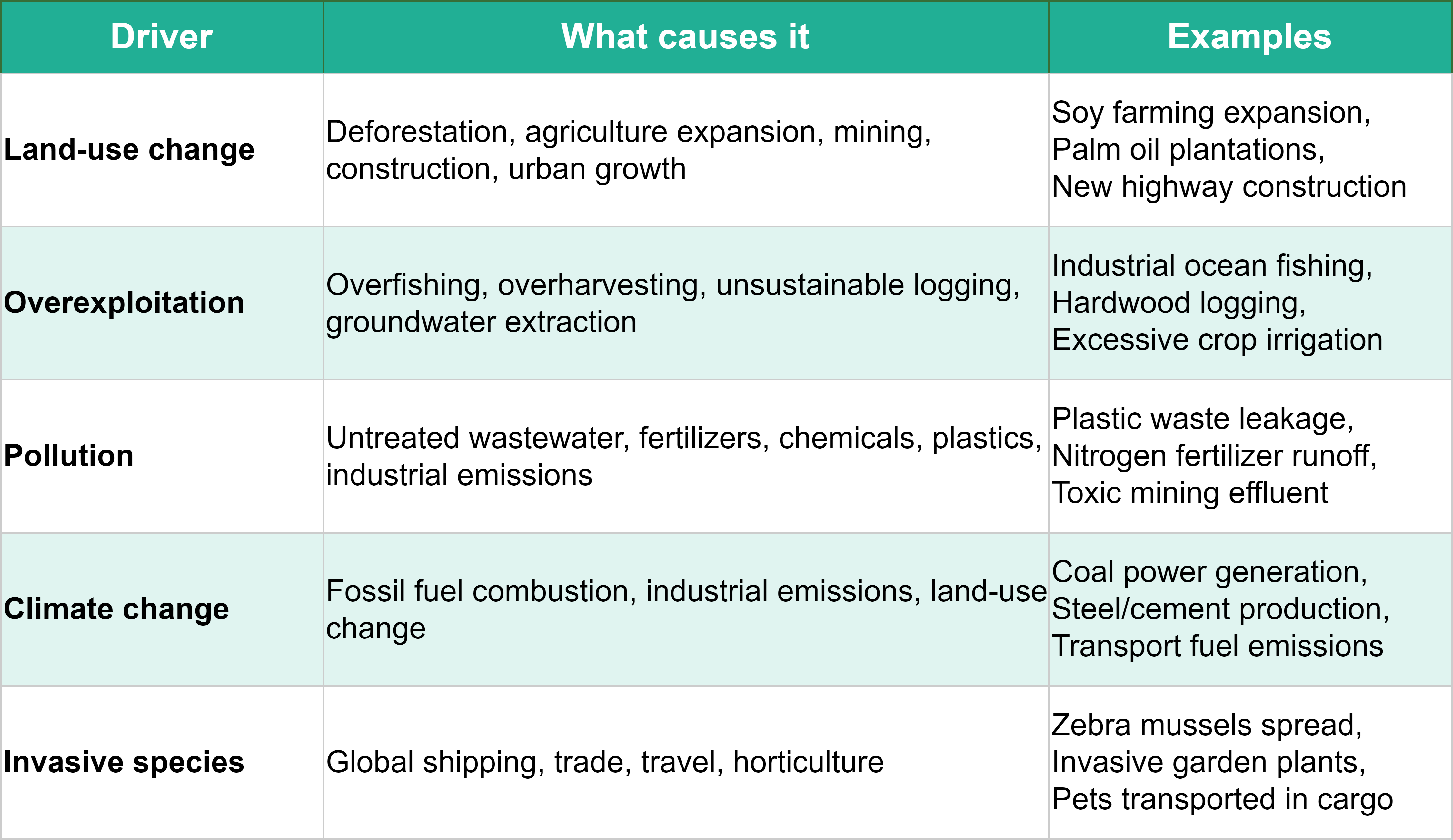
IPBES identifies five direct drivers of biodiversity loss — all linked to human economic activity. Each one connects directly to corporate value chains.
1. Land-use change and habitat conversion
Transforming natural land and sea areas for human use is the largest driver of biodiversity loss. Companies influence this through agriculture, construction, mining, transport infrastructure, and real estate development.
Key findings from the assessment show the scale of this change:
Over one-third of Earth’s land surface is now used for crops or livestock.
32 million hectares of primary or recovering tropical forests were lost between 2010 and 2015.
Urban areas doubled in size since 1992.
Although mining occupies <1% of global land area, it has “significant negative impacts on biodiversity” due to land clearance and toxic pollution.
Corporate sectors implicated include:
Agriculture and livestock
Real estate and urban development
Road builders, ports, pipelines, railways
Extractives and mining
The result: fragmented habitats, disappearing wetlands, and shrinking forests.
2. Overexploitation of natural resources
Extracting biological resources faster than ecosystems can regenerate them is the second-largest driver on land and freshwater, and the dominant driver in marine ecosystems.
Key findings include:
~33% of marine fish stocks are overfished; another ~60% are at maximum sustainable levels.
Industrial fishing now spans at least 55% of the ocean.
290 million hectares of native forests were cut down between 1990 and 2015.
Companies in seafood, timber, fashion, agriculture, cosmetics, paper, and water-intensive industries contribute to this pressure.
3. Pollution
Waste and chemical pollution remain major threats to biodiversity — on land, in freshwater, and across oceans.
Over 80% of global wastewater is discharged untreated.
300–400 million tons of industrial waste enter waterways annually.
Fertilizer runoff has created 400+ coastal dead zones, totaling over 245,000 km².
Marine plastic pollution has increased tenfold since 1980.
At least 267 species — including turtles, seabirds, and marine mammals — are harmed by plastic ingestion or entanglement.
Pollution originates from many corporate activities: manufacturing, agriculture, waste handling, chemical production, mining operations, and consumer goods supply chains. Its impacts accumulate across ecosystems and often travel far from their source.
4. Climate change
Climate change is rapidly increasing its pressure on biodiversity and may soon exceed all other drivers.
Key findings:
Global mean temperatures have already risen 0.7°C since 1980.
Climate change is affecting species from genes to ecosystems.
Coral bleaching, melting ice habitats, and extreme weather events signal rapid ecosystem disruption.
Corporate emissions from energy use, transportation, industrial processes, and land-use change are the primary sources feeding into this driver. As climate impacts intensify, biodiversity loss accelerates.
If you want to do something about climate change, I advise you to read this guide:

5. Invasive alien species
Global movement of goods and people — including a 3× increase in air travel — have dramatically increased the spread of invasive species.
These can:
Prey on native species
Spread disease
Out-compete local flora and fauna
Transform ecosystems permanently
Many industries contribute inadvertently through globalized supply chains, shipping, horticulture, and tourism.
The indirect drivers: economics, policy, and consumption
Behind the direct pressures are deeper structural forces that shape how societies use nature:
World population doubled from 3.7 to 7.6 billion (1970–2018).
Per capita consumption has risen sharply, with large inequalities.
OECD countries subsidize ~$100 billion per year in environmentally harmful agriculture subsidies.
(OECD countrie are members of the Organization for Economic Co-operation and Development (OECD), a group of 38 countries committed to democracy and market economies that collaborate on economic and social policy)Fossil fuel subsidies (~$345 billion per year) generate trillions in environmental externalities.
These indirect drivers create economic incentives that accelerate the direct drivers.
4. How biodiversity loss affects companies
Healthy ecosystems support business operations in countless ways — from soil fertility and water supply to stable coastlines, predictable weather, and reliable raw materials. When these systems decline, companies face real and growing risks across their value chains. The following sections summarize the main business risks linked to biodiversity loss, based on findings from the 2019 Global Assessment.
1. Operational and supply chain risks
The decline of key ecosystem services creates immediate challenges for companies that depend on natural inputs or stable production conditions. For example:
Pollinator decline puts $235–577 billion in annual crop output at risk.
Land degradation has reduced agricultural productivity on 23% of global land.
Overfished oceans increase supply volatility and raise operational costs.
Soil degradation forces farmers and suppliers to use more fertilizers and irrigation.
Water scarcity grows when upstream forests and wetlands are damaged.
The result is increased volatility in commodities such as food ingredients, timber, fishmeal, natural fibers, and botanical materials — all of which many industries rely on.
2. Physical risks to assets and infrastructure
Ecosystems provide natural protection against storms, flooding, landslides, and extreme heat. When these systems deteriorate, physical risks rise:
The loss of coastal habitats increases storm and flood risk for 100–300 million people and the infrastructure in those areas.
More than 85% of wetlands have been lost, weakening natural flood control.
Deforestation increases landslide danger and makes wildfires more severe.
Loss of forest cover worsens droughts and heatwaves.
Businesses in vulnerable regions may face rising insurance premiums, higher repair costs, and more frequent operational disruptions.
3. Market and resource availability risks
As wild species and ecosystems decline, the availability of key natural resources becomes less predictable:
Fish stocks shrink and risk collapse.
Timber supply tightens as forests are cleared or degraded.
Crop yields become more erratic as pollination and soil health decline.
Genetic diversity in crops and livestock continues to fall — 559 domesticated mammal breeds have already gone extinct — reducing resilience to pests, diseases, and climate stress.
These changes affect commodity pricing, supply stability, and long-term business planning.
4. Financial risks
Ecosystem decline also affects financial performance and asset values. Examples include:
Higher insurance payouts after ecosystem-related disasters.
Lower asset values when natural buffers such as mangroves or reefs disappear.
“Stranded asset” risk in sectors tied to destructive practices, where regulations or ecosystem collapse make operations unviable.
Increased economic exposure when carbon sinks like forests and peatlands are lost.
One estimate referenced in the assessment shows how large the financial implications can be: fossil fuel subsidies of $345 billion per year have been linked to $5 trillion in global environmental costs.
5. Regulatory and compliance risks
Governments are responding to biodiversity decline by tightening policy and disclosure demands. This includes:
New reporting rules such as CSRD and the TNFD framework.
Due diligence requirements on deforestation and nature-related impacts.
Rising permit and compliance costs in land-use–intensive sectors.
Expansion of protected areas, limiting where companies can operate.
Companies that do not adapt may face penalties, import restrictions, or legal challenges.
6. Reputation and social license risks
As awareness grows, companies linked to ecological harm face increasing scrutiny. Social conflict is a major concern:
There are more than 2,500 conflicts over fossil fuels, water, food, and land.
Over 1,000 environmental defenders were killed between 2002 and 2013.
NGOs, communities, investors, and consumers now expect companies to demonstrate responsible stewardship of land, water, forests, and wildlife. Failing to do so can lead to project delays, loss of trust, and brand damage.
Key takeaway: Biodiversity risk cuts across operational, financial, legal, and strategic domains. Companies that fail to act face compounding liabilities; those that lead can access new markets and capital.
5. Feedback loops: how impacts become risks
When companies degrade ecosystems, they often undermine the very conditions that support long-term operations. Several reinforcing loops are already visible:
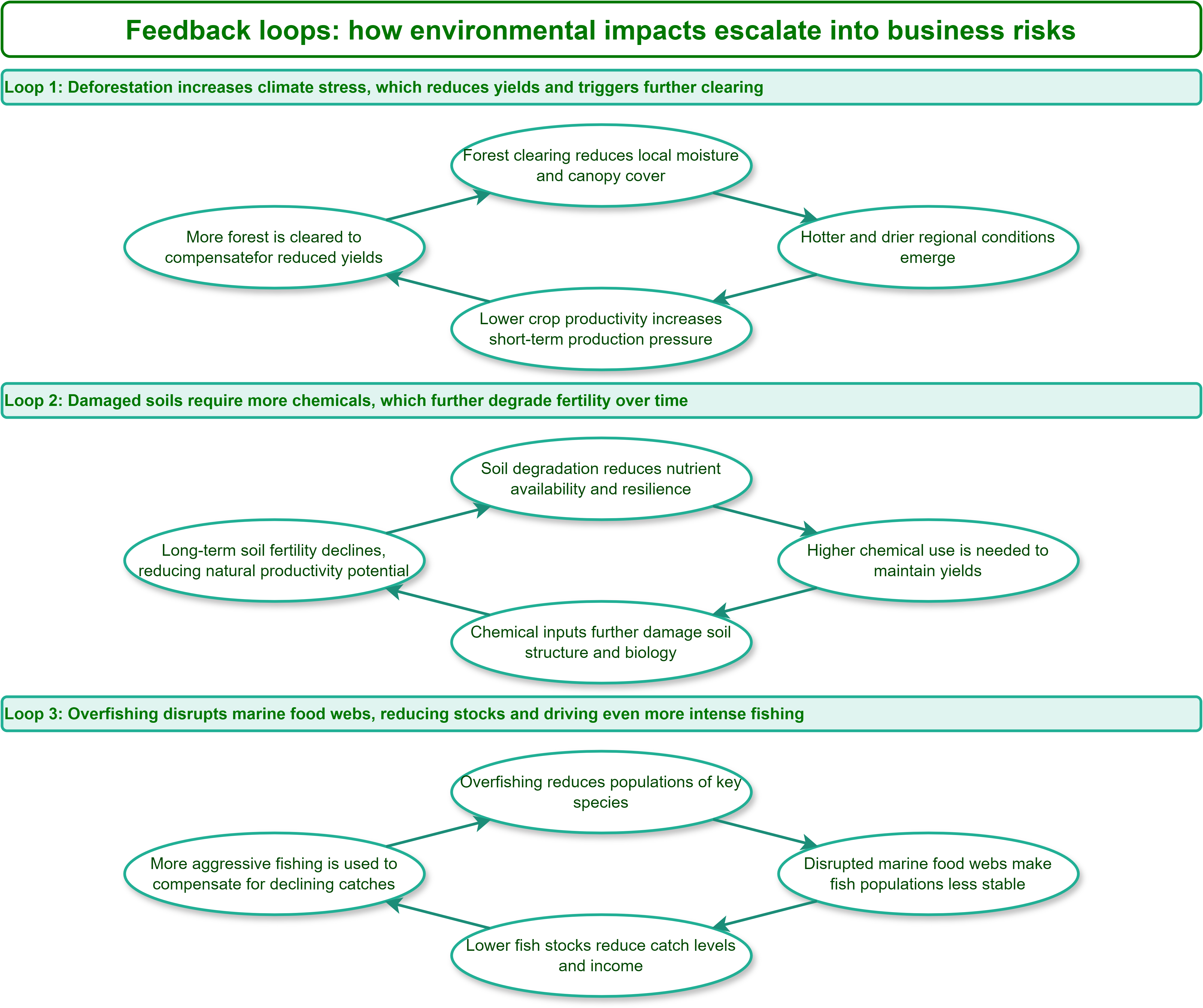
Many of nature’s contributions — such as pollination, pest control, and water regulation — cannot be replaced once lost. This means biodiversity decline can lock companies into long-term vulnerability unless underlying pressures change.
6. Takeaway
The assessment makes clear: biodiversity loss is s a systemic business risk. It touches every part of corporate activity, from raw materials and operations to finance, compliance, and community relations.
Forward-looking companies are responding by:
Eliminating deforestation and other destructive practices from supply chains
Investing in ecosystem restoration and nature-based solutions
Integrating biodiversity considerations into risk management and governance
Preparing for CSRD, TNFD, and other emerging regulations
Supporting policy reforms that align economic incentives with healthy ecosystems
Biodiversity is the foundation of long-term business resilience. Companies that act now will be better positioned to navigate a future shaped by ecological limits — and to help build an economy that works with nature, not against it.
Relevant Sources
Our global food system is the primary driver of biodiversity loss
Corporate giants fall short on forest protection commitments, report
Deforestation and Forest Loss - Our World in Data
Deforestation and Forest Degradation | World Wildlife Fund
Six charts that show the state of global biodiversity loss | World Economic Forum
The Biodiversity Crisis Is a Business Crisis
IPBES global assessment report summary for policymakers