


1. Introduction
Pollution has become an important business issue. Companies are expected to demonstrate how they prevent, control, and reduce their chemical and physical footprint across their value chain.
This article isn’t only for companies in scope of the CSRD. It’s for any organization that wants to report credibly on its environmental impact: EU or non-EU, listed or private, big or small. I use European Sustainability Reporting Standard (ESRS) E2 as a clear and practical blueprint for pollution disclosure. If CSRD doesn’t apply to you (yet), you can still use this guide to structure your reporting and align with international expectations like the Zero Pollution ambition.
ESRS E2 addresses how companies disclose their pollution-related impacts, risks, and opportunities, along with the strategies and metrics used to manage them. It is designed to align business reporting with among others the EU Action Plan ‘Towards a Zero Pollution for Air, Water and Soil’ and the Chemicals Strategy for Sustainability.
In this article, you will learn:
✅ What pollution is
✅ The main objectives of ESRS E2
✅ How ESRS E2 connects with other standards like Climate (E1) and Biodiversity (E4)
✅ The key components of ESRS E2 (E2-1 to E2-5), from policy to microplastics
✅ Acronyms and terms used in ESRS E2
By the end, you’ll gain a clear, structured understanding of reporting about pollution and ESRS E2.
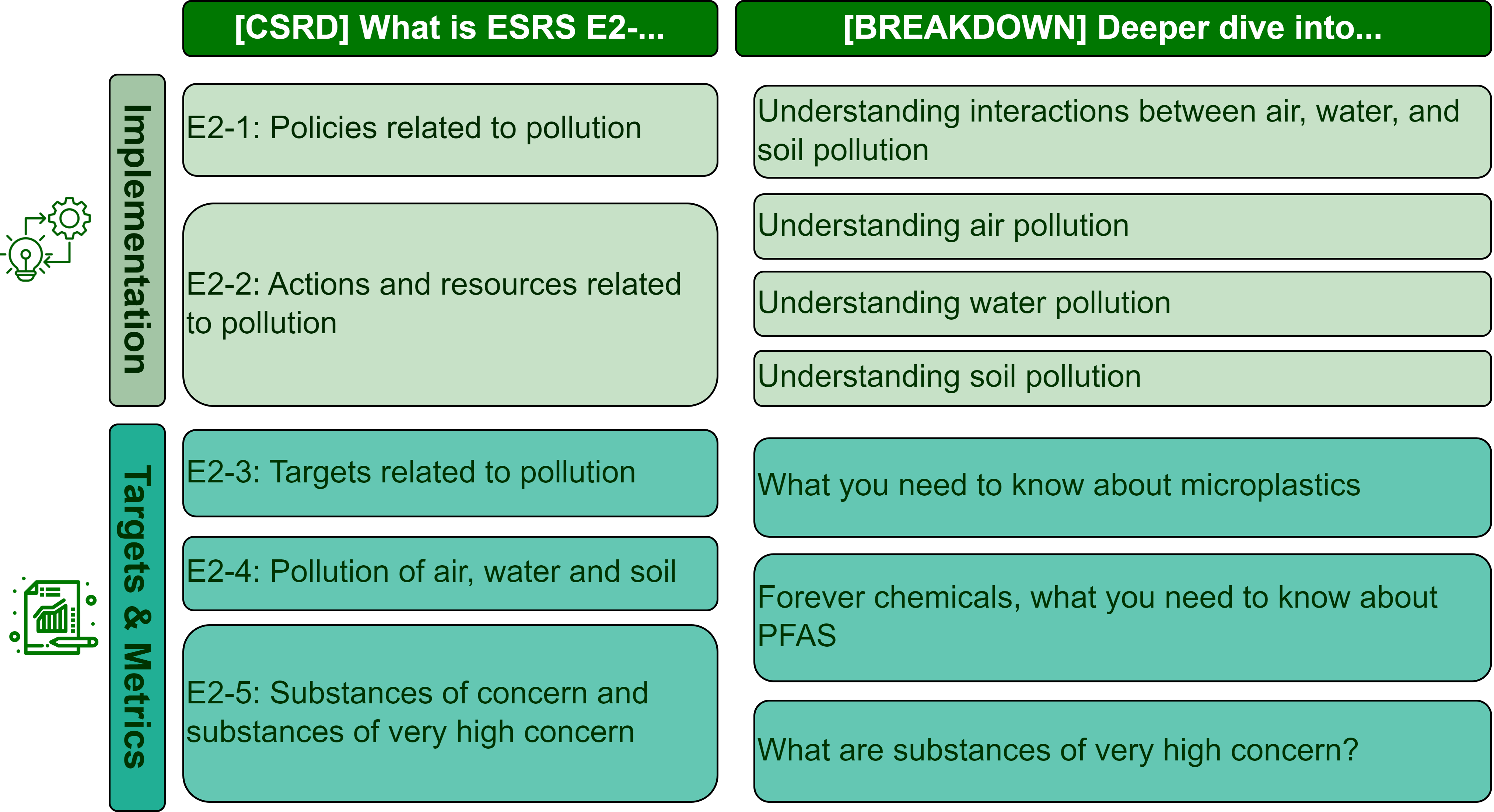
Before we dive into the guide, here is an overview of all articles that are currently available.
Missing something? Please send me a message or place a comment.
You can find any of these articles by navigating to sustainabilitysimplified.eu/
and using the search button.
2. Short introduction to pollution
First of all, it is important to know what pollution actually is in a reporting context. In short: Pollution is the direct or indirect introduction of pollutants into the air, water, or soil that can be harmful to human health or the environment.
In today’s world, the scale of pollution is becoming increasingly critical. It is no longer just a local issue but a global systemic threat that degrades ecosystems and reduces biodiversity. According to the 2025 Lancet Countdown on health and climate change, air pollution mortality has reached staggering levels. In 2022, deaths attributable to total ambient PM2.5 air pollution (fine inhalable particles with diameters generally 2.5 micrometers or smaller) increased from 7.5 million deaths in 2010 to 8.5 million globally.
The threat of chemical pollution, often referred to as “novel entities,” has reached a tipping point. Scientists have confirmed that we have crossed the planetary boundary for chemical pollution, meaning the pace at which humanity is producing and releasing new substances into the environment exceeds the Earth’s ability to safely process them. This crisis is exacerbated by the rise of microplastics, which are now found in almost every biological system, contributing to systemic inflammation and cardiovascular risks.
To halt the progression of pollution, the European Union has established the Zero Pollution Action Plan, which aims to reduce pollution to levels that are no longer considered harmful to health or natural ecosystems by 2050.
Because pollution poses such a direct and measurable risk to both global health and business resilience, it is included as the second environmental standard (ESRS E2) in the CSRD.
Here follows a brief timeline of two frameworks by the European Union:
December 2019: The European Union published the European Green Deal. This massive framework introduced the overarching “Zero Pollution Ambition for a toxic-free environment.”
October 2020: The EU published the Chemicals Strategy for Sustainability. The European Commission officially designated this strategy as the first step and a core pillar for delivering on the 2019 Green Deal’s zero-pollution commitment. It tackled the “toxic-free” part of the overarching goal first.
May 2021 (the broader plan): The EU published the Zero Pollution Action Plan. This document formally laid out the targets for the remaining aspects of the 2019 ambition—specifically detailing the operational targets for air, water, and soil pollution.
Read the Zero Pollution Action Plan here:
Zero pollution targets - Environment - European CommissionRead more about the Chemicals Strategy for Sustainability here:
Chemicals Strategy
3. Understanding the objective of ESRS E2
The objective of ESRS E2 is for companies to disclose information on pollution whenever it represents a material impact, risk, or opportunity. This ensures stakeholders understand how a company manages its chemical footprint and its transition toward a toxic-free environment.
The standard defines five key sub-topics:
Pollution of air: Emissions of pollutants like SOx, NOx, and particulate matter (excluding GHGs). To understand the difference between air pollution and greenhouse gas emissions check out this article:
Pollution of water: Emissions to both freshwater and seawater.
Pollution of soil: Direct emissions to land and groundwater.
Substances of (very high) concern (SoC & SVHC): Including the manufacturing, use, and distribution of hazardous chemicals.
Microplastics: Both primary (manufactured) and secondary (resulting from product wear and tear).

![[BREAKDOWN] What are substances of very high concern?](https://substackcdn.com/image/fetch/$s_!Uo83!,w_140,h_140,c_fill,f_webp,q_auto:good,fl_progressive:steep,g_auto/https%3A%2F%2Fsubstack-post-media.s3.amazonaws.com%2Fpublic%2Fimages%2F86e9bb0e-9592-4d1d-96cd-1807286c099c_1857x1731.png)
![[BREAKDOWN] What you need to know about microplastics](https://substackcdn.com/image/fetch/$s_!EZHC!,w_140,h_140,c_fill,f_webp,q_auto:good,fl_progressive:steep,g_auto/https%3A%2F%2Fsubstack-post-media.s3.amazonaws.com%2Fpublic%2Fimages%2Fcb56f839-354d-425e-807d-98bad5c19376_1857x1731.png)
To get a better understanding of the interactions between air, water, and soil pollution:
Interaction with other topics (ESRS Standards)
ESRS E2 interacts with several other standards:
ESRS E1 Climate Change: E1 covers the seven main greenhouse gases (like CO₂ and methane), while E2 covers all other harmful air emissions.
ESRS E3 Water: E3 focuses on the volume of water used, while E2 focuses on the pollutants contained within that water.
ESRS E4 Biodiversity: While E4 looks at how pollution drives ecosystem change, E2 focuses on the actual emissions causing that change.
ESRS E5 Resource Use: E5 looks at circularity and waste, but the pollutants generated during resource extraction or waste transformation are handled by E2.
4. The different components of ESRS E2
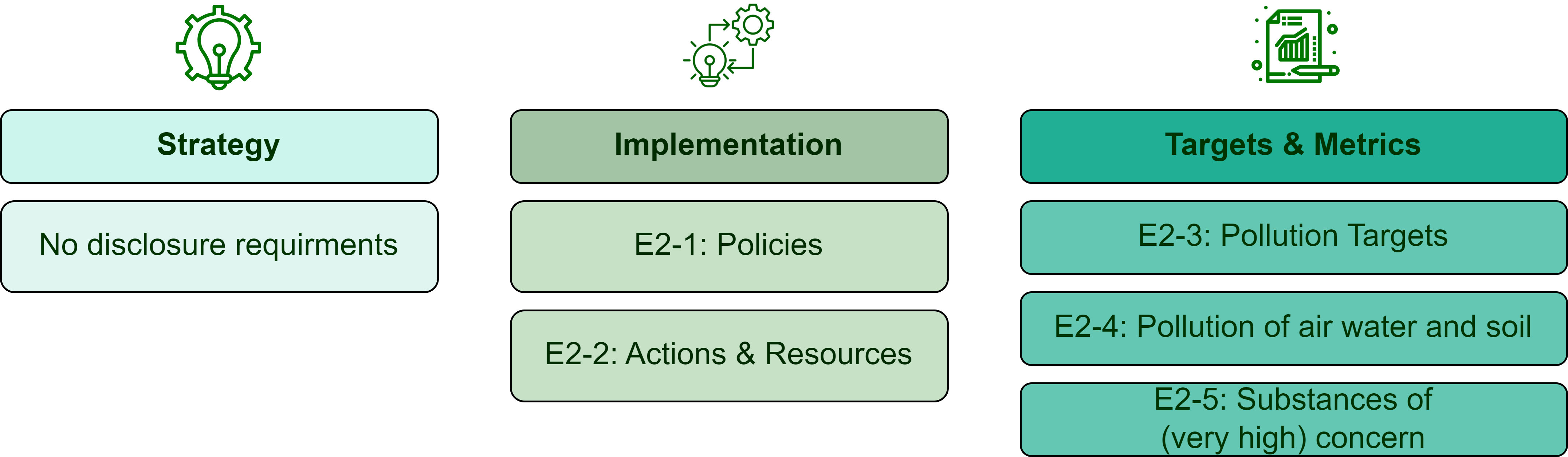
While ESRS E1 is structured around three pillars: Strategy (long-term plans, risk analysis, and resilience), Implementation (policies, actions, and resources), and Targets & Metrics (quantifiable goals, emissions data, and financial implications). ESRS E2 is structured into only two pillars: implementation (how you handle pollution) and targets & metrics (the actual numbers).
Read more below to explore each element in detail. I’ve also linked to my other articles below, where you can dive deeper into each specific topic, from ESRS E2-1 through ESRS E2-5, for a more comprehensive understanding.

E2-1, E1-2: Policies, actions, and resources
E2-1 (Policies): companies must disclose their policies for preventing and reducing pollution. The rules in ESRS 2 GDR-P frame these policies.
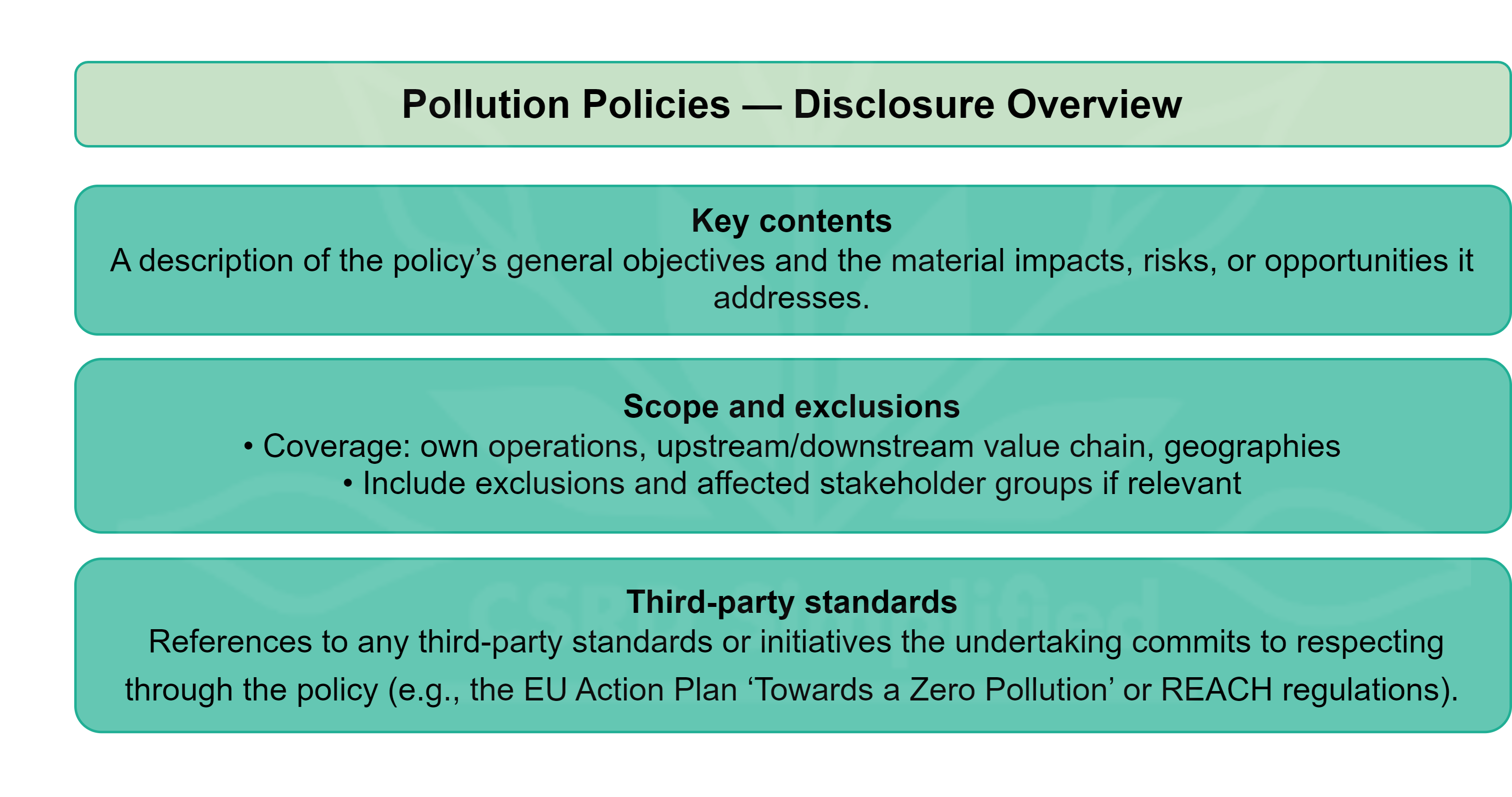
Read more about ESRS E2-1 here:
![[CSRD] E2-1: Policies related to pollution](https://substackcdn.com/image/fetch/$s_!6GcW!,w_140,h_140,c_fill,f_webp,q_auto:good,fl_progressive:steep,g_auto/https%3A%2F%2Fsubstack-post-media.s3.amazonaws.com%2Fpublic%2Fimages%2F8814db75-247f-475e-b856-3a1ff9b6206a_2048x2048.jpeg)
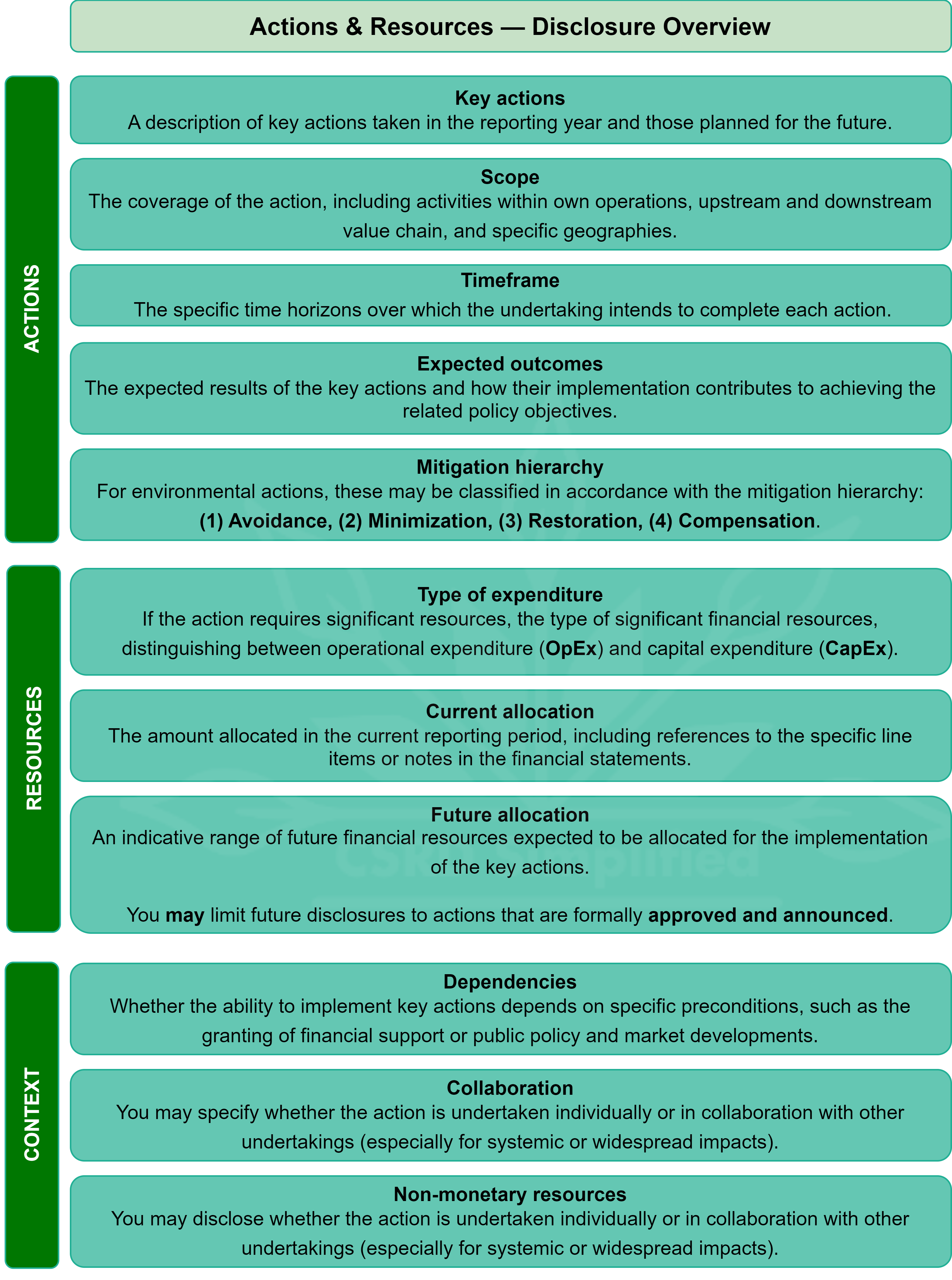
E2-2 (Actions and resources): requires reporting on the key actions taken (such as installing new filtration systems) and the financial resources (CapEx/OpEx) allocated to them.
Read more about ESRS E2-2 here:

E2-3: Targets related to pollution
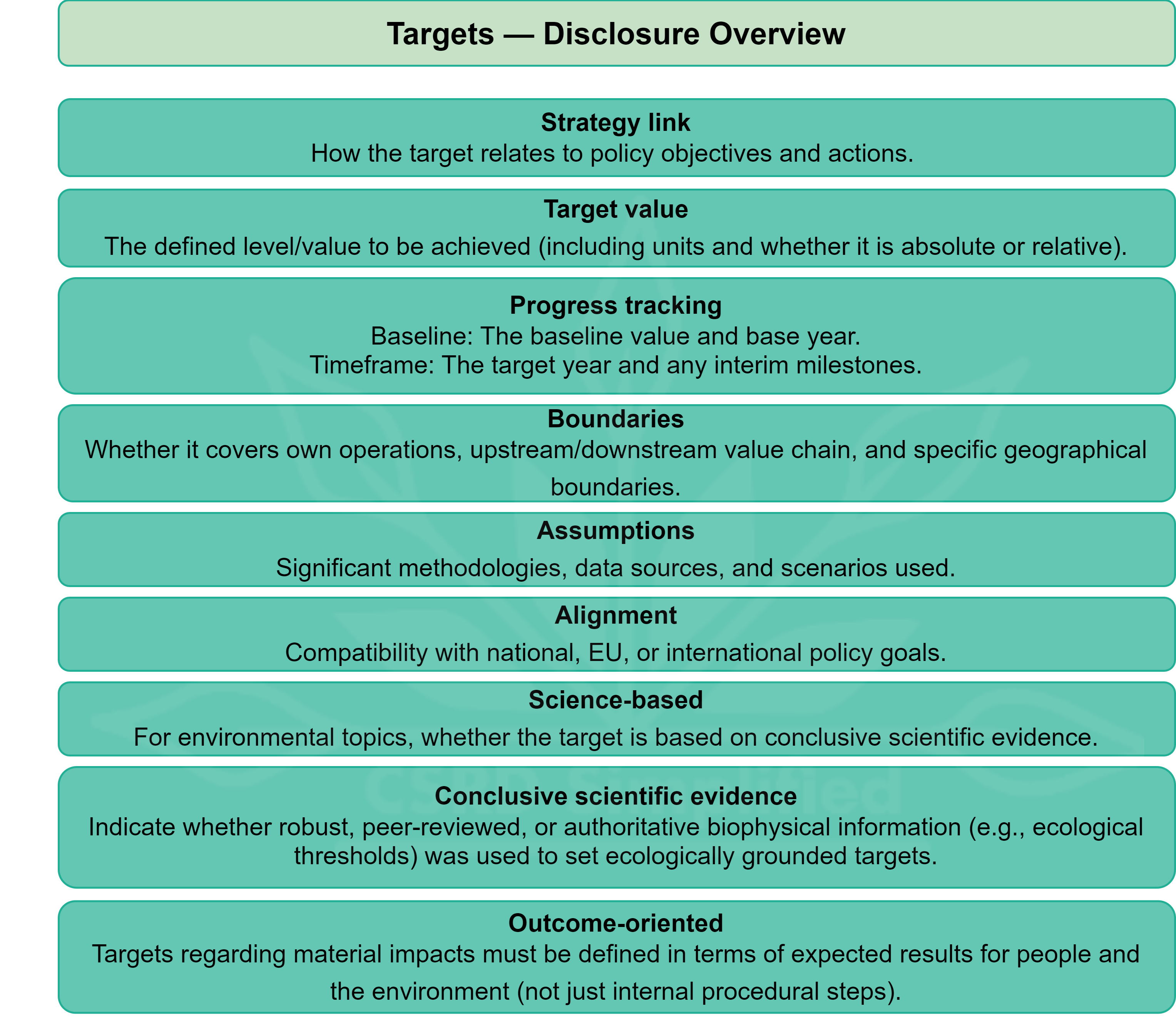
E2-3 focuses on the disclosure of specific, measurable goals for reducing pollutants.
Read more about ESRS E2-3 here:
E2-4: Pollution of air, water, and soil
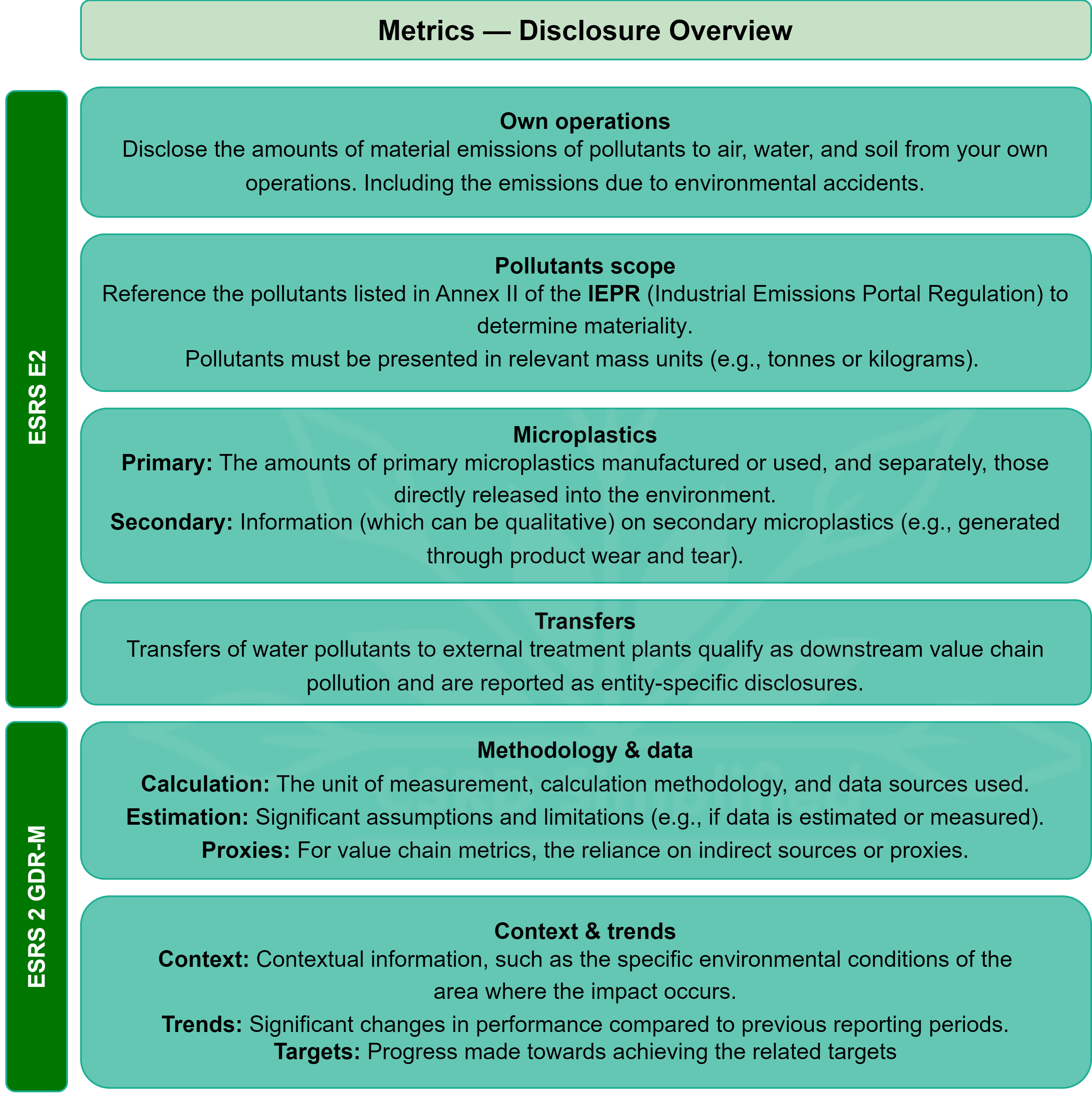
E2-4: this is the data-heavy section. Companies must report:
Material emissions: Amounts of pollutants released into air, water, and soil from own operations.
Microplastics: Weight of primary microplastics manufactured/used, and qualitative or quantitative info on secondary microplastics (like tire wear).
Read more about ESRS E2-4 here:
E2-5: Substances of concern and SVHC
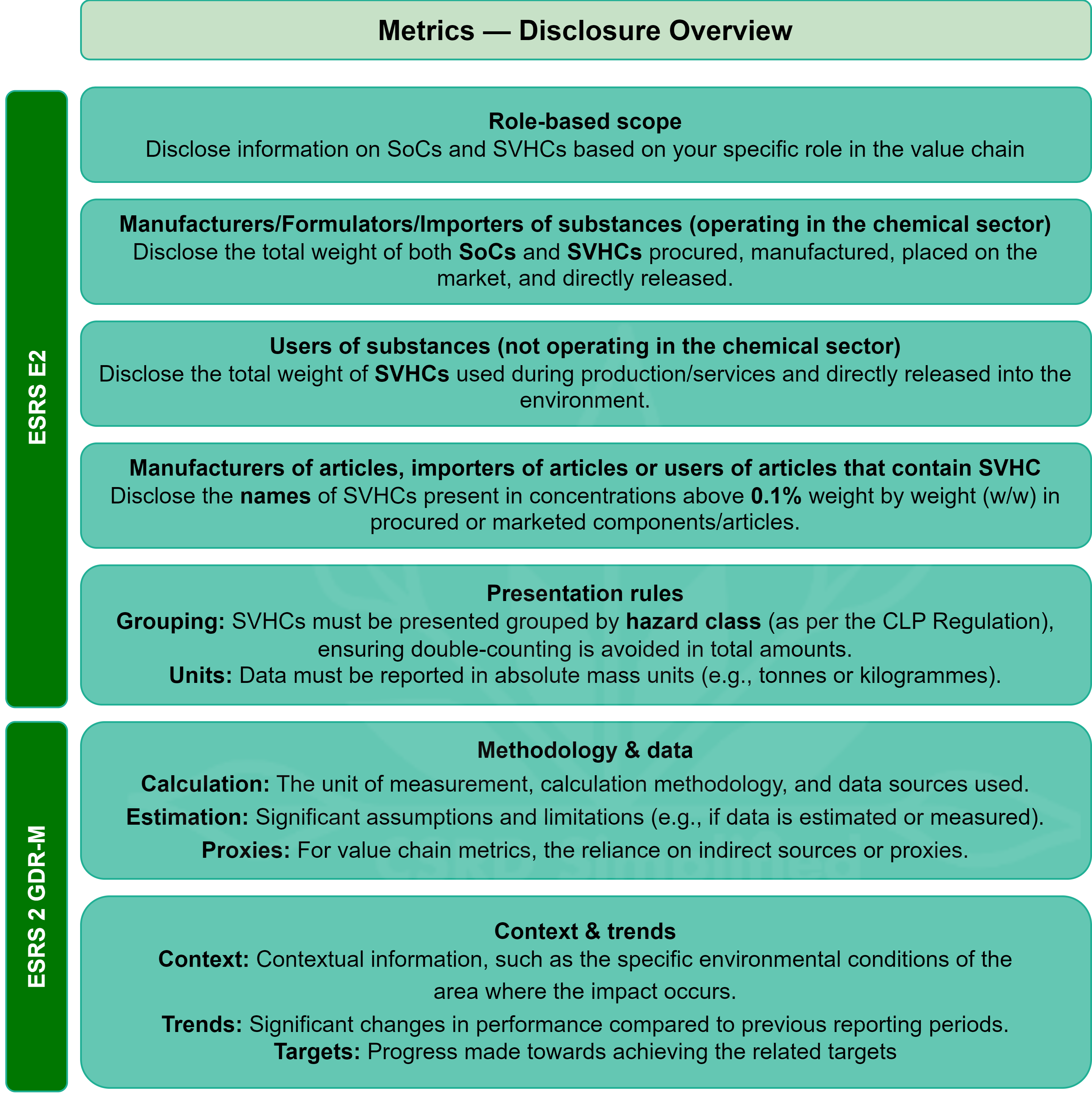
This requirement is particularly strict for the chemical sector.
Manufacturers/importers: Must disclose the total weight of SoC and SVHC procured, manufactured, placed on the market, or released.
Other users: Must disclose the weight of SVHC used in production and released.
Article manufacturers: Must name specific SVHCs present in products at concentrations above 0.1%.
Read more about ESRS E2-5 here:
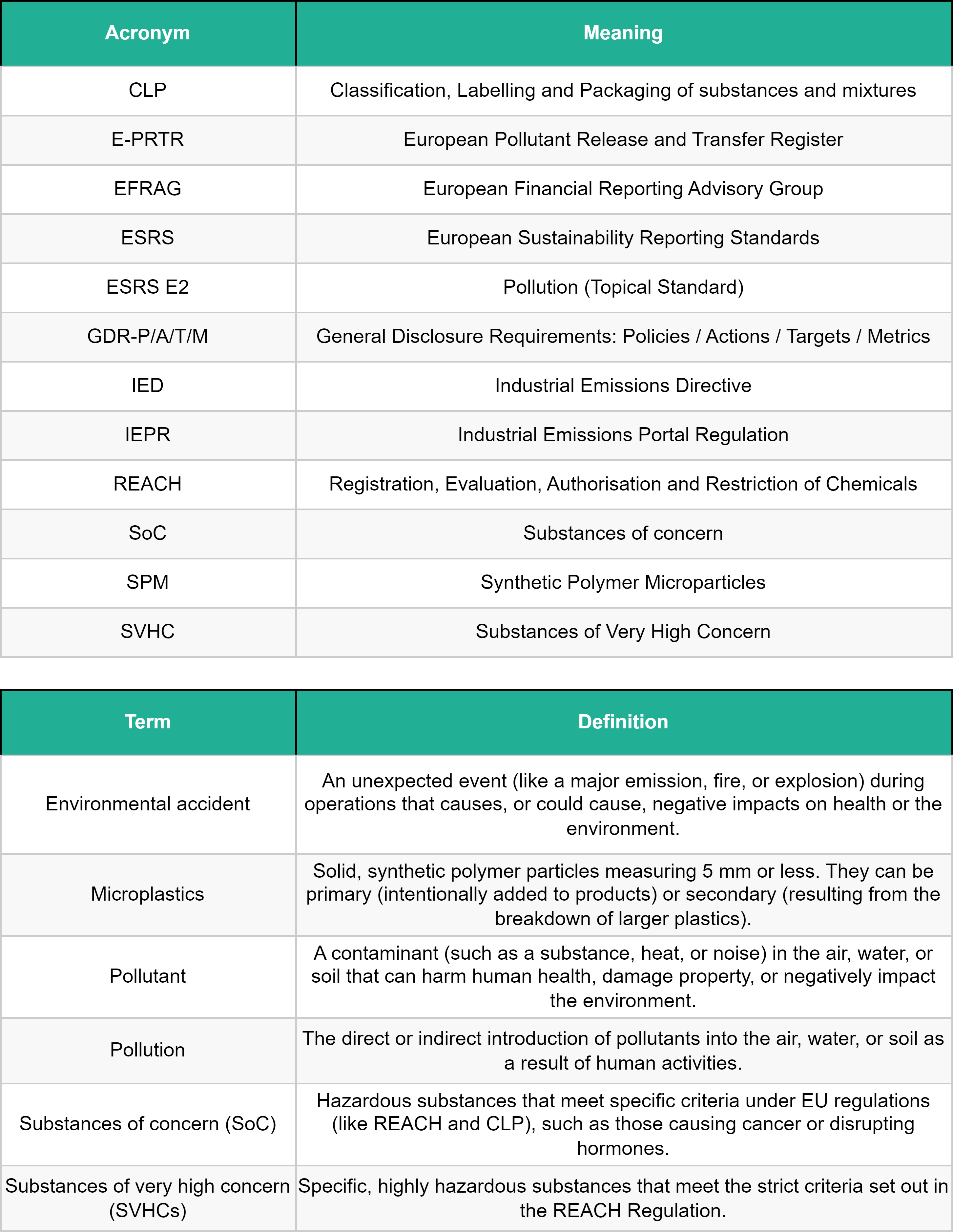
4. Acronyms and terms
Relevant Sources
Planetary boundaries - Stockholm Resilience Centre
Microplastics and Nanoplastics in Atheromas and Cardiovascular Events - PubMed
Zero pollution targets - Environment - European Commission