


1. Introduction
We finish the Pollution standard with perhaps the most technical but chemically critical disclosure: Substances of Concern (SoC) and Substances of Very High Concern (SVHC).
While E2-4 focuses on bulk emissions, E2-5 zooms in on the toxicity of the materials you handle. It connects your reporting directly to major EU chemical regulations, such as REACH and CLP.
This disclosure asks a fundamental question: Is your business model dependent on hazardous chemicals?
I will briefly explain the requirements for disclosing information on these dangerous substances.
More elaborate articles are, or will become available, which can be found on: Sustainability Simplified.

2. What are SoCs and SVHCs?
These are not just pollutants in the general sense; they are chemicals flagged for their potential to cause serious harm to health or the environment.
Substances of Very High Concern (SVHC): A specific legal list under the EU REACH regulation. These are carcinogens, mutagens, reproductive toxins (CMRs), or substances that persist and bioaccumulate in the environment.
Substances of Concern (SoC): A broader category defined in the ESRS (aligned with the EU Chemicals Strategy). It includes SVHCs but also substances that hamper recycling (circular economy) or cause chronic health effects.
Read more about SVHC here:

The ESRSes define SoC and SVHC as follows:
Substances of Concern (SoC)
“A substance that:
(a) Meets the criteria laid down in Article 57 of Regulation (EC) No 1907/2006 and is identified in accordance with Article 59(1) of that Regulation;
(b) Is classified in Part 3 of Annex VI to Regulation (EC) No 1272/2008 in one of the following hazard classes or hazard categories:
(i) carcinogenicity categories 1 and 2;
(ii) germ cell mutagenicity categories 1 and 2;
(iii) reproductive toxicity categories 1 and 2;
(iv) endocrine disruption for human health categories 1 and 2;
(v) endocrine disruption for the environment categories 1 and 2;
(vi) persistent, mobile and toxic or very persistent, very mobile properties;
(vii) persistent, bioaccumulative and toxic or very persistent, very bioaccumulative properties;
(viii) respiratory sensitisation category 1;
(ix) skin sensitisation category 1;
(x) hazard to the aquatic environment – categories chronic 1 to 4;
(xi) hazardous to the ozone layer;
(xii) specific target organ toxicity – repeated exposure categories 1 and 2;
(xiii) specific target organ toxicity – single exposure categories 1 and 2.”
Substances of Very High Concern (SVHCs)
“Substances that meet the criteria laid down in Article 57 of Regulation (EC) No 1907/2006 (REACH) and were identified in accordance with Article 59(1) of that Regulation.”
3. ESRS E2-5 at a glance
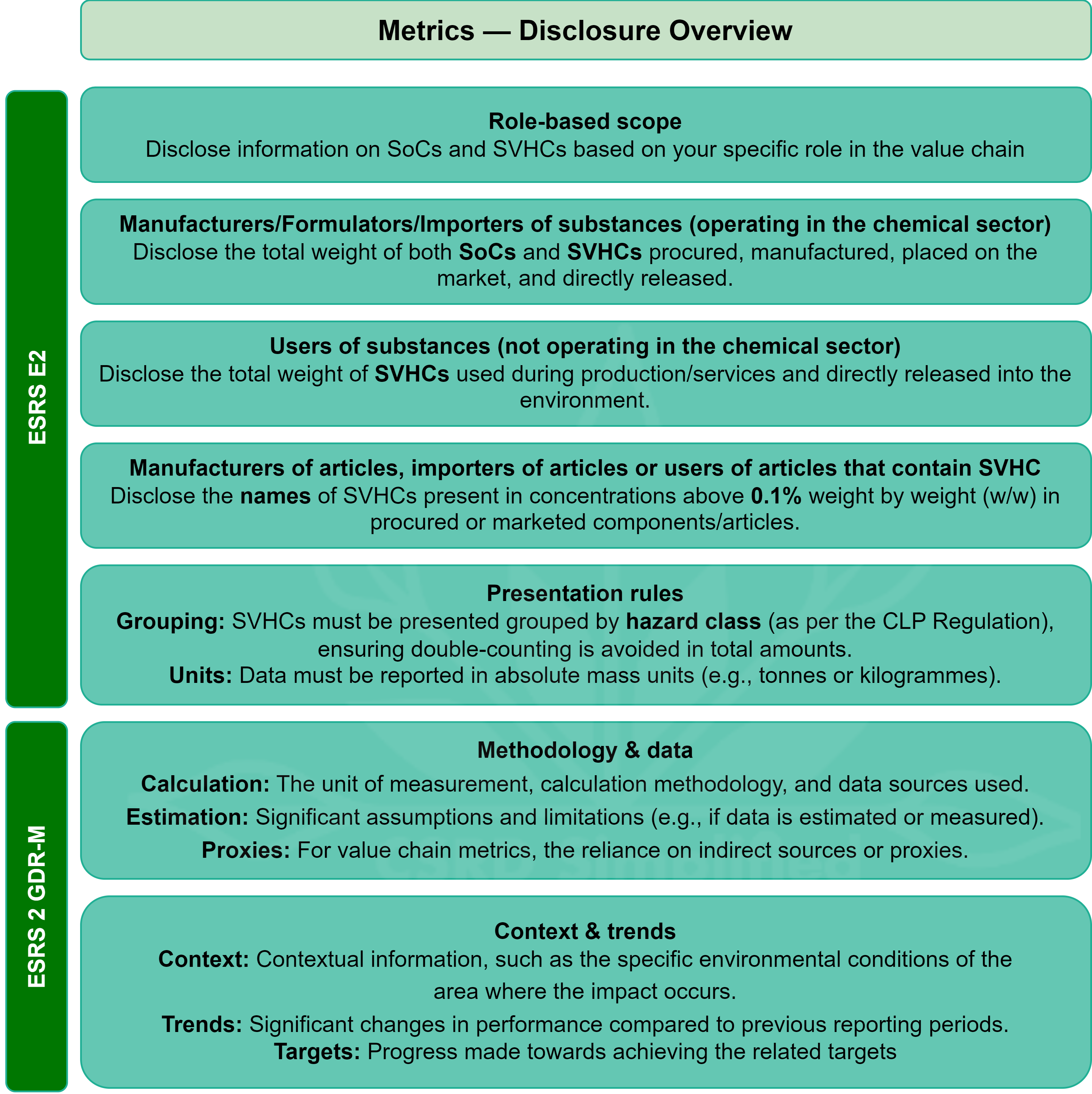
E2-5 is unique because your disclosure obligations depend entirely on what you do (your role in the value chain).
The standard breaks requirements down into categories:
4. How E2-5 links to the rest of ESRS E2
E2-5 provides the hazard context to your pollution management:
E2-1 (Policy): Establishes the governance and strategic commitment to eliminate or minimize the use of hazardous substances.
E2-2 (Action): Details the concrete steps taken to substitute these substances, such as R&D into safer alternatives or changing procurement standards.
E2-3 (Target): Sets the specific, measurable goals for reducing the volume of substances of concern in products and operations over time.
E2-5 (Metric): Quantifies the risk. By reporting the actual weight of SVHCs used or produced, this metric reveals the “toxicity footprint” of your business. A static or increasing number here immediately challenges the credibility of your phase-out targets (E2-3) and the effectiveness of your substitution efforts (E2-2).
5. Bottom line
E2-5 is the bridge between sustainability reporting and chemical compliance.
Check your REACH data: If you are a European manufacturer, you likely already track SVHCs for legal compliance. E2-5 asks you to aggregate and publish this data.
Know your role: Determine immediately if you fall under Category A (Chemical Manufacturer) or Category B (User), as the reporting burden for manufacturers (tracking all SoCs) is significantly higher than for users (tracking only SVHCs).
Transparency is inevitable: The EU’s goal is a “Toxic-Free Environment.” Hiding hazardous chemical use is becoming impossible; the strategy now is to show how you are managing and reducing it.