


1. Introduction
Water is the foundation of life and a critical resource for nearly every industry. Yet, the chemical properties that make water essential, specifically its ability to dissolve almost anything, also make it uniquely vulnerable to pollution.
For sustainability professionals, water risk is often viewed through the lens of scarcity (quantity). However, water quality is equally important. Understanding how industrial activities transform water chemistry, often in subtle and invisible ways, is essential to comprehend the full extent of their environmental impact.
In this article, you will learn:
✅ Why water’s chemical structure makes it the Universal Solvent
✅ The difference between visible waste and invisible threats
✅ How specific business activities drive water pollution
By the end of this article, you will understand water pollution and how corporate activities directly alter the quality of this important resource.

1. Water, the perfect solvent
At first glance, water seems simple. We know its chemical formula, H₂O, which means it is made of just two hydrogen atoms and one oxygen atom. However, despite its simple structure, water behaves in complex ways that are essential for life but also risky for the environment.
Why water is sticky
Scientists call water the Universal Solvent because it is better at dissolving other substances than almost any other liquid. But why?
It all comes down to electricity. You can think of a single water molecule as a tiny magnet.
The Oxygen side has a slight negative electrical charge.
The Hydrogen side has a slight positive electrical charge.
Because opposites attract, the positive side of one water molecule grabs onto the negative side of another, or onto other substances entirely. This is called polarity. It is this “stickiness” that allows water to break down salts, sugars, and minerals effectively.

The delivery system
This magnetic ability makes water an incredible means of transportation.
The good news: In nature and our bodies, water grips onto essential nutrients and carries them where they need to go. It transports dissolved vitamins through your blood to your cells and pulls sap from the roots of a tree all the way to the highest leaves.
The bad news: This same strength is also water’s greatest vulnerability. Because it dissolves things so easily, it cannot distinguish between good nutrients and bad chemicals.
As water flows over the ground (like rainwater running off a street or farm), it easily dissolves and picks up toxic substances like pesticides, motor oil, and industrial waste. Instead of just washing over them, it absorbs them, becoming a delivery system for poisons. It then carries these pollutants into our rivers, lakes, and oceans.
2. Understanding water pollution
Water pollution occurs when harmful substances—chemicals, microorganisms, or physical waste—contaminate a body of water to the point where it becomes unsafe for its intended use, such as drinking, swimming, or supporting aquatic life.
Pollution isn’t always visible like a plastic bottle floating in a river. Some of the most dangerous forms of pollution are invisible changes to the water’s chemistry:
Oxygen depletion: Fish and other aquatic creatures need oxygen dissolved in the water to breathe. When too much organic waste (like sewage) enters the water, bacteria multiply rapidly to eat it. These bacteria use up all the available oxygen, creating “dead zones” where nothing else can survive.
Thermal pollution: Pollution isn’t always a substance; sometimes it is energy. If the temperature of a river changes drastically (usually getting hotter), it can kill sensitive species. Warm water cannot hold as much oxygen as cold water, so heating a river effectively suffocates the fish.
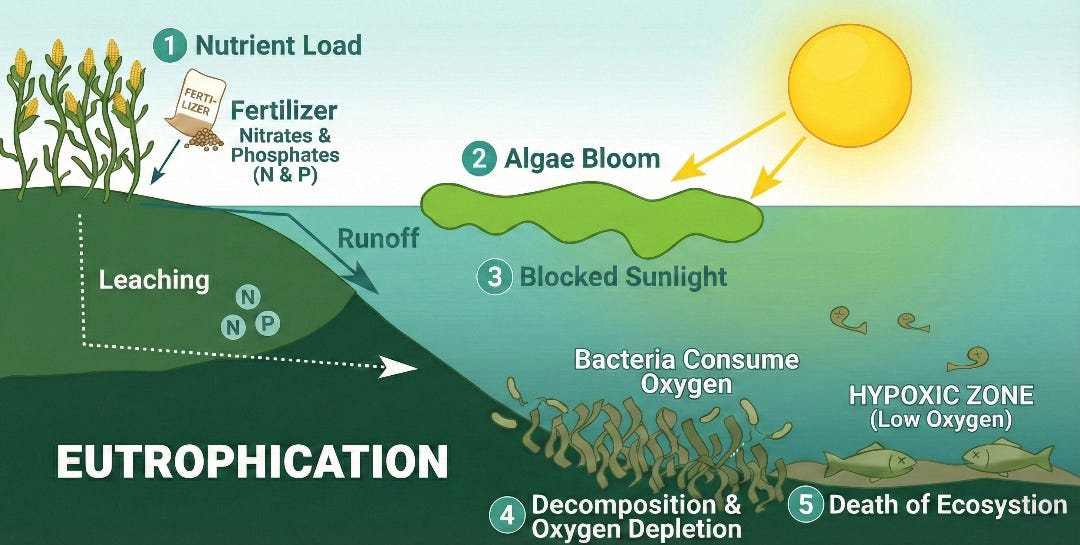
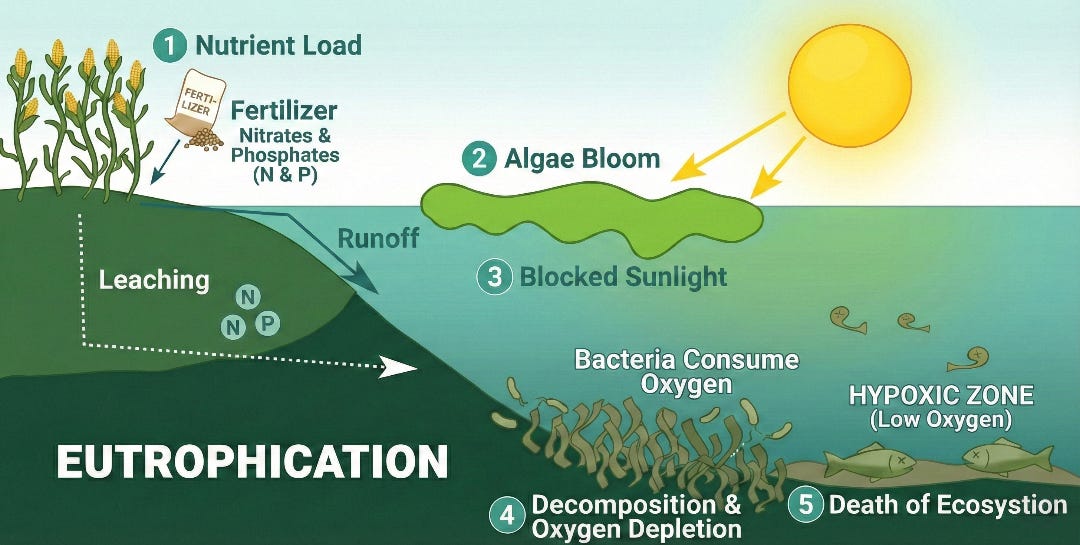
Eutrophication: This is a process caused by an excess of nutrients, specifically nitrogen and phosphorus (often from fertilizers). These nutrients act like super-food for algae, causing massive algal blooms on the surface. When these blooms die and rot, they choke the water of oxygen.
3. Business as the driver of water pollution
Industries are a major source of water degradation. While regulations exist, companies pollute water through several specific mechanisms, often categorized as point sources (a direct pipe) or non-point sources (runoff from a large area).
Here are the primary ways companies introduce pollution:
Industrial discharge
Many industries, such as textile manufacturing and pharmaceuticals, use water to wash chemicals during production. This wastewater is often loaded with dyes, heavy metals (like lead and mercury), and toxic solvents. If not properly treated before being released, these chemicals enter the food chain. Through a process called bioaccumulation, small animals eat these toxins, and larger predators eat the small animals, concentrating the poison until it reaches dangerous levels in the fish humans eat.
Thermal pollution
Power plants and steel mills use massive amounts of water to cool down their machinery. They draw cool water from a nearby lake, run it through their hot pipes, and dump it back into the lake at a much higher temperature. This sudden "thermal shock" kills fish eggs and larvae and depletes the water's oxygen levels.
Mining and acid mine drainage
Mining companies dig deep into the earth, exposing rocks that have been buried for millions of years. When certain minerals (like sulfides) are exposed to air and water for the first time, they react to create sulfuric acid. This acid flows into nearby streams, turning them bright orange or red and dissolving heavy metals from the surrounding rock, creating a highly toxic flow known as Acid Mine Drainage.
Agricultural runoff
While often viewed as farming rather than industry, large-scale corporate agriculture is a massive polluter. Rain washes excess fertilizers and pesticides off the fields and into waterways. This is the leading cause of eutrophication and algal blooms mentioned earlier, turning clear lakes into green swamps.
Sources
Regional Cooperation for Water Quality Improvement in Southwestern Pennsylvania
Comprehensive review of industrial wastewater treatment techniques
Water Pollution, Its Treatment, and Its Adverse Impact on Humans
THERMAL POLLUTION AND ITS IMPACTS ON HUMAN HEALTH: A REVIEW
A Comprehensive Review on Mine Tailings as a Raw Material in the Alkali Activation Process