


1. Introduction
When we manage pollution in a corporate setting, we often treat it in silos. We view air emissions, wastewater discharge, and solid waste as separate compliance boxes to tick. However, nature does not recognize these boundaries. The Earth acts as a giant, interconnected system.
For sustainability professionals, understanding this movement is important. Solving a problem in one medium—for example, scrubbing toxins from a factory smokestack—can inadvertently create a new problem in another if the resulting toxic ash leaches into the soil. To avoid these regretful solutions, we must look at the environment as a whole.
In this article, you will learn:
✅ How air, water, and soil interact as connected reservoirs
✅ How air pollution travels in the sky to contaminate land and water
✅ How soil acts as a reservoir that can release pollutants
✅ How water bodies can release toxins back into the air or trap them in the soil
By the end of this article, you will understand pollution transport and why a holistic approach is necessary to prevent pollution shifting in your environmental strategy.

2. Pollution moves from bucket to bucket
When we think about pollution, we often picture them in separate boxes: a dark cloud of smoke in the sky (air pollution), a plastic bottle floating in a river (water pollution), or a landfill leaking into the ground (soil pollution).
In reality, nature doesn’t have boxes. Our planet acts as a giant, interconnected system. Pollution rarely stays where it starts. Instead, it constantly moves between the air we breathe, the water we drink, and the soil that grows our food.
This traveling of pollutants is known as cross-media transfer. It describes how a chemical or particle moves from one environmental compartment to another.
The three buckets: Imagine the environment as three interconnected buckets representing air, water, and soil.

If you pour pollution into the air bucket (like exhaust from a car), it doesn’t just vanish.
Gravity pulls some of it down into the soil bucket.
Rain washes the rest into the water bucket.
If we only focus on cleaning up one bucket, for example, using a filter to scrub toxins out of factory smoke, we often end up with a pile of toxic ash. If that ash is buried improperly, it leaks into the soil and water. Solving a problem in one medium can inadvertently create a new one in another.
Learn more about soil, water, and air pollution here:

3. How air pollution becomes soil & water pollution
The atmosphere often acts as a rapid transport highway, carrying pollutants far from their source before depositing them onto land and water.
Atmospheric deposition
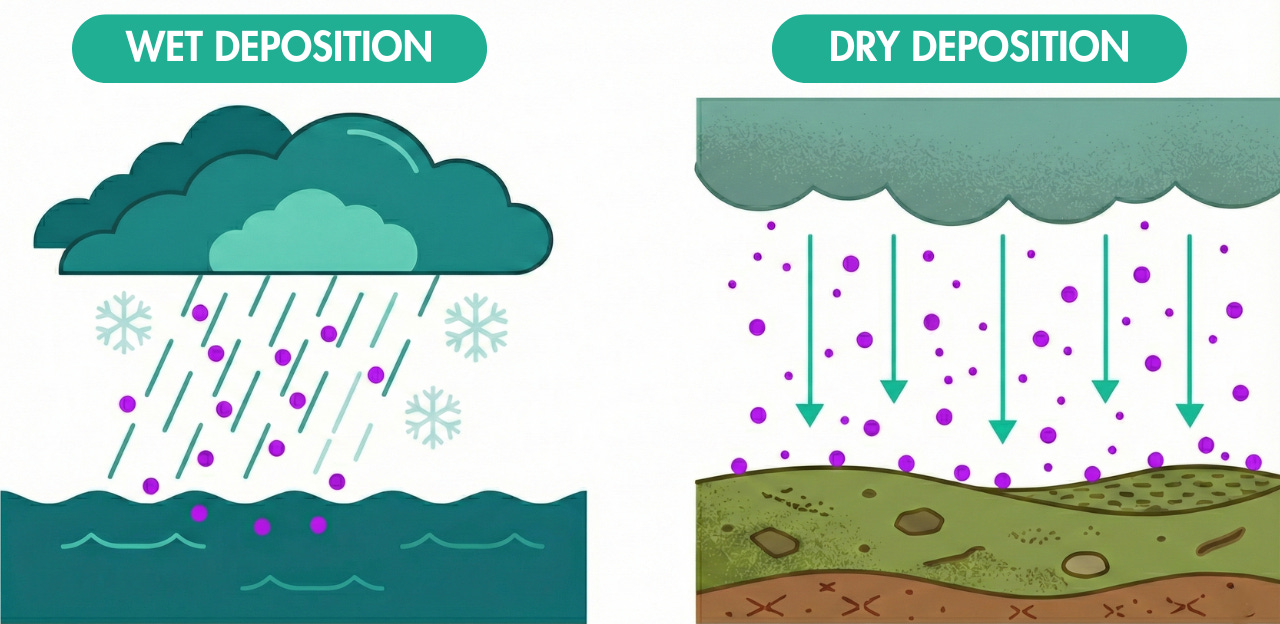
This is the primary mechanism by which airborne pollutants settle onto surfaces. It occurs in two forms:
Wet deposition: Pollutants are scavenged by rain, snow, or fog. This is the dominant pathway for heavy metals like lead (Pb) and zinc (Zn) in humid regions.
Dry deposition: Gases and particles settle directly onto surfaces due to gravity. In arid regions, this is the main source of soil contamination.
Acid rain
Emissions of sulfur dioxide (SO₂) and nitrogen oxides (NOx) from burning fossil fuels transform in the atmosphere into acids. These deposit onto lakes and soils, lowering pH levels (acidification), which can kill aquatic life and leach toxic metals like aluminum from the soil.
Mercury cycling
Mercury emitted into the air can travel globally. It eventually deposits into oceans and lakes, where it converts into methylmercury, a potent neurotoxin, and accumulates in the food web.
4. How soil pollution becomes water & air pollution
Soil acts as both a reservoir and a source of pollution, releasing stored contaminants into groundwater or back into the air.
From the soil to water
Leaching to groundwater: Water moving through the soil (percolation) dissolves pollutants and carries them into underground aquifers. For example, nitrates from agricultural fertilizers and heavy metals like cadmium (Cd) can leach from soil into groundwater.
Runoff to surface water: Heavy rains wash soil particles laden with pesticides and fertilizers into nearby rivers and lakes. This pollution causes eutrophication (nutrient overload) in water bodies.

