


OKRs for profitable sustainability
In Article 1, we built the Sustainability Flywheel: a mechanism to turn data and decisions into compounding value. In Article 2, we designed the Loonshot Engine: a protected space to nurture the fragile innovations that fuel that flywheel.
![[PS1] Designing a sustainability flywheel for profit, resilience, and long-term value](https://substackcdn.com/image/fetch/$s_!6s4Q!,w_140,h_140,c_fill,f_webp,q_auto:good,fl_progressive:steep,g_auto/https%3A%2F%2Fsubstack-post-media.s3.amazonaws.com%2Fpublic%2Fimages%2F4087b4ec-c5f9-4a9f-8935-355cfeb5a42c_1024x646.png)
![[PS2] How to build an innovation engine that feeds your sustainability flywheel](https://substackcdn.com/image/fetch/$s_!4ELR!,w_140,h_140,c_fill,f_webp,q_auto:good,fl_progressive:steep,g_auto/https%3A%2F%2Fsubstack-post-media.s3.amazonaws.com%2Fpublic%2Fimages%2F0b8329e3-fd8b-4c11-a6bb-aa630b25ede6_1024x1024.png)
Now, we face the most difficult hurdle in achieving profitable sustainability: the execution gap.
Companies excel at setting 2050 targets. They are less proficient at knowing what to do the next day to hit them. We see this gap in the data: a recent study found that nearly 40% of companies that set climate targets ending in 2020 missed them or quietly abandoned them.
The problem is the translation: “Net Zero by 2050” is a vision, not a work plan. When a vision is that distant, it creates no urgency for the procurement manager negotiating a contract today, or the logistics coordinator booking freight for next month.
To bridge this gap, organizations can adapt the Objectives and Key Results (OKR) framework—famously codified by Andy Grove and John Doerr—specifically for the nuances of ESG.
In this article, you will learn:
✅The fundamental difference between KPIs and the change-driven engine of OKRs.
✅ How to distinguish between Committed OKRs for operational efficiency and Aspirational OKRs for high-risk innovation.
✅ Real-world applications of OKRs at companies like Yves Rocher and Zalando to solve siloization and Scope 3 challenges.
✅ A seven-step guide to start using OKRs and avoiding common failures like the Moses Trap.
✅How OKRs integrate into the broader Profitable Sustainability framework of flywheels and loonshot engines.
By the end, you’ll understand how to deploy the OKR framework as the steering mechanism that makes profitable sustainability a repeatable quarterly habit.
What OKRs mean for sustainability
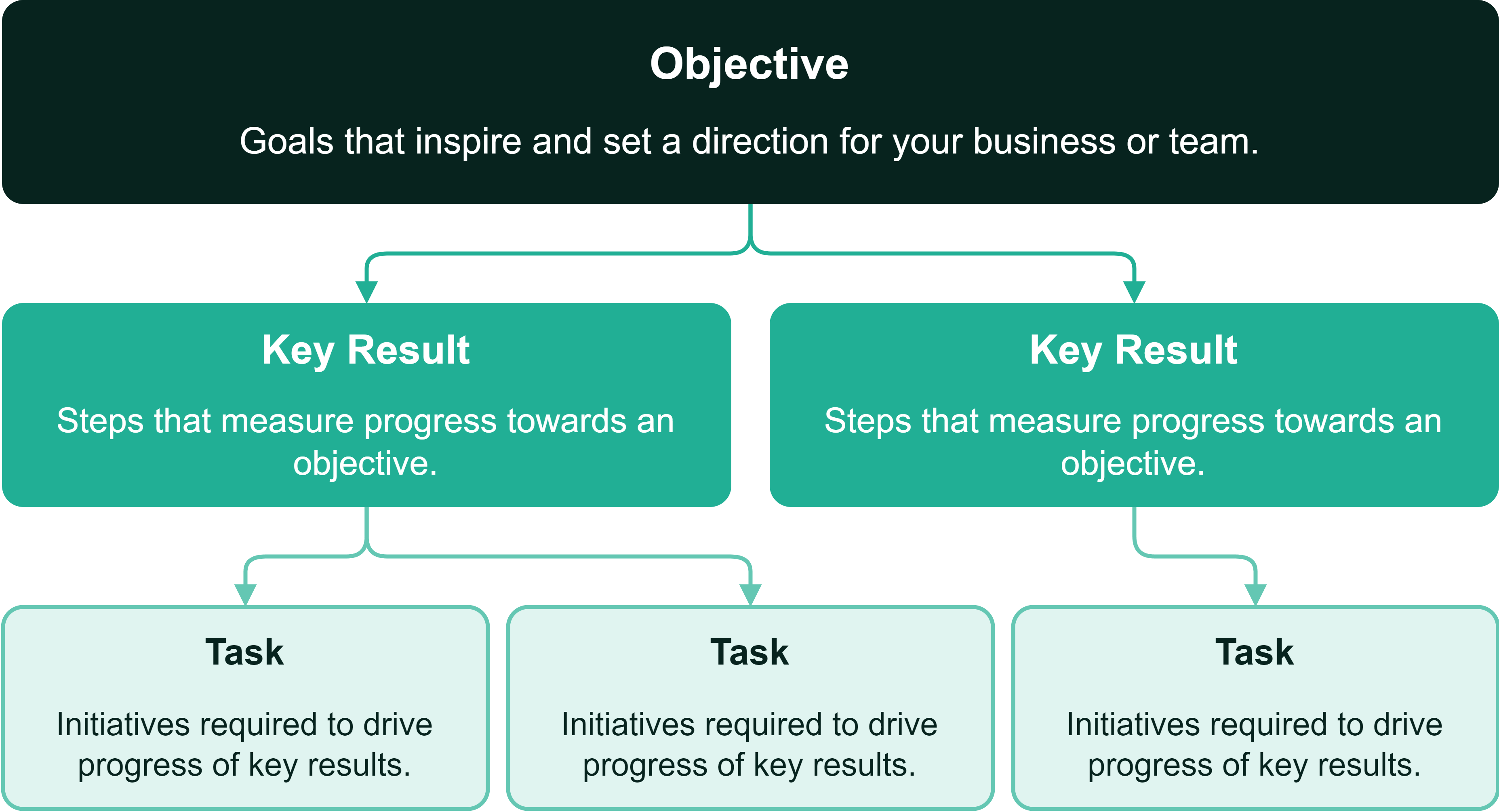
OKRs stand for Objectives and Key Results, a collaborative goal-setting protocol used by companies, teams, and individuals. Originating from Andy Grove’s management systems at Intel, the framework is built on the philosophy that “Ideas are easy. Execution is everything”. OKRs act as a precision communication tool to ensure that everyone in an organization aligns their efforts toward the same important issues.
The system consists of two components:
The Objective (the what): This is simply what is to be achieved. An objective provides clear direction and should be significant, concrete, action-oriented, and ideally inspirational.
The Key Results (the how): These benchmark and monitor how you actually reach the objective. Effective key results must be specific, time-bound, aggressive yet realistic, and, most importantly, measurable and verifiable. As former Google executive Marissa Mayer noted, “It’s not a key result unless it has a number”. Furthermore, key results must describe true outcomes rather than just activities.
OKRs are not the same as targets and KPIs
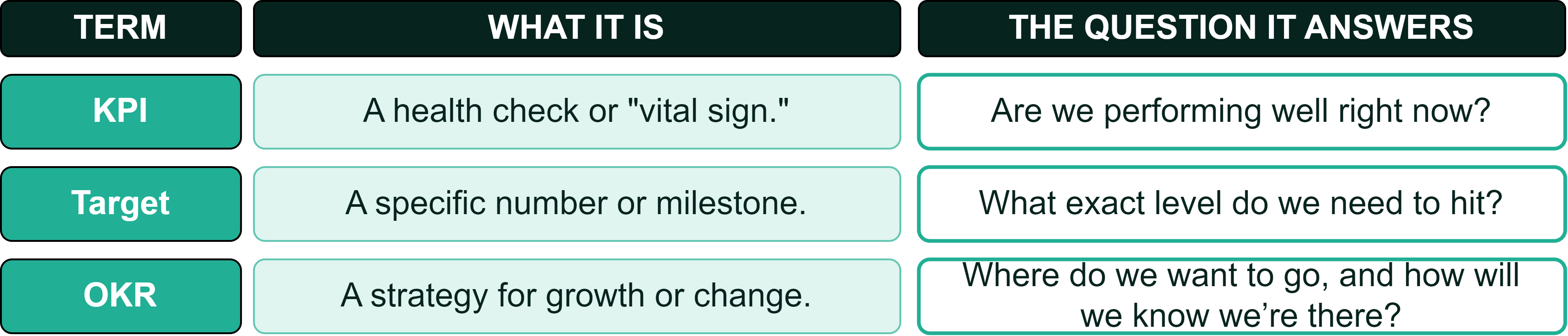
Think of KPIs as your business’s vital signs, the health check that answers, “Are we performing well right now?” They are steady-state metrics, like a car’s speedometer, that tell you if you are running smoothly.
A target is simply the specific number or milestone you want those metrics to hit, defining, “What exact level do we need to hit?” (such as a destination speed of 65 mph).
OKRs are the engine for bold change, providing a strategy for growth that answers, “Where do we want to go, and how will we know we’re there?” They combine an inspiring goal (the Objective) with measurable markers (Key Results) to push you toward something new.
Together, they create a complete system: if a KPI shows you are slowing down, you set an OKR to build a new engine, using a specific target to prove your new strategy succeeded.
How the system works in practice
OKRs are meant to be black-and-white. At the end of a goal cycle, typically a quarter, you evaluate whether you met the key result or not, leaving no room for gray areas or subjective judgment. Many companies score them on a mathematical scale. Google, for example, uses a 0.0 to 1.0 scale:
0.7 to 1.0 (Green): You delivered on the goal.
0.4 to 0.6 (Yellow): You made progress but fell short of completion.
0.0 to 0.3 (Red): You failed to make real progress.
A crucial rule of the framework is that the successful completion of all key results must guarantee that the objective is achieved. If you can score a 1.0 on all your key results but still haven’t accomplished the overarching objective, the OKR was poorly designed.
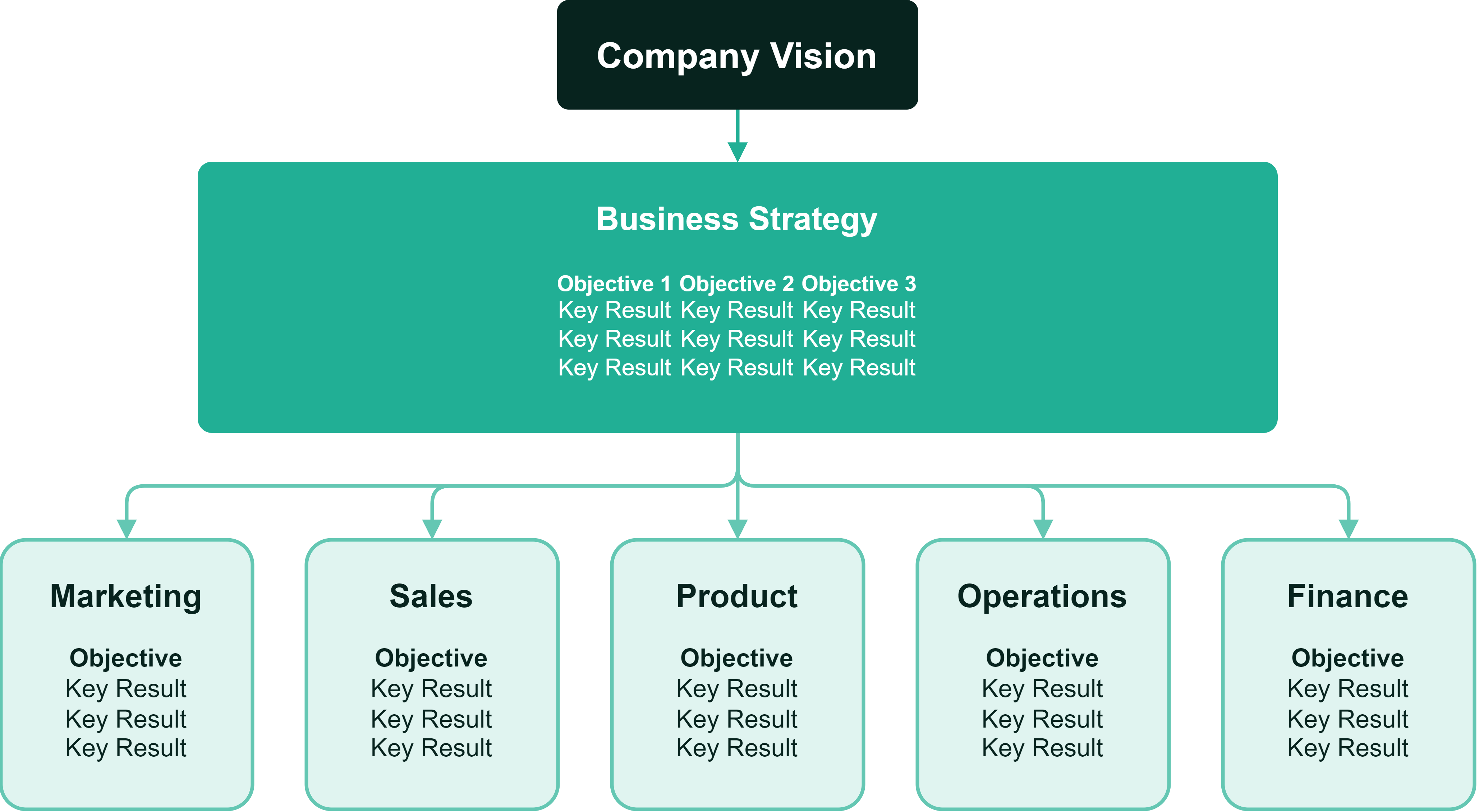
To get the most out of OKRs, organizations make them entirely public, meaning the most junior staff can look up the goals of everyone else, all the way up to the CEO. These transparent goals act as neon-lit road signs that demolish corporate silos and empower employees to see exactly how their day-to-day work connects to the company’s broader mission.
Types of OKRs
OKRs are divided into two main categories: committed OKRs and aspirational (or stretch) OKRs. It is critical to differentiate between the two, as confusing them can lead to misallocated resources or defensive teams.
Committed OKRs: These are operational goals tied to core company metrics, such as product releases, sales, bookings, and hiring. They represent priorities that the organization agrees must be achieved, meaning teams are expected to adjust their schedules and resources to ensure they are delivered. Because they are commitments, they are expected to be achieved in full (100 percent, or a score of 1.0) within a set time frame. If a committed OKR falls short of a 1.0 score, it requires a postmortem or explanation to understand what went wrong in the planning or execution.
Aspirational OKRs: Also known as stretch goals, these reflect bigger-picture, higher-risk, and more future-tilting ideas. They express how you want the world to look, even if you do not yet have a clear idea of how to get there or lack the resources necessary to deliver the outcome. Because they are designed to mobilize the organization and push people past their limits, they are inherently challenging, and a failure rate of around 40 percent is considered normal. The expected average score for an aspirational OKR is 0.7 (or 70 percent attainment).
Linking this back to the sustainability innovation engine and the sustainability flywheel discussed in the previous two articles:
Committed OKRs are for the Soldiers. They ensure the core business (the Flywheel) stays healthy and efficient.
Aspirational OKRs are for the Artists. These are the Loonshots. Because these OKRs expect a 40% failure rate, they provide the psychological safety for teams to try crazy things without fear of punishment.
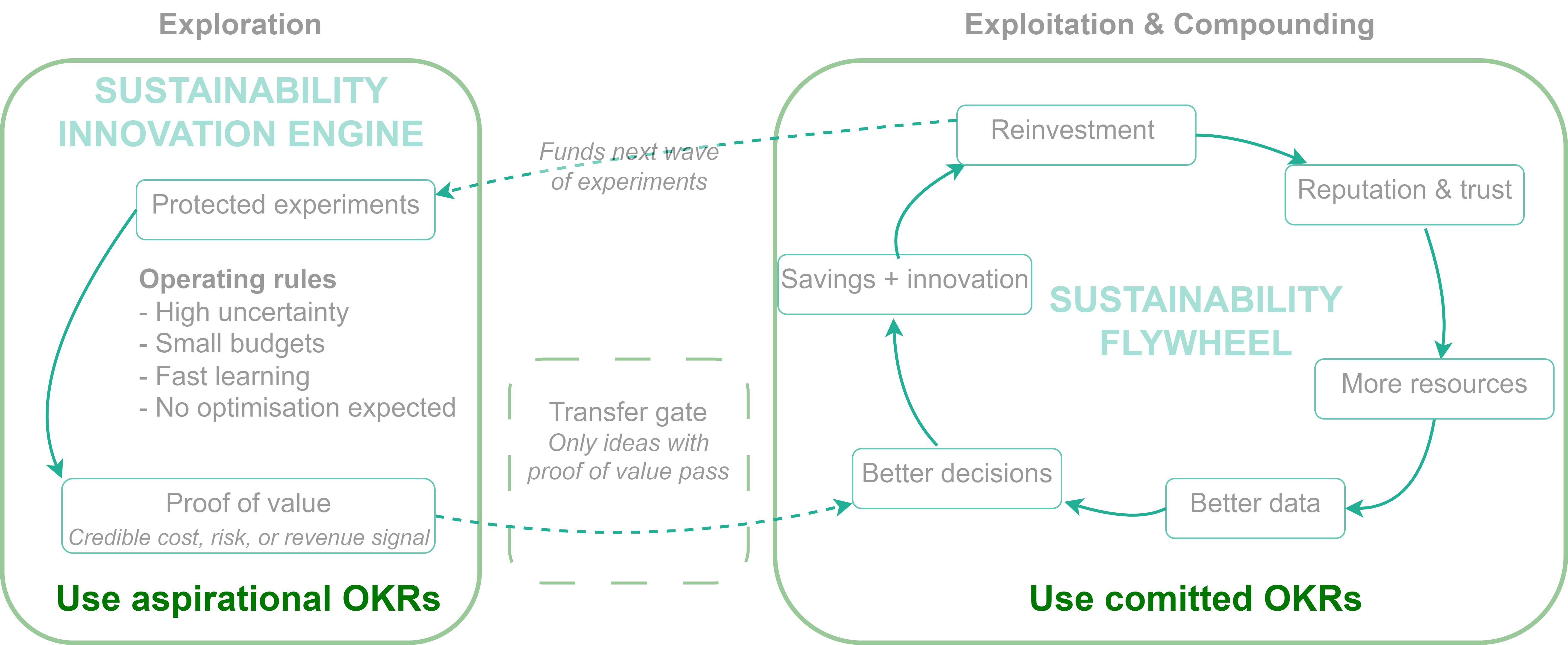
When a Loonshot (aspirational OKR) finally shows a value signal (success), use the OKR framework to help transition that idea into a committed OKR to make the idea scale.
Companies applying OKRs for sustainability
Yves Rocher: Integrating committed products into revenue
For many companies, sustainability is a side project handled by a specialized team, while the rest of the company focuses on selling products. Yves Rocher uses OKRs to break down this wall (siloization). They integrate green goals directly into the company’s core success metrics.
