


Loonshots for profitable sustainability
In the previous article, we designed a sustainability flywheel: a way to turn better data, smarter decisions, and reinvestment into a compounding engine for profit, resilience, and long-term value.
But there is a hard truth most organisations discover the painful way:
Many sustainability flywheels never start spinning.
Not because the model is wrong—but because the early ideas that would power the flywheel are killed too early. Pilots stall. Innovations get stuck in “proof-of-concept.” Teams reset direction every year. Momentum never builds.
This is exactly the failure mode Safi Bahcall describes in Loonshots.
His research helps explain why organisations systematically reject the very ideas they later wish they had protected—and how to design systems that let fragile innovations survive long enough to become profitable.
In this article, you’ll learn:
✅ Why sustainability innovation fails inside otherwise well-run organisations
✅ How Safi Bahcall’s core Loonshots concepts explain common ESG failure modes
✅ How to design a lightweight sustainability loonshot engine that protects early ideas and connects them to the core business
✅ How loonshots feed the sustainability flywheel — and why the flywheel cannot spin without them
✅ A concrete case study showing how fragile sustainability ideas became a repeatable, profitable system over time
By the end, you’ll understand not just why sustainability innovation so often stalls, but how to build the missing system that allows profitable sustainability to get started and scale.
What Loonshots means for sustainability
Bahcall’s research highlights three ideas that matter directly for sustainability leaders.
1. Phase transitions: when innovation suddenly stops
One of the book’s core insights is that organisational behaviour can change abruptly when incentives shift. As groups grow, the balance often moves from stake (you win if the idea wins) to rank (you win if your position improves).
When rank dominates, organisations become hostile to risk. New ideas are filtered out—not because they are bad, but because they threaten existing structures. Bahcall describes this as a phase transition: the same people behave differently under different incentive physics.

For sustainability, this explains a familiar pattern: once initiatives touch core operations, capex, or margins, they face resistance that has little to do with their actual business merit.
2. Artists and soldiers: why one system can’t do both
In Loonshots, Safi Bahcall distinguishes between two fundamentally different kinds of work that exist inside every organisation.
Artists explore fragile, uncertain ideas. Their job is to test possibilities, learn quickly, and find out whether something could work.
Soldiers execute, scale, and optimise what already works. Their job is reliability, efficiency, and consistency.
Both roles are essential—but they succeed under very different conditions.
Artists need small budgets, fast decisions, and permission to be wrong early. Soldiers need stable processes, clear targets, and predictable returns. Problems arise when organisations apply soldier rules too early. New sustainability ideas are judged using annual budgets, fixed KPIs, and short payback expectations—the same standards used for mature investments. Under those conditions, uncertainty looks like failure, and fragile ideas rarely survive.
Bahcall’s insight is not that one role is more important than the other. It is that one system cannot optimise for both at the same time.
His rule is simple: separate the phases, but keep them connected. Artists should explore until there is evidence of value. Soldiers should take over once scaling makes sense. The handover between the two—when an idea moves from exploration to execution—is where most sustainability efforts either succeed or quietly die.
3. The Moses Trap: why hero leadership breaks innovation
Another failure mode Bahcall describes is the Moses Trap: when ideas advance only at the discretion of a single powerful leader. This can look decisive and effective, especially early on—but it creates bottlenecks and bias.
In sustainability, this often shows up when progress depends on one exceptional CSO or CEO. As long as that person pushes, projects move. But when they shift focus, lose influence, or leave, the innovation pipeline collapses. The organisation never learned how to move ideas forward on its own.
The alternative is a system mindset. Instead of acting as heroes, leaders act as gardeners: they design clear rules, incentives, and decision paths so that good ideas can emerge, be tested, and transferred reliably—regardless of who is in the room. That is what turns sustainability innovation from a personal mission into an organisational capability.
A simple sustainability loonshot engine
The sustainability flywheel explains how value compounds once momentum exists.
![[PS1] Designing a sustainability flywheel for profit, resilience, and long-term value](https://substackcdn.com/image/fetch/$s_!6s4Q!,w_140,h_140,c_fill,f_webp,q_auto:good,fl_progressive:steep,g_auto/https%3A%2F%2Fsubstack-post-media.s3.amazonaws.com%2Fpublic%2Fimages%2F4087b4ec-c5f9-4a9f-8935-355cfeb5a42c_1024x646.png)
A loonshot engine explains how that momentum gets started in the first place.
Most organisations already run sustainability initiatives. What they usually lack is a system that allows early ideas to survive long enough to prove whether they work.
A simple sustainability loonshot engine looks like this:
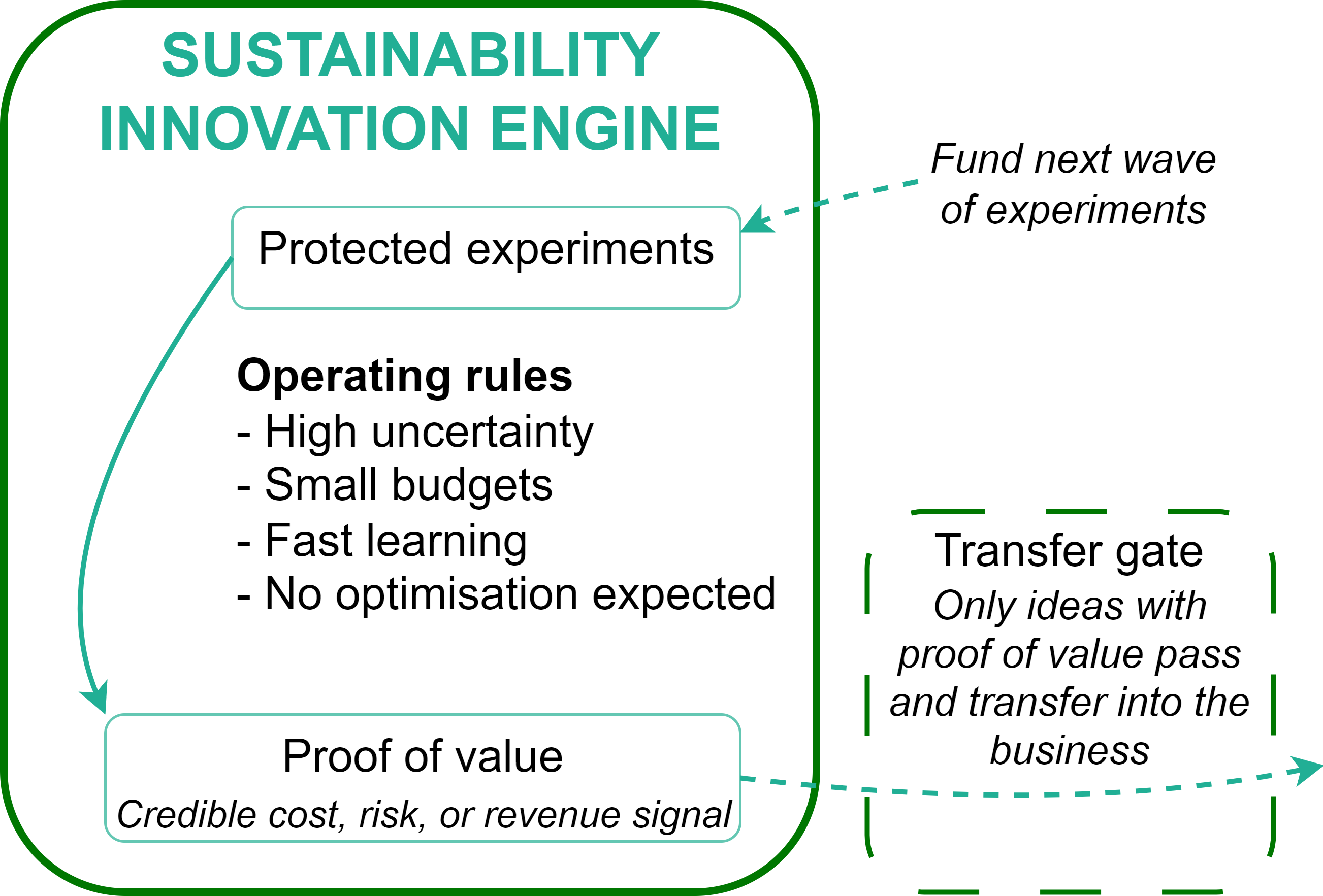
This is not a new department.
It is not a large transformation programme.
Think of it as a small, deliberately lightweight system layered on top of the existing organisation.
Its role is very specific:
to test sustainability ideas cheaply,
to learn quickly,
and to hand over only the ideas that clearly create value.
Everything else is allowed to fail early and quietly.
This engine feeds the sustainability flywheel at exactly the point where most organisations struggle: turning ideas into real savings, innovation, and momentum.
Step 1 – Diagnose the phase transition
Many organisations believe sustainability innovation fails because of culture, mindset, or lack of ambition.
Loonshots suggests a different explanation:
innovation often fails because the decision system has crossed a tipping point.
As organisations grow, decision-making tends to shift from:
“Will this idea work?”
to“Will this affect my position, budget, or risk exposure?”
When that happens, uncertainty becomes a reason to reject ideas — even if the expected value is attractive.
In sustainability, this shows up in very recognisable ways:
Ideas move quickly when they stay within one team, but stall once multiple functions are involved
Approval discussions focus on downside risk, not upside potential
Finance asks for certainty that can only exist after experimentation
This is not a people problem.
It is a system design problem.
Practical focus
Review your last 10 sustainability ideas that did not progress. Ask a simple question:
At what point did the decision shift from learning to risk avoidance?
KPIs to track
Time from idea submission to pilot approval
Number of approval layers required to start a pilot
Number of functions with veto power over experiments
Step 2 – Separate artists and soldiers
One of the most actionable ideas in Loonshots is that exploration and execution require different rules.
Artists explore uncertain ideas. They need speed, protection, and permission to be wrong.
Soldiers scale proven ideas. They need reliability, efficiency, and control.
Most organisations apply soldier rules too early — especially in sustainability. Early ideas are forced to meet the same standards as mature investments, which almost guarantees rejection.
A sustainability loonshot engine creates a protected space for artists, without weakening operational discipline elsewhere.
In practice, this means:
Small budgets
Clear learning goals
Limited exposure to the rest of the organisation
This is not:
A reporting team
A branding exercise
A traditional R&D function
It is a temporary shelter for fragile ideas.
Practical focus
Create a small cross-functional team (sustainability, finance, operations, data) that runs a handful of experiments per year, each designed to answer one clear business question.
KPIs to track
Cost per experiment
Time to first measurable signal (cost reduction, risk reduction, feasibility, or demand)
The goal is not certainty. The goal is to decide whether an idea deserves a chance to scale.
Step 3 – Build transfer, not more pilots
Many sustainability innovations fail after they succeed.
Pilots deliver results—but never become standard practice. This is what Bahcall describes as a system failure, not an execution failure.
To avoid “pilot purgatory” (successful pilots that never scale), transfer must be designed upfront.
Every sustainability experiment should pass four explicit transfer gates:
Value signal demonstrated
A credible cost saving, risk reduction, or revenue signal exists.Operational owner assigned
A business unit or function commits to owning the solution.Process integration defined
Changes to procedures, systems, or decision templates are documented.Funding source identified
Scale-up is linked to capex, opex, or reinvested savings.
Practical focus
Require each experiment to nominate its future operational owner before it starts.
KPIs to track
% of pilots transferred into operations
Time from pilot completion to full rollout
Step 4 – Fund learning so good ideas don’t die early
In the flywheel article, reinvestment is about scaling proven value.
Here, reinvestment has a different job: keeping exploration alive long enough to find value.
Many sustainability ideas don’t fail because they’re wrong. They fail because funding resets before the organisation has learned enough to decide. A pilot shows promise, but there is no budget to run the next iteration, expand to a second site, or do the integration work needed for transfer. The idea quietly dies—not from poor performance, but from lack of continuity.
That’s why a loonshot engine needs a simple rule: once an experiment shows a credible value signal, it should unlock small, predictable follow-on funding.
You can formalise this in different ways (green revolving funds, internal carbon fees), but the mechanism matters less than the principle:
Protect a portion of verified savings or budget to fund the next round of experiments and scale-up work.
Practical focus
Create a small “follow-on” pool that can fund the next step after a pilot—replication at a second site, process integration, supplier onboarding, or data system changes. Make access to that pool conditional on passing the transfer gates (value signal, owner, integration plan, funding path).
KPIs to track
Annual verified sustainability savings
% of savings (or budget) reserved for follow-on funding and scale-up work
Number of experiments that receive follow-on funding within 60 days of showing a value signal
Step 5 – Convert S-type loonshots into strategy
Some sustainability ideas improve efficiency or reduce costs. Others quietly change how the organisation makes decisions.
Loonshots calls these S-type innovations.
A simple way to think about it:
P-type loonshots change what you do (a new product, process, or technology).
S-type loonshots change how decisions are made (rules, incentives, metrics).
In sustainability, many of the most powerful breakthroughs are S-type:
Using lifecycle cost instead of purchase price
Applying internal price signals to emissions or resources
Shifting from product sales to service models
These changes often look small on paper, but they systematically steer decisions toward lower risk and higher long-term value.
Because they reshape decision logic, they are harder to reverse — and harder for competitors to copy.
Practical focus
Identify one recurring decision where sustainability impacts exist but are currently invisible (e.g. procurement, capex approval, product design).
KPIs to track
% of relevant decisions using lifecycle or sustainability-adjusted metrics
Number of decisions delayed, redesigned, or cancelled due to sustainability insights
Step 6 – Prevent the Moses Trap
In Loonshots, the “Moses Trap” is the pattern where progress depends on a single powerful sponsor. Ideas move forward because one leader believes in them—not because the organisation has a repeatable way to test, prove, and transfer them.
Sustainability is especially vulnerable to this. One strong CSO or CEO can push projects through. But when that person is busy, changes roles, or leaves, the pipeline slows down or collapses. The organisation never learns how to innovate without them.
The fix is not less leadership. It is a better system.
You want sustainability ideas to advance because they meet clear criteria—not because they have the right champion. That is what makes innovation scalable and durable.
A practical way to do this is to create a standing “loonshot review” forum with simple, consistent rules:
Experiments are approved based on a clear learning goal and a limited budget.
Projects move from pilot to rollout only if they pass the transfer gates (value signal, owner, integration plan, funding path).
The forum includes finance and operations so that scaling decisions are real, not symbolic.
Practical focus
Create a recurring (e.g., monthly) review where sustainability experiments are evaluated with a one-page template. Keep decisions fast and criteria consistent. Rotate membership so the system doesn’t become another rank-driven bottleneck.
KPIs to track
Number of business units or functions sponsoring experiments (not just the sustainability team)
Share of experiments with an operational owner assigned before the pilot starts
Average decision cycle time (proposal → approval; pilot complete → scale decision)
How this feeds the sustainability flywheel
The connection to the sustainability flywheel is direct:
