


1. Introduction
In the world of corporate sustainability, we celebrate a “15% reduction in global water use” or a “net-zero commitment for 2040” as if these figures, when aggregated onto a shiny spreadsheet, tell the whole story of a company’s environmental footprint.
But environmental data is often meaningless at a global aggregate level. In fact, for topics like pollution and water, “the average” is often a mask that hides the most significant risks a business faces.
What you will read in this article:
✅ Why global averages hide existential operational and reputational risks.
✅ How “strategic disaggregation” reveals the truth about your footprint.
✅ Why pollution and water stress are fundamentally “local” issues.
✅ The path from reporting data to building genuine corporate resilience.

2. The problem with the “global average”
Imagine a multinational beverage company. Its global sustainability report proudly states it has reduced its water intensity by 10% across all operations. On paper, this looks like a win.
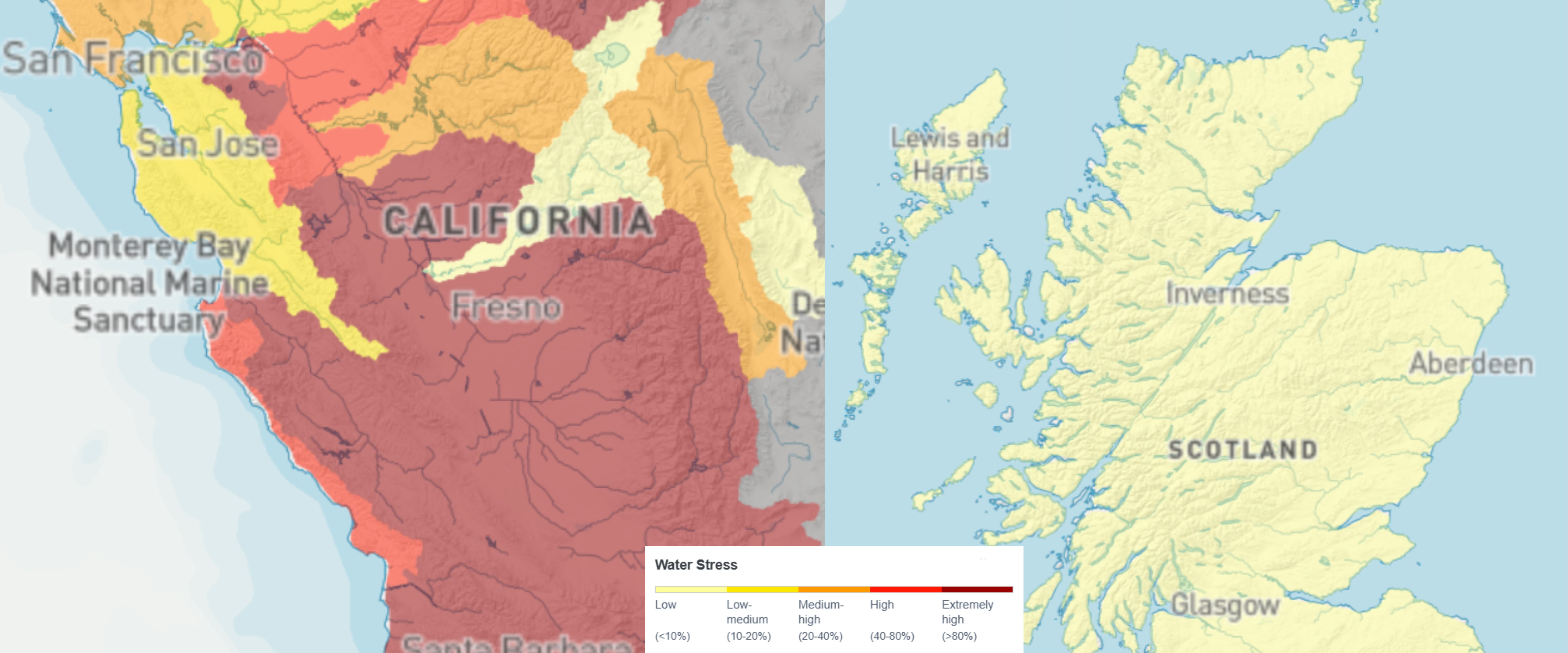
However, dig deeper, and you find that 90% of those savings came from a bottling plant in rainy Scotland, where water is abundant. Meanwhile, at its facility in the drought-stricken Central Valley of California, water use actually increased. By looking only at the aggregate, investors and stakeholders miss the fact that the company is facing an existential operational and reputational risk in California.
This is the “Averaging Trap.” For environmental impacts, context is everything.
3. Breaking down the silos of data
To avoid the trap, businesses must move from simple aggregation (lumping everything together) to strategic disaggregation (breaking data down by site or region). Information should be presented in a way that reflects where significant variations in risks or opportunities actually arise.
This shift requires looking at:
Geography and asset: A factory in a protected ecosystem or a water-scarce basin is not the same as a factory in an industrial park with a surplus of resources.
The “Obscurity” risk: High-level reporting can often obscure material information. If a company’s total emissions are stable, but they are increasingly concentrated in a community with strict new air-quality laws, the “average” fails to signal a major looming cost.
The CSRD perspective:
Under the European Sustainability Reporting Standards (ESRS):
ESRS 1 (General Requirements): Mandates that companies must disaggregate information by country, site, or significant asset whenever presenting it at a higher level would “obscure material information” about impacts, risks, or opportunities.
ESRS E2 (Pollution): Requires site-specific screening to identify actual pollution-related impacts, focusing on where emissions to air, water, and soil are most material.
ESRS E3 (Water): Explicitly requires companies to disclose total water consumption specifically in areas of high water stress.
3. Why pollution is a “local” issue
When we talk about pollution, we are rarely talking about a global atmospheric phenomenon (with the notable exception of greenhouse gases). Most pollution—whether it is nitrogen runoff into a river, microplastics on a specific coastline, or sulfur dioxide in a local community’s air—is felt at the site or basin level.
Reporting “1,000 tonnes of material emissions” globally doesn’t tell a user if that emission is happening in a desert or a wetland. The former might have a negligible impact on local biodiversity, while the latter could lead to a total ecosystem collapse—a “severe” impact defined by its scale, scope, and irremediable character.
4. Water stress: the ultimate contextual challenge
Water is the most context-sensitive resource of all. To manage it effectively, companies must look beyond their own fences. “water stress” is a combination of quantity (scarcity), quality, and accessibility.
![[INSIGHT] E3: Water scarcity, water stress, and water risk: What’s the difference?](https://substackcdn.com/image/fetch/$s_!Cx-F!,w_140,h_140,c_fill,f_webp,q_auto:good,fl_progressive:steep,g_auto/https%3A%2F%2Fsubstack-post-media.s3.amazonaws.com%2Fpublic%2Fimages%2Fd0d2896d-6946-4596-a439-3efc42c8b197_2048x2048.jpeg)
When a company reports a single water figure, it treats every liter of water as having equal “value.” But a liter of water in a water-stressed basin in the Sahara is infinitely more important to the business and the environment than a liter of water in the Great Lakes. True sustainability leadership requires identifying which operations are located in these high-pressure basins and managing them with site-specific targets.
5. The path forward: from reporting to resilience
This shift toward context-specific data isn’t just a compliance exercise; it is a fundamental shift in how we understand corporate resilience.
True materiality: By breaking down data, companies can identify which specific assets are at risk of regulatory shutdowns, local community backlash, or physical resource failure.
Meaningful stakeholder engagement: You cannot engage with an “aggregate” community. You engage with the people living next to a specific plant. Their local knowledge is a key input for understanding your actual impact.
Ecological thresholds: Sophisticated companies are beginning to set targets based on ecological thresholds—the “tipping points” of a specific local environment. This ensures that corporate actions are actually solving the problems that matter most in that specific spot.

The next step: Mapping your context with LEAP
Transitioning from global averages to local resilience requires a structured methodology. One of the most effective tools for this, is the LEAP approach.
Developed by the Taskforce on Nature-related Financial Disclosures (TNFD), LEAP provides a four-phase journey to move a business from an “operational blind spot” to strategic water and nature management, read more about it here:
By adopting the LEAP framework, companies can systematically dismantle the “Averaging Trap,” ensuring that their sustainability strategy is as localized as the environmental challenges we face.