


1. Introduction
Soil is often treated as an inert platform for building factories or planting crops. In reality, it is the living skin of our planet, a complex, non-renewable resource that takes centuries to form but only moments to destroy.
Soil pollution presents a unique challenge: unlike a plume of smoke or an oil spill, it is often invisible. Contaminants can hide for decades, silently traveling through the ground to poison aquifers or accumulating in the food chain until they reach toxic levels on our plates.
To manage environmental liabilities, companies must understand not just what they emit, but how those emissions interact with the land beneath their feet.
In this article, you will learn:
✅ Why soil is often called the living skin of the Earth
✅ How pollutants behave underground
✅ How toxins climb the food chain through bioaccumulation and biomagnification
✅ How specific industries create a toxic soil
By the end of this article, you will understand the mechanics of soil pollution and why protecting this finite asset is important.

1. Soil, the living skin
Soil is often called the living skin of the Earth. It is a dynamic mix of mineral particles, organic matter, water, and air.
Mineral particles (~45%): These come from the weathering of rocks over thousands of years. They are categorized by size: sand (large and gritty), silt (medium and floury), and clay (microscopic and sticky).
Organic matter (~5%): This is the “engine” of the soil. It includes living organisms like bacteria and fungi, plant roots, and humus (decomposed plant and animal remains). It holds nutrients and helps the soil soak up water like a sponge.
Pore space (~50%): The gaps between soil particles are filled with air and water, which are essential for roots to breathe and for nutrients to move.
Soil formation and layers
Soil forms very slowly through the interaction of climate, living organisms, and topography acting on rocks over time. This creates distinct layers called horizons. The top layer (topsoil) is the most fertile and is where most biological activity happens. Because it takes hundreds of years to form just one inch of topsoil, soil is considered a non-renewable resource.

2. Understanding soil pollution
Soil pollution occurs when human-made chemicals or other alterations reach concentrations that harm the health of plants, animals, or humans. Unlike air or water pollution, soil pollution is often “invisible” and can remain hidden for decades.
How pollutants behave in soil
Once a pollutant enters the soil, it doesn’t just sit there; it interacts with the soil particles:
Sorption: This is when a pollutant “sticks” to the surface of clay or organic matter. If a pollutant is strongly “sorbed,” it stays in place; if not, it can move easily.
Leaching: Rainwater can wash soluble pollutants down through the soil and into the groundwater, which eventually reaches our drinking water.
Soil pollution occurs when the concentration of harmful chemicals or substances in the soil is high enough to damage soil functions or pose a risk to the health of humans, animals, and plants.
Types of pollution
Point-source pollution: Contamination originating from a single, identifiable source, such as a specific industrial spill, an illegal dumping site, or a leaking underground storage tank.
Diffuse pollution: Contamination spread over large areas that cannot be traced to a single source. This often occurs through atmospheric deposition (pollutants falling with rain) or the widespread use of agricultural chemicals.
Common soil contaminants
Industrial and human activities introduce various pollutants into the soil:
Heavy metals: Elements like lead, mercury, arsenic, and cadmium, which are toxic and persist in the environment for centuries.
Organic pollutants: Including pesticides, mineral oils, and persistent organic pollutants (POPs).
Nutrient imbalance: Excessive nitrogen and phosphorus from fertilizers can leach into water or disrupt soil biology.
Impact of soil pollution: The food chain
Soil is a natural filter, but when overloaded with pollution, it sends toxins directly into our food and water.
Food & Water: Plants absorb heavy metals through their roots, and chemicals leak into our drinking water.
Ecosystems: Pollution kills the beneficial microbes that keep land fertile.
Toxins climb the food chain via two processes:
Bioaccumulation: Plants act as biological pumps. They often cannot distinguish between nutrients and toxins. A plant might absorb toxic Arsenic instead of Phosphorus. When an animal (or human) eats that plant, the toxin is absorbed faster than the body can excrete it, accumulating in organs like the liver.
Biomagnification: As predators eat herbivores, the concentration of the toxin increases at each step up the food chain. A human eating livestock raised on contaminated feed ingests a concentrated dose of the pollutant.
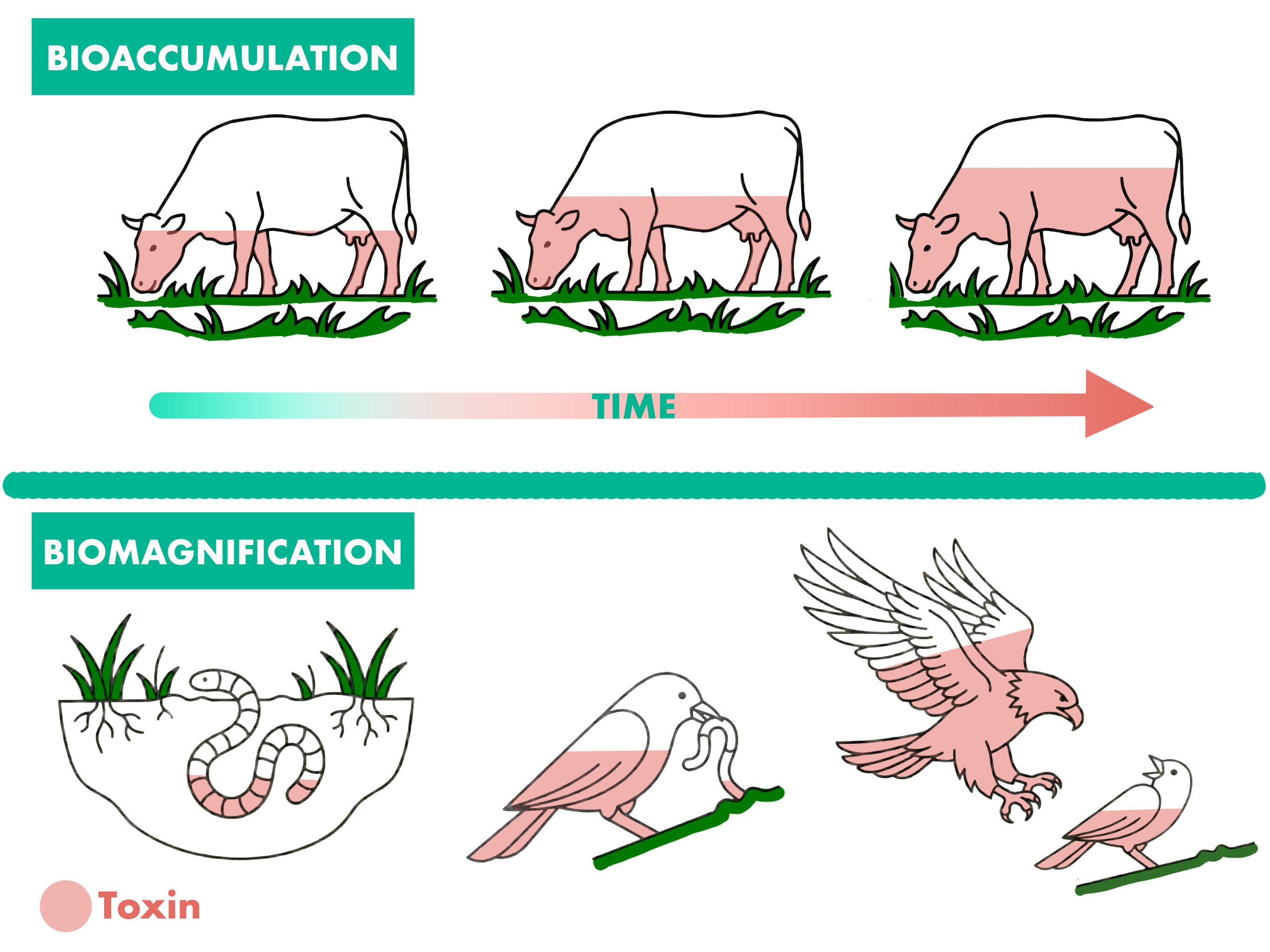
The result: By the time we eat crops or livestock from polluted land, we are consuming a concentrated dose of the original soil toxins.
3. Business as the driver of soil pollution
Mining and raw material extraction
Mining is one of the most visible ways industry alters the earth. It doesn’t just move dirt, it also changes the soil’s chemistry.
Toxic legacies: Mining unearths heavy metals like lead, mercury, and arsenic. Unlike organic waste, these “forever chemicals” do not break down and can stay in the soil for centuries, long after the mine has closed.
Waste mountains: After valuable minerals are removed, the leftover “tailings” (powdered rock) are often stored in large piles or ponds. These fine particles easily blow away in the wind or wash away in the rain, spreading toxins to nearby farms and forests.
Fuel extraction: Drilling for oil and gas can lead to accidental spills. Additionally, “brines”—salty, toxic water found deep underground—are often brought to the surface during drilling, poisoning the soil if they leak.
Manufacturing and industrial factories
Factories create the products we use daily, but their production lines often generate hazardous by-products.
Chemical leaks: Industries like textile dyeing, leather tanning, and chemical manufacturing use powerful solvents and dyes. If these aren’t stored in perfectly sealed containers, they seep into the ground through cracks in factory floors or storage area leaks.
Falling pollutants: Pollution isn’t just a ground-level issue. Factories release smoke and soot into the sky. When it rains, these airborne chemicals turn into “acid rain” or simply settle as dust, coating the soil in a layer of industrial pollutants.
The tech burden: As we produce more electronics, the “e-waste” industry has grown. When old phones or computers are recycled improperly—such as by burning them to get to the copper inside—toxic dioxins and metals are baked directly into the earth.
Waste disposal and trash Management
The way we get rid of what we don’t want is a major source of “hidden” soil pollution.
Landfill hazards: Even “legal” landfills can be a problem. As trash decomposes, it creates a toxic “garbage juice” called leachate. If the landfill’s bottom liner fails, this liquid sinks into the soil, carrying battery acid, pharmaceuticals, and household cleaners with it.
Historical burying: In the past, many companies used an “out of sight, out of mind” approach, simply burying barrels of industrial waste. Today, these aging barrels are rusting and leaking, creating “brownfields”—plots of land too contaminated to be used safely.
Sewage sludge: Sometimes, treated waste from cities (sewage sludge) is used as fertilizer. While it contains nutrients, it can also contain concentrated pathogens and microplastics if the treatment process isn’t rigorous enough.
Construction and transportation
Building the world’s infrastructure requires movement and materials that can degrade the land.
Road runoff: Busy roads are constant sources of pollution. Every time a car brakes or a tire wears down, tiny bits of metal and rubber fall onto the asphalt. Rain washes these metals and oily compounds (PAHs) into the soil along the roadside.
Soil sealing: This is a unique type of “pollution” where we cover living soil with concrete or asphalt. This “seals” the soil, killing the beneficial microbes underneath.
Leaded history: Even though leaded gasoline was banned decades ago in many places, the lead particles emitted from exhaust pipes during that era still sit in the topsoil of many urban yards today.
The agrochemical industry
Large-scale farming depends on an industrial supply chain that can inadvertently harm the soil it aims to help.
Fertilizer impurities: Creating massive amounts of fertilizer involves processing rocks and minerals. This process can leave behind trace amounts of radioactive elements or heavy metals like cadmium, which are then spread across millions of acres of farmland.
Pesticide production: The factories that manufacture bug and weed killers generate their own concentrated waste. If a manufacturing plant has a spill, it creates a “point-source” of pollution—a small area with an extremely high, dangerous concentration of chemicals.
Sources
Major contaminants of emerging concern in soils: a perspective on potential health risks - PMC
Soil architecture and physical properties
Heavy Metals Removal from Electroplating Wastewater by Waste Fiber-Based Poly(amidoxime) Ligand
Polycyclic Aromatic Hydrocarbons: Sources, Toxicity, and Remediation Approaches - PMC
Don't let nitrogen acidify your soil
UN says up to 40% of world’s land now degraded | Environment | The Guardian
Frontiers | Phytoremediation: A Promising Approach for Revegetation of Heavy Metal-Polluted Land