


Last updated: 10/28/2025
1. Introduction
Setting strong Environmental, Social, and Governance (ESG) targets is how companies move from good intentions to measurable impact. While values express what an organization stands for, and policies describe how those values are put into practice, targets make progress tangible — defining specific, time-bound goals that show whether commitments are being met.
Well-designed ESG targets translate ambition into action. They create accountability, allow progress to be tracked, and align business strategy with stakeholder expectations and regulatory requirements.
This article will walk you through:
✅ What ESG targets are and how they differ from values and policies
✅ Turning priorities into actionable goals aligned with global frameworks
✅ Embedding ESG targets into strategy, governance, and performance management
✅ Tracking progress, managing trade-offs, and learning from real-world examples like Microsoft and Amazon

2. What ESG targets are and why they’re different from values and policies
Values express what a company stands for.
Policies define how those values are put into practice.
Targets, in turn, set measurable performance expectations that show whether the company is living up to its commitments.
In other words:
A value might be “We believe in gender equality.”
A policy could state “We promote equal opportunities and fair pay.”
A target makes it measurable: “Increase women in management to 35% by 2026.”
Well-designed ESG targets translate ambition into action. They are specific, measurable, and time-bound, allowing stakeholders to track real progress rather than intentions.
For example:
“Reduce Scope 1 and 2 greenhouse gas emissions by 50% by 2030 (baseline year: 2020).”
This clarity enables accountability and comparability, which is why frameworks such as the European Sustainability Reporting Standards (ESRS) under the CSRD require companies to disclose measurable targets for material ESG topics.
Determining which topics warrant targets begins with a materiality assessment — identifying the environmental, social, and governance issues that matter most to the business and its stakeholders.

3. Build your ESG targets
Engage stakeholders and use due diligence insights
It is important to bring relevant stakeholders into the conversation early, which is also done during the materiality assessment. This ensures your targets reflect real-world expectations rather than internal assumptions.
Stakeholder engagement can take many forms — surveys, interviews, focus groups, or community roundtables. What matters is that you gather diverse input.
Ask yourself:
What outcomes do stakeholders want to see?
What does success look like from their perspective?
What are their main concerns or ideas?
Example:
Employees might focus on diversity or workplace safety. Investors might push for stronger climate targets. Local communities may care about pollution, water, or jobs.
In parallel, use ESG due diligence findings to shape your targets. This involves assessing where your company may cause or contribute to environmental or human rights impacts, and where controls may be weak.
In short, combine what stakeholders expect with what your due diligence reveals. That intersection produces relevant, credible targets — and avoids setting goals that look good but miss the real issues.
Turn priorities into SMART targets
Once you’ve identified what matters most, the next step is to turn priorities into clear, measurable commitments.
The SMART framework is a simple but powerful way to make ESG targets actionable and trackable across all themes — environmental, social, and governance.
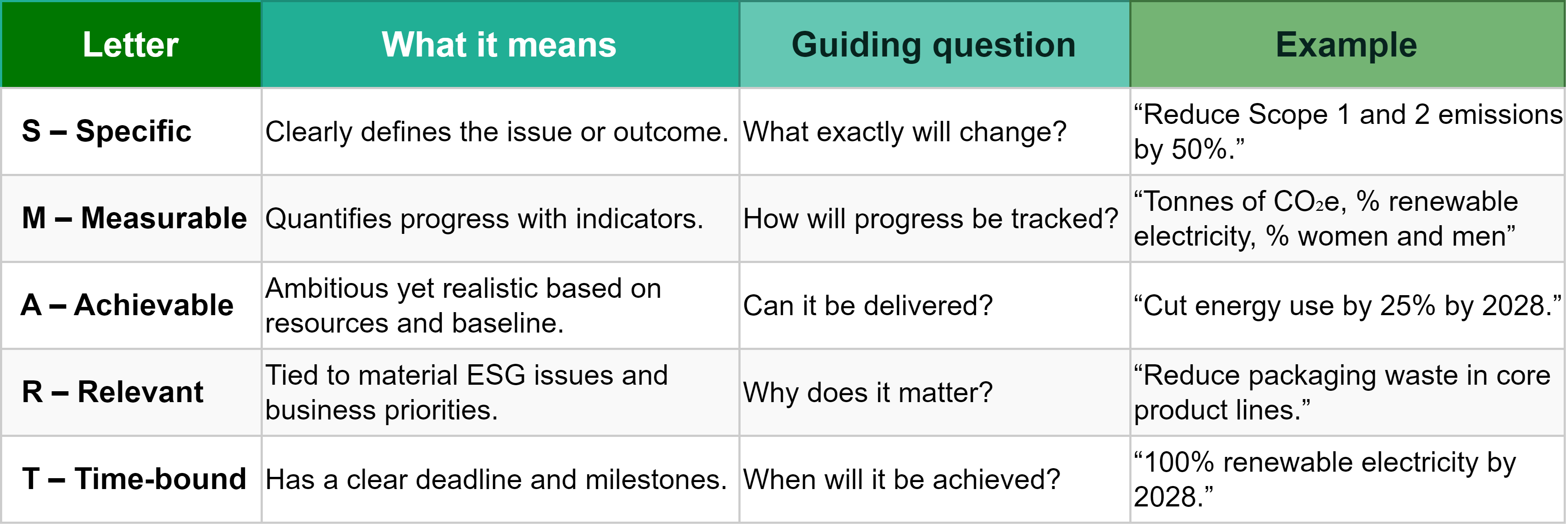
Some environmental targets, such as for GHG emissions, should also align with science-based thresholds. Read more about science based targets here:
![[BREAKDOWN] E1-6: What is the Science Based Targets initiative (SBTi) and how does it work?](https://substackcdn.com/image/fetch/$s_!rTGI!,w_140,h_140,c_fill,f_webp,q_auto:good,fl_progressive:steep,g_auto/https%3A%2F%2Fsubstack-post-media.s3.amazonaws.com%2Fpublic%2Fimages%2F20657086-78d5-4c2d-948b-8af47f39625e_2048x2048.jpeg)
Align targets with international frameworks
Once targets are defined, align them with recognized frameworks. This adds credibility, consistency, and comparability.
You don’t need to reference every framework. Focus on those most relevant to your sector and stakeholders.
Key frameworks to know:
ESRS (under the EU’s CSRD): Companies in scope must disclose measurable targets and progress for material sustainability topics, based on a double materiality assessment.
Read more: Sustainability reporting | EFRAGGRI Standards: The world’s most widely used sustainability reporting framework, including topic-specific standards (e.g., GRI 305 for emissions, GRI 403 for health & safety). These define disclosure requirements and performance indicators often used as the basis for setting ESG targets.
Read more: GRI StandardsTCFD / SBTi (climate focus):
UN Global Compact & SDGs: Encourages companies to align strategies and targets with its Ten Principles and contribute to the UN Sustainable Development Goals (e.g., SDG 13: Climate Action, SDG 5: Gender Equality, SDG 8: Decent Work).
Read more: UN Global Compact SDGsUN Guiding Principles & OECD Guidelines: Set expectations for human rights, due diligence, and responsible business conduct across operations and value chains.
Read more: UN Guiding Principles on Business and Human Rights (UNGPs) | OECD Guidelines for Multinational Enterprises on Responsible Business Conduct
Alignment ensures your targets are part of a broader sustainability narrative rather than standalone commitments. By linking them to recognized global frameworks, you create a shared language that investors, regulators, and rating agencies already understand and trust.
3. Turning targets into action and accountability
Defining ESG targets is only half the journey. The harder and more important part is putting them into action and tracking progress.
