


1. Introduction
Lowering resource use per product is excellent for financial margins and operational productivity. But when lower unit costs incentivize companies to produce, ship, or process significantly more, total resource consumption and absolute emissions still climb. What looks like a major efficiency win on the financial P&L can easily become a net increase in physical pollution.
This gap between unit-level engineering gains and total environmental impact is driven by the rebound effect and the Jevons paradox.
Understanding this distinction is important for corporate leaders navigating modern disclosure frameworks like the Corporate Sustainability Reporting Directive (CSRD), the GHG Protocol, and ISO standards—where compliance and climate goals also depend on absolute reductions and not just unit-level efficiency.
In this article, you’ll learn:
✅ What the rebound effect actually means, and why efficiency alone won’t shrink your footprint
✅ The economic traps that eat your savings, like lower operating costs accidentally fueling business expansion
✅ Where efficiency backfires, with examples from heavy industry, farming, transport, and tech
✅ Why saving money on green upgrades can end up funding new emissions elsewhere
✅ 3 practical corporate guardrails to make sure your efficiency investments make you more sustainable
By the end, you’ll have a realistic framework to evaluate tech investments accurately, separate unit-level gains from absolute impact, and protect your company's actual environmental progress.

2. What is the rebound effect?
The tension between technological efficiency and actual resource conservation is one of the most enduring debates in environmental economics. It dates back to 1865, when economist William Stanley Jevons observed that as steam engines became more fuel-efficient, overall coal consumption actually went up, not down.
Today, when an engineering team projects that a new technology will cut energy use per unit by 20%, corporate financial models typically assume the company’s total energy bill and footprint will also drop by 20%.
But this rarely happens. The rebound effect measures the gap between what engineering models predict on paper (Potential Energy Savings) and what is actually achieved in practice (Actual Energy Savings):
This relationship leads to three possible real-world outcomes:
Zero Rebound (R = 0): The ideal scenario. A 20% efficiency gain results in a full 20% reduction in total resource consumption.
Partial Rebound (0 < R < 1): The most common scenario. Economic or behavioral shifts eat away at a portion of the projected savings, leaving you with less environmental benefit than expected.
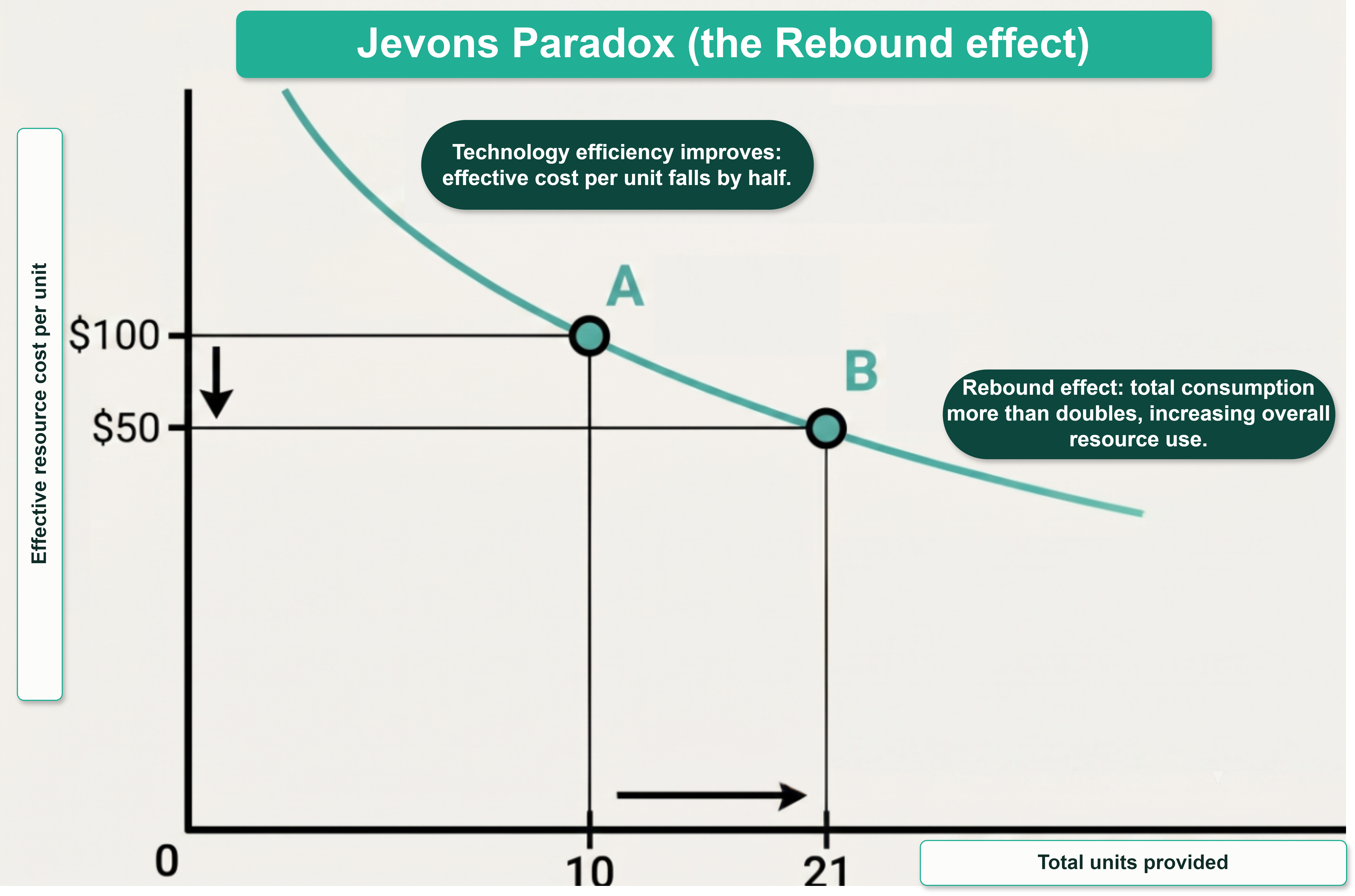
Backfire / The Jevons Paradox (R > 1): The worst-case scenario. Technical efficiency gains lower operating costs so dramatically that demand surges, causing absolute resource consumption to rise above baseline levels.
3. Macroeconomic growth effects
When technological efficiency improves across an entire industry, it lowers the costs for a single company, and it also boosts the productivity of the whole economy.
While making a process more efficient sounds like a win for the environment, that added economic momentum creates three growth engines that can drive total resource consumption back up.
1. Shift toward high-efficiency sectors
What happens: As an industry becomes more efficient and profitable, it offers higher returns on investment.
Why it backfires: Investors, capital, and workforce talent naturally migrate away from slower, traditional industries and flow directly into these highly efficient, high-growth sectors. This influx of resources expands the industry’s size and footprint beyond its original scale.
2. The technology domino effect
What happens: An efficiency breakthrough in one sector rarely stays isolated—it spills over into surrounding industries.
Why it backfires: If a logistics company figures out how to drastically cut freight costs per mile, every manufacturing, retail, and agriculture business that relies on shipping suddenly sees its own operational costs drop. This domino effect lowers prices across the market, stimulating broader business activity and increasing resource demand across the entire economy.
3. Freeing up capital for enterprise expansion
What happens: Money that companies previously had to budget for baseline costs, like energy, fuel, or raw materials, is now freed up as surplus cash flow.
Why it backfires: In a competitive market, businesses do not let capital sit idle. They reinvest those savings into the business to hire more staff, launch new product lines, or build larger facilities. This continuous economic expansion generates a compounding growth loop that can easily overwhelm the initial per-unit resource savings.
At a macro level, efficiency is a catalyst for economic growth. When technology makes a resource cheaper or more productive to use, the market responds by scaling up overall business activity, which often results in using more total resources than before.
Key economic factors that shape macro rebound
Predicting the exact size of this macro rebound depends heavily on two critical factors:
Resource substitution flexibility: When it is easy for a company to swap energy for machinery, labor, or materials, lower energy costs make expanding operations extremely attractive, triggering full backfire.
The green-versus-fossil trap: If green energy and fossil fuels are easily interchangeable in production, a breakthrough that makes green energy cheaper lowers overall industrial costs. This cost drop can expand total industrial output so much that total fossil fuel use actually goes up alongside green energy to power the expanded scale.
Example
Imagine a delivery company operating a fleet of 50 diesel trucks:Breakthrough: Electric trucks suddenly become 50% cheaper to run per mile than diesel.
Substitution: The company replaces most of its fleet with electric trucks to save money.
Scale explosion: Because shipping costs have dropped so dramatically, customer demand for deliveries explodes by 300%.
Backfire: To handle this massive new delivery volume, the company now needs 200 total trucks. Even if 80% of its expanded fleet is electric (160 electric trucks), it still needs 40 diesel trucks to cover peak routes, meaning it is still burning a massive amount of fossil fuel to support its expanded scale.
How a nation’s wealth influences rebound
Rebound dynamics also look very different depending on a country’s economic stage:
Developing economies: Rebound effects are initially lower because limited access to capital and infrastructure naturally constrains how quickly consumption can expand.
Advanced economies: High technical efficiency and massive industrial capacity create stronger rebound dynamics as production expands, though this rebound eventually slows down once overall demand for basic energy services becomes saturated.
4. Where efficiency backfires in different sectors
Heavy industry and manufacturing
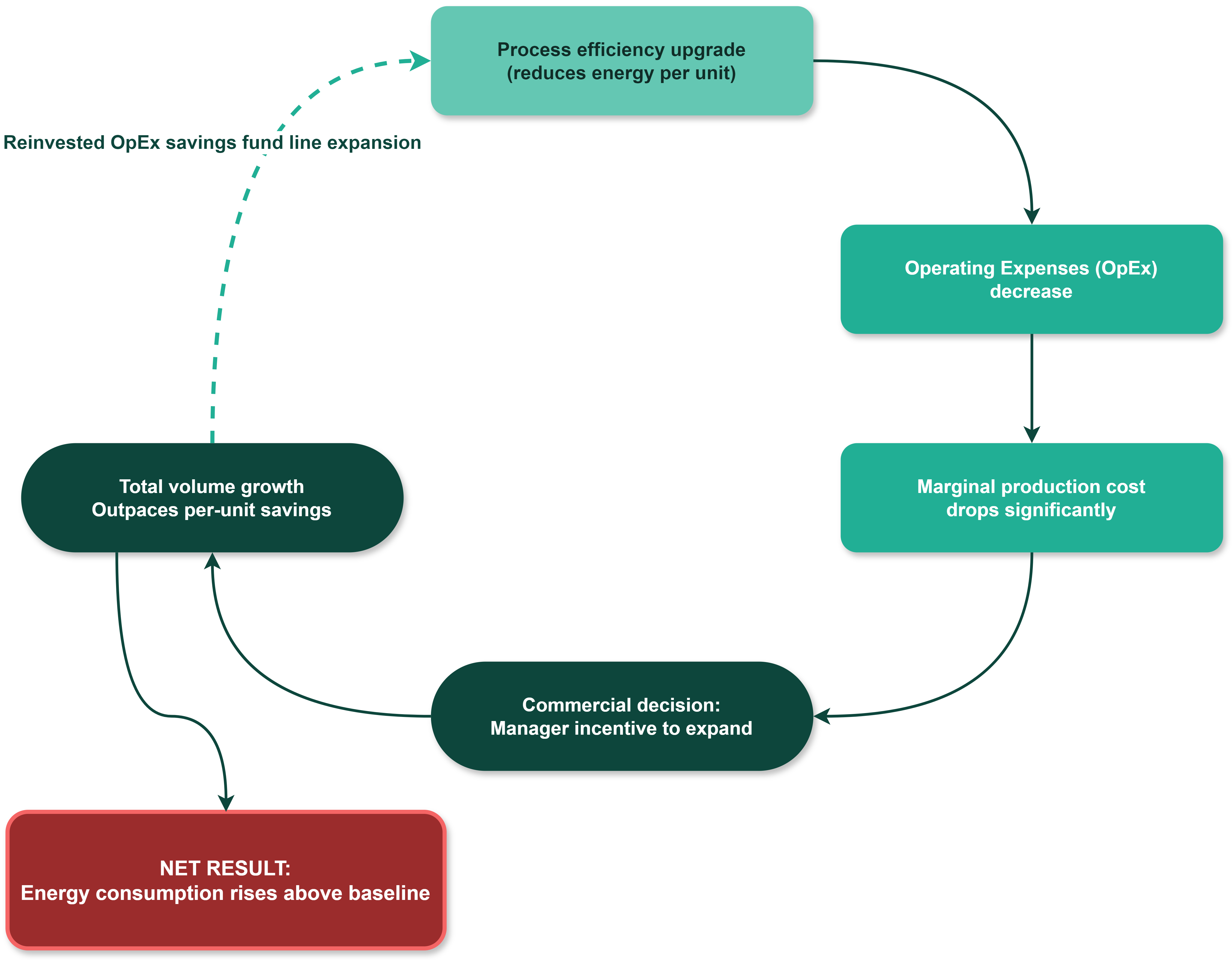
When industrial facilities optimize their processes to use less energy per unit of output, the marginal cost of production drops. Because operating expenses decrease, manufacturing becomes more profitable at scale.
Instead of keeping production steady and pocketing the energy savings, industrial managers face a strong commercial incentive to expand facility capacity, add shift cycles, or build new production lines. When total production volume increases enough to outpace the per-unit savings, absolute energy consumption rises above baseline levels—turning an intended resource reduction into a full operational backfire.
Agriculture and the irrigation paradox
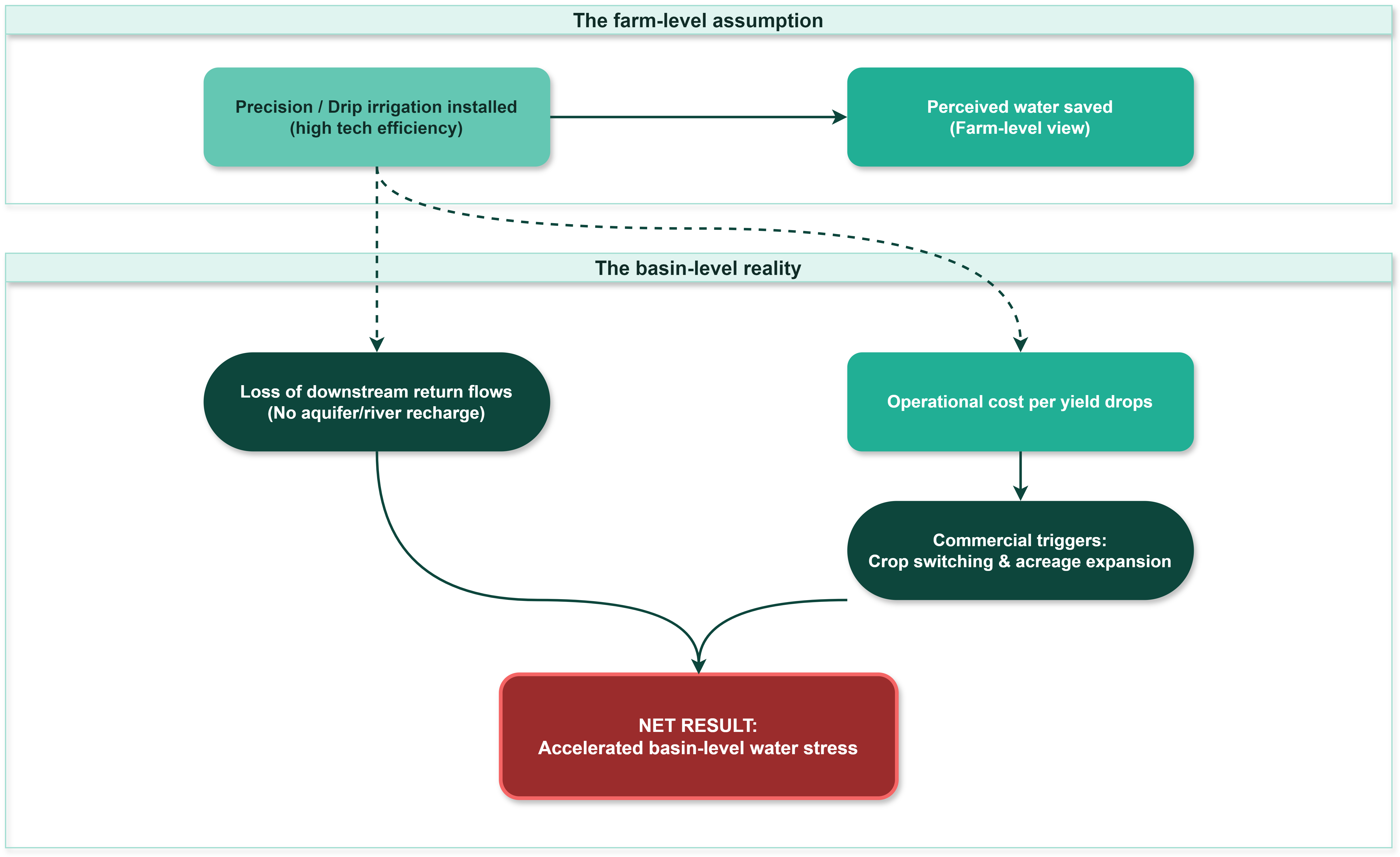
Efficiency in agricultural irrigation often focuses on delivering water directly to crop roots while minimizing visible surface loss. However, at a watershed level, traditional inefficient methods (like surface flooding) allow unabsorbed water to seep underground into aquifers or flow back into local river systems, where downstream users and natural ecosystems capture and reuse it.
High-efficiency precision irrigation minimizes these return flows, effectively trapping more water on-site. Furthermore, because efficient technology reduces the operational cost per crop yield, farm managers are incentivized to alter their business strategy:
Crop switching: Replacing lower-value, drought-tolerant crops with water-intensive, high-margin alternatives.
Acreage expansion: Bringing previously uncultivated or rain-fed land into active irrigation.
As a result, local water extraction increases while downstream groundwater recharge declines, exacerbating overall water stress in the river basin.
Autonomous mobility and freight
Efficiency gains in transport can backfire through both physical supply chains and user behavior:
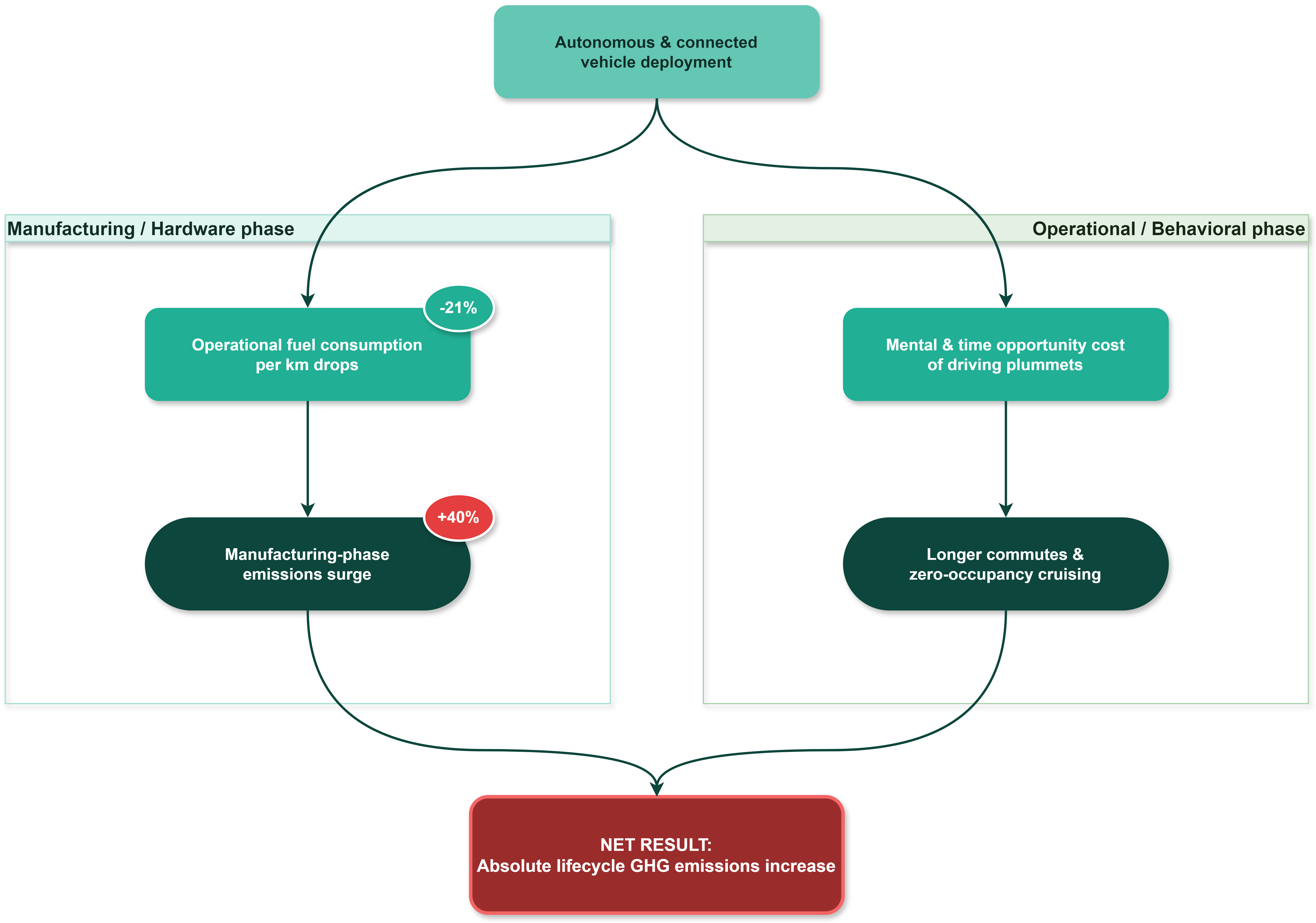
Life-cycle emissions shift: Software optimization and automated driving can smooth out traffic patterns and reduce operational fuel consumption per kilometer. However, producing the specialized hardware, computing processors, and sensor arrays required for automation significantly increases manufacturing-phase emissions. If production impacts outweigh operational efficiency gains, total life-cycle emissions increase.
Reduced opportunity costs: When travel becomes hands-free or effortless, the mental burden and time cost of commuting drop. Passengers become willing to live farther away and endure longer trips. Additionally, driverless vehicles may engage in zero-occupancy cruising to avoid parking fees. The sheer increase in total distance traveled cancels out per-kilometer efficiency gains.
Voluntary sustainability and the re-spending effect
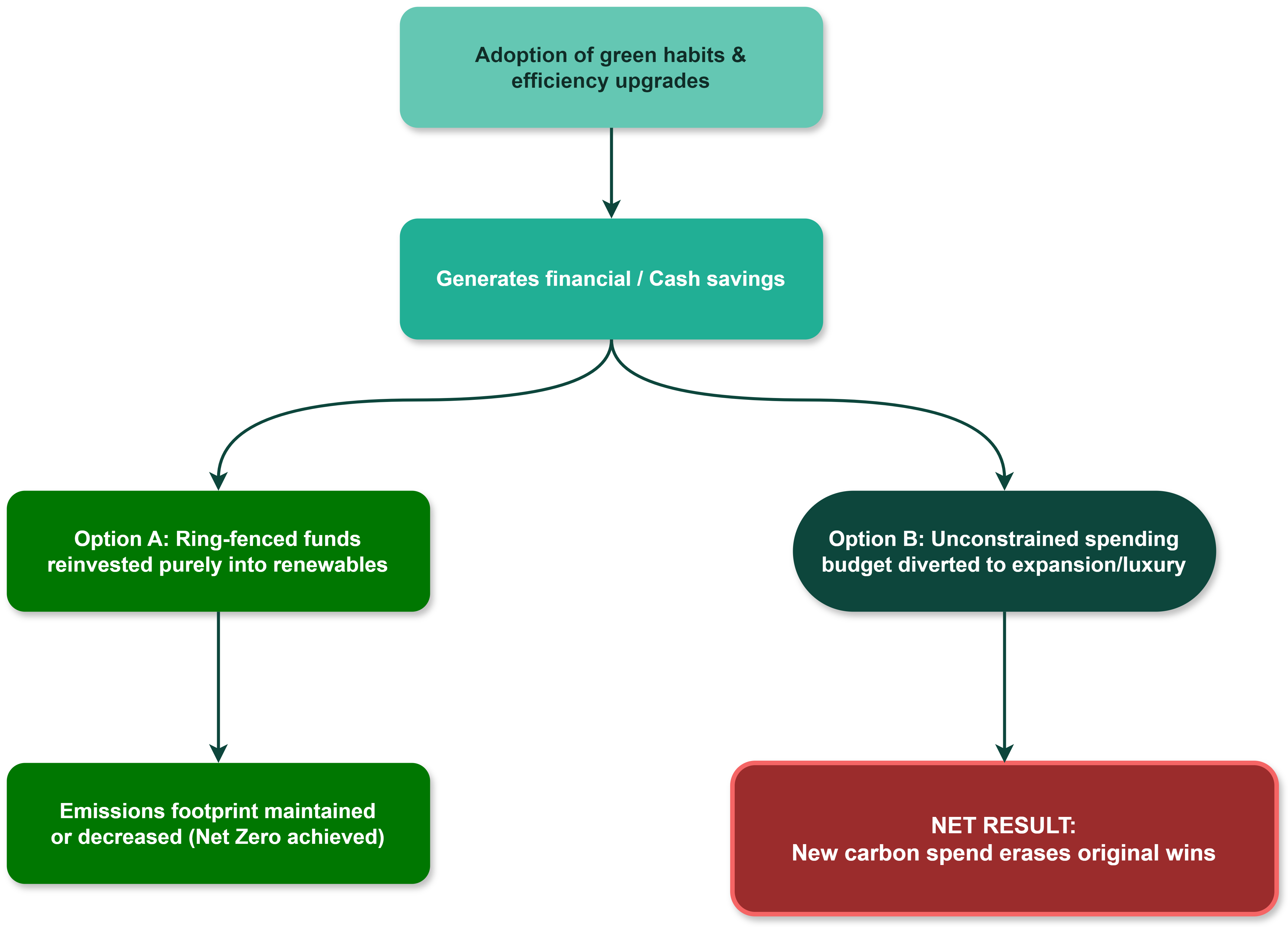
When a company or household adopts a green habit, it often saves money. For example, a business might cut its electricity bill by installing efficient lighting, or a household might save money on groceries by switching to a plant-based diet.
The problem arises with what happens to those savings. If the money saved is spent on high-emission goods or activities, the new environmental damage can cancel out—or even exceed—the original green progress.
Swapping one footprint for another: An organization or person changes what they buy to lower their environmental impact, such as using recycled materials or adopting a lower-carbon diet.
Because these choices are often cheaper, they leave leftover cash. If a family saves $200 a month on groceries and uses that money to book an international flight, or if a company uses its material savings to buy new office electronics, the emissions from the flight or electronics erase the original environmental wins.
Reinvesting bill savings into expansion: Upgrading to energy-efficient machinery or fuel-efficient vehicles lowers monthly utility and fuel bills.
The business now has extra operating cash. If that unconstrained surplus capital is used to expand factory operations, open a new location, or manufacture more goods, the emissions from that new business activity erode a huge portion of the energy savings—and can sometimes even lead to higher overall emissions than before the upgrade.
Digitalization and ICT
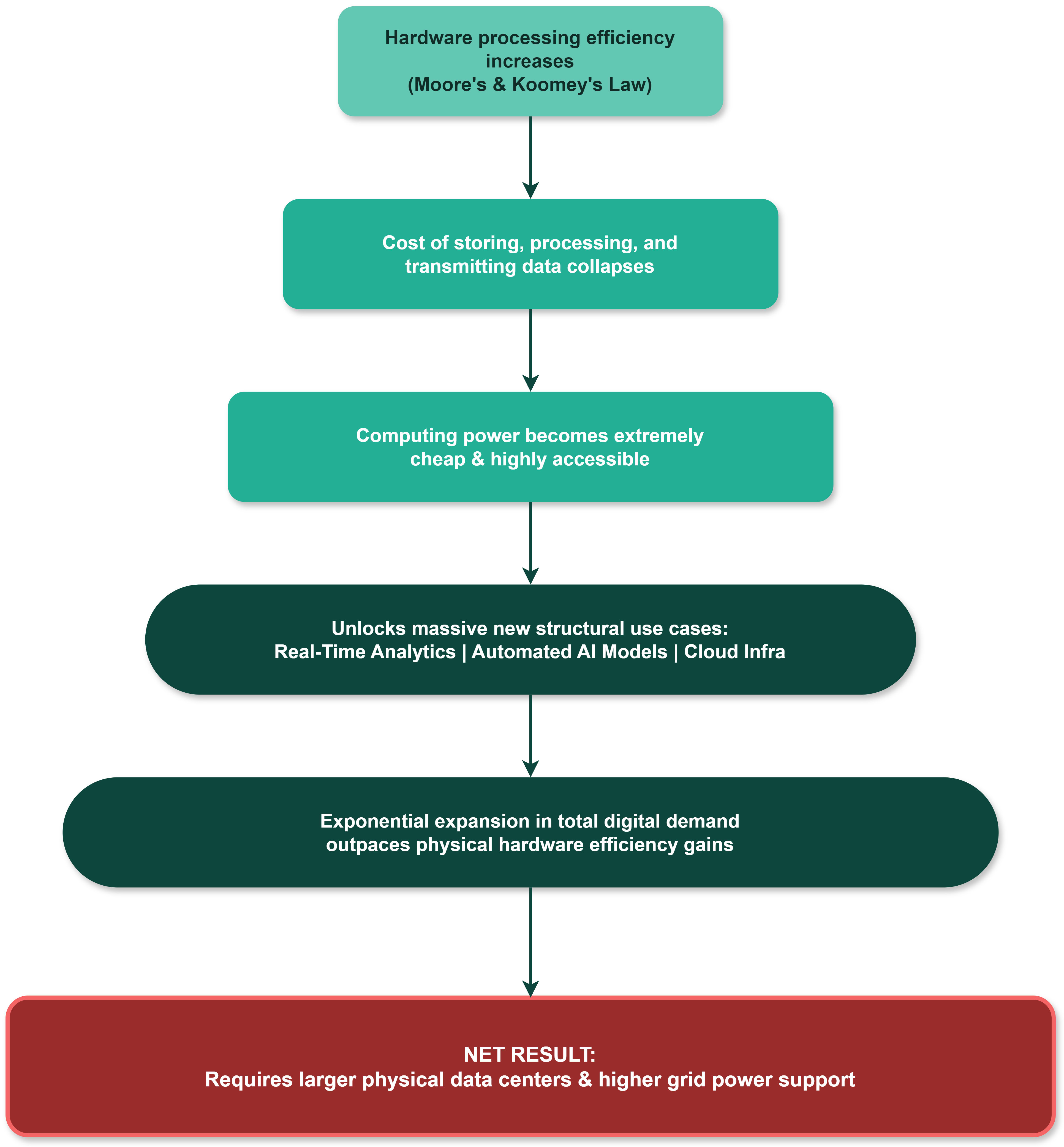
As processing hardware becomes exponentially more efficient, the cost of storing, processing, and transmitting a unit of data collapses.
Because computing power becomes remarkably cheap and accessible, digital efficiency does not shrink data center footprints. Instead, it unlocks entirely new use cases, such as real-time analytics, automated machine learning models, and massive cloud infrastructure. The exponential expansion in total digital demand outpaces the physical efficiency gains of hardware, requiring larger physical data centers and higher baseline power grids to support the additional infrastructure layer.
5. Designing a rebound-proof corporate strategy
To make sure that energy and resource efficiency actually cuts total emissions, rather than just funding extra business expansion, companies need to combine efficiency upgrades with smart economic guardrails.
Here are three tools to stop efficiency savings from turning into accidental consumption:
1. Internal carbon pricing
A company charges its own business departments an internal fee (for example, $50 or $100) for every ton of carbon they emit. When a department buys more efficient equipment, this fee absorbs a portion of the cash savings instead of letting operating bills plunge.
Why it stops rebound
Without a fee: When a machine becomes 50% more efficient, the energy cost to run it per hour cuts in half. Because operating costs plunge, running an extra shift becomes extremely profitable. Managers are tempted to add shifts or build new production lines—driving total energy use and carbon emissions right back up.
With a fee: The carbon fee adds an extra charge on top of energy use. When the machine becomes more efficient, its emissions drop, so the carbon fee drops too. However, because the fee inflates the overall cost of running the machine, the savings per hour are much smaller. Running extra shifts yields much slimmer profit margins, removing the financial incentive for managers to over-consume power.
Upside
Prepares the company for future government climate regulations. Paying a predictable internal fee today prevents financial shock when external carbon taxes arrive tomorrow.
Downside
It directly lowers short-term operating profit margins. Neutralizing a major rebound effect can require setting internal carbon fees quite high, which absorbs cost savings that department heads would prefer to retain in their operational budgets for hiring or expansion.
2. Hard resource caps (Cap-and-trade)
Executive leadership sets a strict, non-negotiable physical limit on the total tons of carbon, water, or raw materials an entire company (or facility) is allowed to consume. Under an internal cap-and-trade model:
Corporate management issues a fixed pool of internal emissions allowances to individual business units.
As a department implements efficiency upgrades, its actual resource use drops, leaving it with extra unused allowances.
The company lets departments trade these allowances internally. Units that need to expand production must buy extra allowances from units that saved resources—allowing the business to adjust operational budgets internally while keeping total company footprint strictly under the master cap.
Why it stops rebound
It creates an unbreakable physical ceiling on total corporate resource use. No matter how cheap or efficient a process becomes, an individual facility cannot expand production beyond its assigned allowance unless another division cuts its consumption to free up permits.
Upside
Banks and institutional ESG investors reward companies operating under clear, verifiable physical caps with lower borrowing costs and better financing terms.
Downside
It creates unpredictable internal budget expenses and capital rigidity. Business units that want to expand face unexpected costs buying allowances from other divisions. Furthermore, if executive leadership sets the internal cap too generously, allowances become worthless, failing to restrain departmental spending and letting rebound occur anyway.
3. Ring-fenced green re-spending
Cash saved from energy efficiency is locked into an internal revolving green fund. This money can only be spent on low-impact green projects, like buying renewable energy or upgrading insulation.
Why it stops rebound
It stops saved cash from being spent on high-emission business expansion like extra travel or bigger factories. Channeling re-spending into clean options cuts overall rebound significantly.
Upside
Turns sustainability into a self-funding business engine. Past energy savings automatically pay for the next wave of green upgrades, protecting sustainability budgets from corporate cost-cutting.
Downside
It takes away executive spending flexibility. Leadership loses the freedom to redirect efficiency savings into non-green, high-growth priorities like hiring, software, or marketing.
Takeaway
Stopping the rebound effect requires an explicit, conscious financial trade-off: accepting higher upfront equipment costs, tighter profit margins, and restricted cash flexibility in the short term.
In return, organizations gain regulatory protection, lower borrowing costs, predictable long-term energy boundaries, and real, lasting pollution cuts. Without paying these short-term costs, efficiency upgrades may fuel business expansion—leaving the company even more financially exposed to future carbon taxes and resource shortages.
Relevant Sources
The rebound effect report | UKERC | The UK Energy Research Centre
Frontiers | Moral Licensing—Another Source of Rebound?
Climate change mitigation potential of Norwegian households and the rebound effect
The rebound effect through industrial ecology’s eyes : the case of transport eco-innovation
The Rebound Effect and Energy Efficiency Policy
(PDF) Energy efficiency and rebound effects: a review
(PDF) The “energy rebound effect” within the framework of environmental sustainability
The paradox of irrigation efficiency | FSI
Energy Substitution, Technical Change and Rebound Effects
Energy efficiency and rebound effect in European road freight transport
(PDF) Rebound effects undermine carbon footprint reduction potential of autonomous electric vehicles
Digitalization and energy consumption. Does ICT reduce energy demand?
How to deal with the rebound effect? A policy-oriented approach - Maastricht University