


1. Introduction
Climate targets connect a company’s mitigation plan to the EU’s pathway to climate neutrality and the Paris goal of limiting warming to 1.5°C. ESRS E1 makes the link explicit: transition plans and business models must be compatible with a 1.5°C pathway and the EU Climate Law objective of climate neutrality by 2050.
When it comes to disclosing climate-related targets, the process can seem daunting. However, by breaking it down into manageable steps, you can ensure your company meets the necessary requirements while effectively communicating your climate goals.
What you’ll learn:
✅ What E1-6 requires from you
✅ Target-setting workflow
✅ Climate target examples from well-known companies
By the end, you’ll have a practical checklist to design, evidence, and present climate targets that meet ESRS E1.

2. What E1-6 requires from you
E1-6 requires you to disclose climate targets “in accordance with ESRS 2 GDR-T.” Practically, that means each target needs the basics: link to policy/actions, unit (absolute or relative), scope, baseline and base year, target year (plus milestones), methods, assumptions, and scenario references.
The main components that need to be disclosed are:
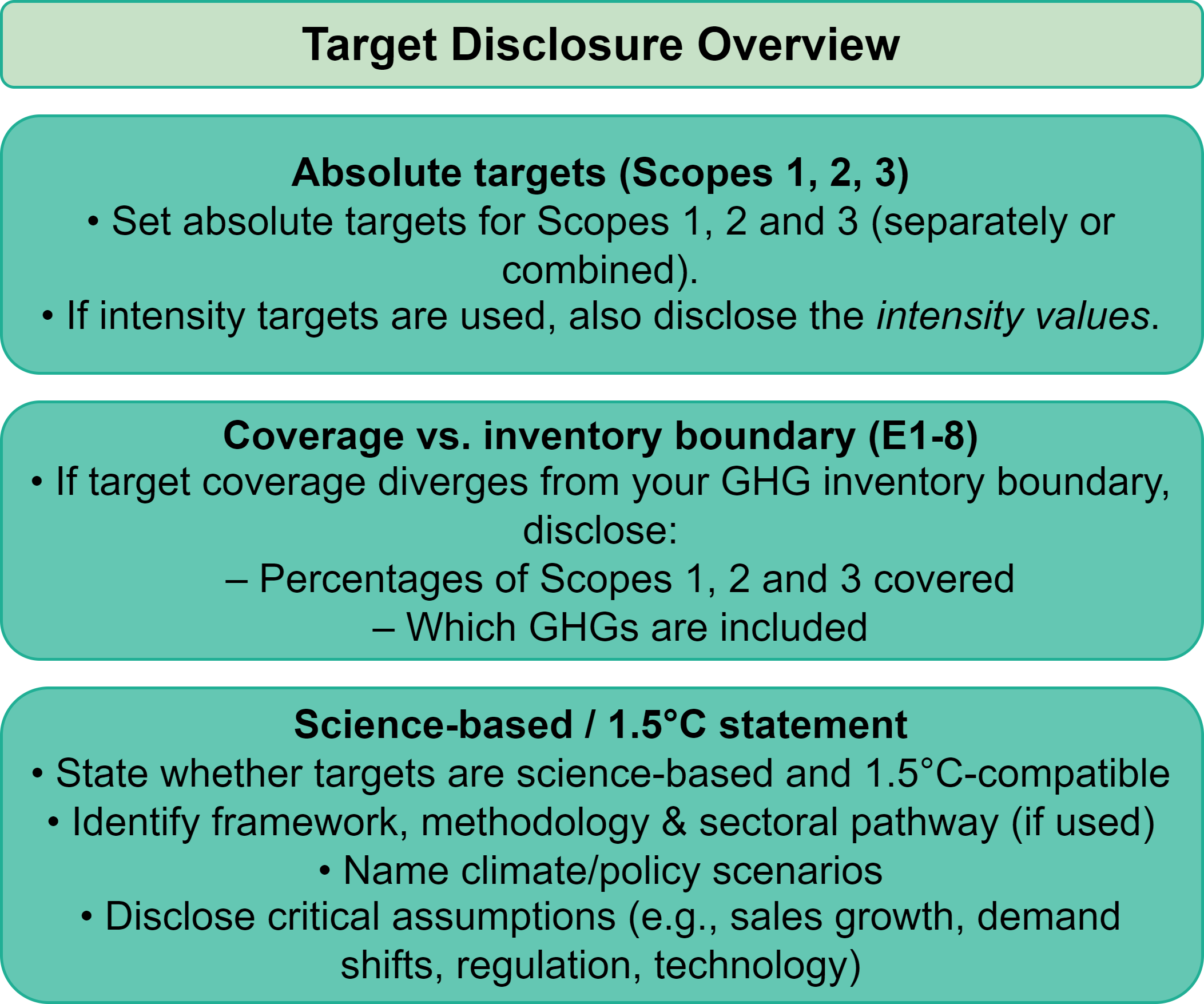
Some key concepts based on the disclosure and application requirements
Set absolute reduction targets by scope (and add intensity if helpful).
Disclose absolute GHG-reduction targets for Scope 1, Scope 2 and Scope 3, either separately or combined.
If combined, say which scopes are covered and the share for each. If the target’s scope differs from your emissions boundary (E1-8), disclose the % of Scopes 1/2/3 covered and which GHGs are included.
State if targets are science-based and 1.5°C-compatible.
Explain whether your targets are compatible with 1.5°C, the framework/methodology used, whether a sectoral pathway was applied, and the climate/policy scenarios. Briefly note critical assumptions (e.g., demand, regulation, technologies) that can change absolute emissions.
![[BREAKDOWN] E1-6: What is the Science Based Targets initiative (SBTi) and how does it work?](https://substackcdn.com/image/fetch/$s_!rTGI!,w_140,h_140,c_fill,f_webp,q_auto:good,fl_progressive:steep,g_auto/https%3A%2F%2Fsubstack-post-media.s3.amazonaws.com%2Fpublic%2Fimages%2F20657086-78d5-4c2d-948b-8af47f39625e_2048x2048.jpeg)
Respect the “gross target” rule.
Targets must be gross: do not count removals, carbon credits or avoided emissions toward meeting your reduction level.
If you use intensity, still show absolute numbers.
You may set intensity targets, but if you only use intensity you must also disclose the associated absolute values for the target year and interim year(s)—even if absolute emissions rise with growth.
Choose and keep a recent base year.
Do not change the baseline or base year unless target or reporting boundaries change. Pick a recent base year (no earlier than three years before the first reporting year of the new target period, with a pre-2030 allowance).
Show targets with actions if helpful.
You may present targets alongside mitigation actions, showing decarbonisation levers and their quantitative contributions, either as a list, a table, or a graphic over time.
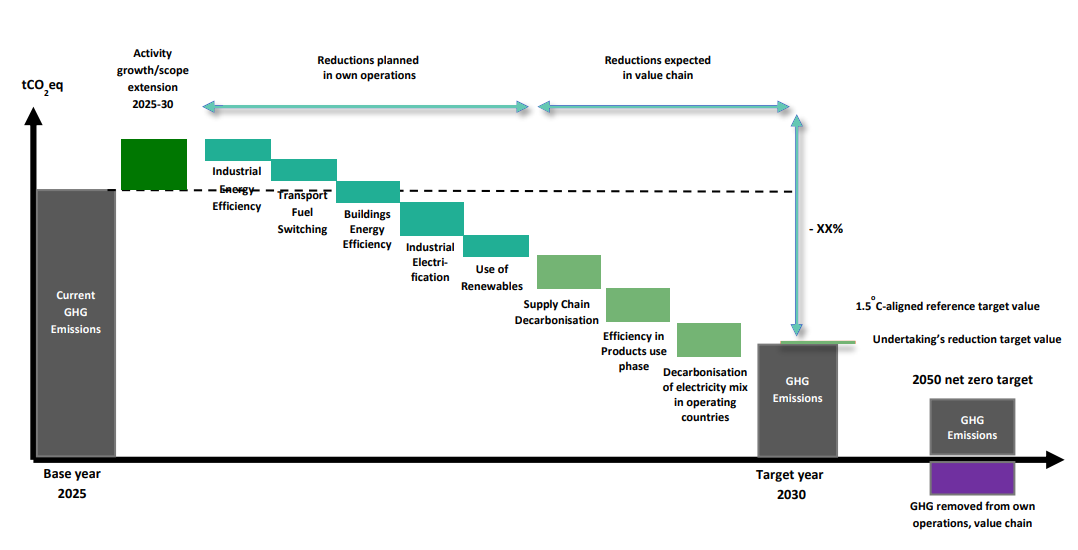
Match boundaries where relevant.
If you report E1-8 using an operational control boundary, you may set Scope 1–2 targets against that boundary.
Compare your targets to a 1.5°C pathway.
Calculate a 1.5°C-aligned reference target value for Scopes 1–2 (and separately for Scope 3 if you have Scope 3 targets) and compare your own target values against it.
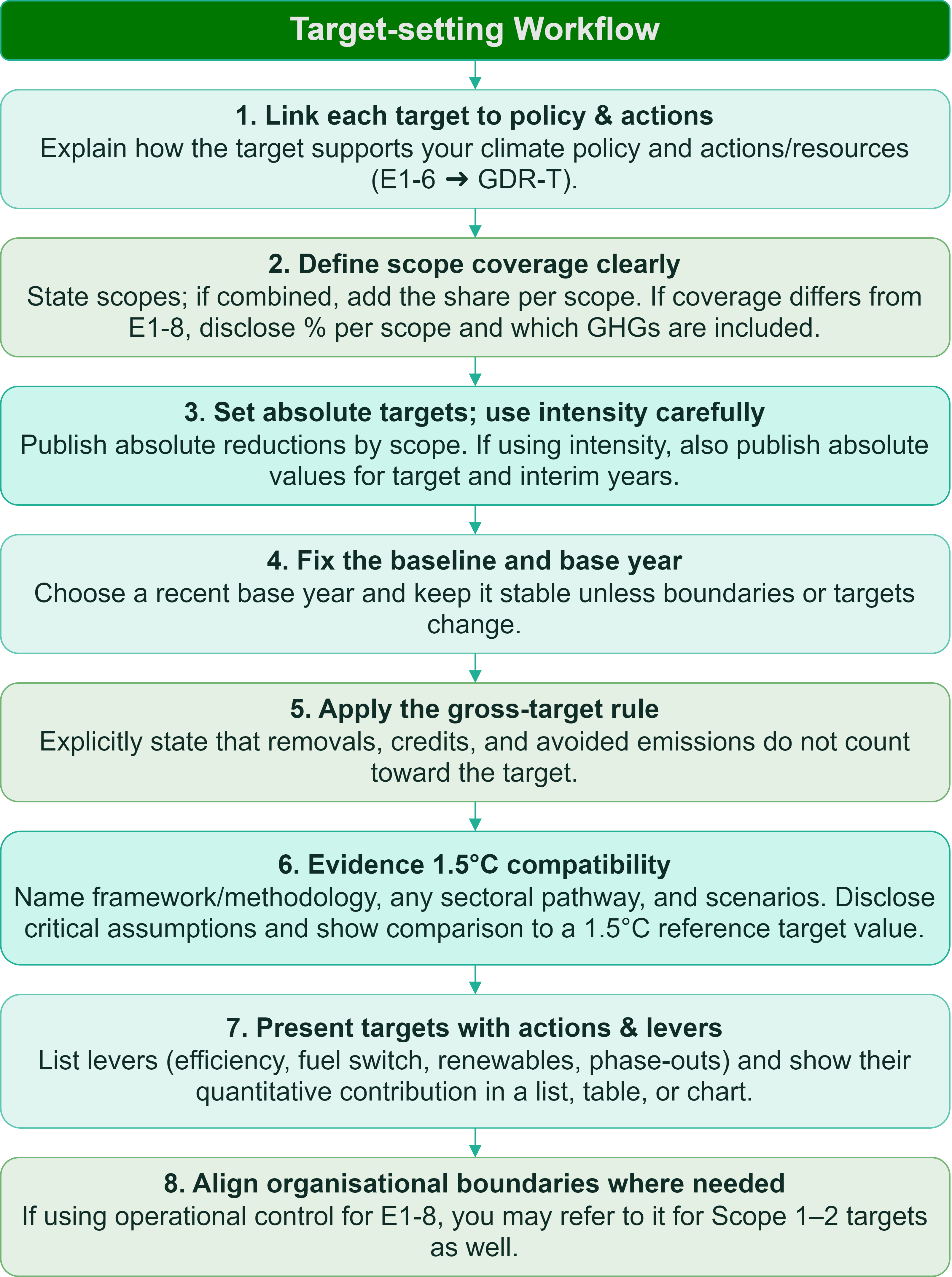
3. Target-setting workflow
Here is a workflow you can use to set your targets:
4. Climate target examples from well-known companies
Microsoft
This blog from 2020 goes beyond corporate pledges by providing a detailed, science-based action plan backed by measurable targets, clear timelines, and significant financial investment. It also combines Microsoft’s own operational changes with initiatives to help other organizations reduce their carbon footprints, aiming for systemic, industry-wide impact.
Microsoft will be carbon negative by 2030 - The Official Microsoft Blog
Maersk
This blog explains Maersk’s commitment to achieving net-zero greenhouse gas emissions across its value chain by 2040. Maersk’s plan is very detailed, breaking down targets by scope, operational segment, and even well-to-wake shipping emissions, while linking them to concrete investments and procurement strategies.
Climate Change | Sustainability and ESG | Maersk
Apple
Apple’s Apple 2030 plan aims to bring the company’s entire carbon footprint to net zero by 2030 through recycled and renewable materials, clean electricity, and lower-carbon shipping. The company reports major progress, including a 60% reduction in CO₂e emissions since 2015. Apple’s program links product innovation directly to environmental goals, showing how design, packaging, manufacturing, and customer energy use are all part of the decarbonisation strategy.