


1. Introduction
While most climate disclosures focus on reducing emissions, E1-9 looks at the other side of the equation — removing greenhouse gases (GHGs) from the atmosphere and funding carbon reduction projects outside your own operations.
This disclosure explains what removals you achieve, how permanent they are, and what carbon credits you use or plan to use.
The goal is transparency: readers should clearly see how much of your progress comes from cutting your own emissions versus relying on external offsetting projects.
I will briefly explain the requirements for companies to disclose their GHG removals and GHG mitigation projects financed through carbon credits.
More elaborate articles are available, which can be found below.

2. What are GHG removals and carbon credits?
GHG removals happen when carbon dioxide or other greenhouse gases are taken out of the atmosphere and stored — either by nature (for example, trees or soil capturing carbon) or by technology (such as carbon capture and storage, or direct air capture).
Carbon credits represent one tonne of CO₂ (or equivalent) that has been avoided or removed elsewhere. Companies can buy and cancel these credits to compensate for some of their own emissions.
However, under ESRS, credits cannot be counted toward your emission reduction targets (E1-6). You must report them separately here to avoid double-counting.
The ESRS defines a carbon credit as follows:
“A transferable or tradable instrument that represents one metric tonne of CO2eq emission reduction or removal and is issued and verified according to recognised quality standards.”
And the ESRS defines a GHG removals as follows:
“(Anthropogenic) removals refer to the withdrawal of GHGs from the atmosphere as a result of deliberate human activities. These include enhancing biological anthropogenic sinks of CO2 and using chemical engineering to achieve long-term removal and storage. Carbon capture and storage (CCS) from industrial and energy-related sources, which alone does not remove CO2 from the atmosphere, can remove atmospheric CO2 if it is combined with bioenergy production (Bioenergy with Carbon Capture & Storage - BECCS). Removals can be subject to reversals, which are any movement of stored GHG out of the intended storage that re-enters the atmosphere. For example, if a forest that was grown to remove a specific amount of CO2 is subject to a wildfire, the emissions captured in the trees are reversed.”
3. ESRS E1-9 at a glance
E1-9 asks companies to disclose information on:
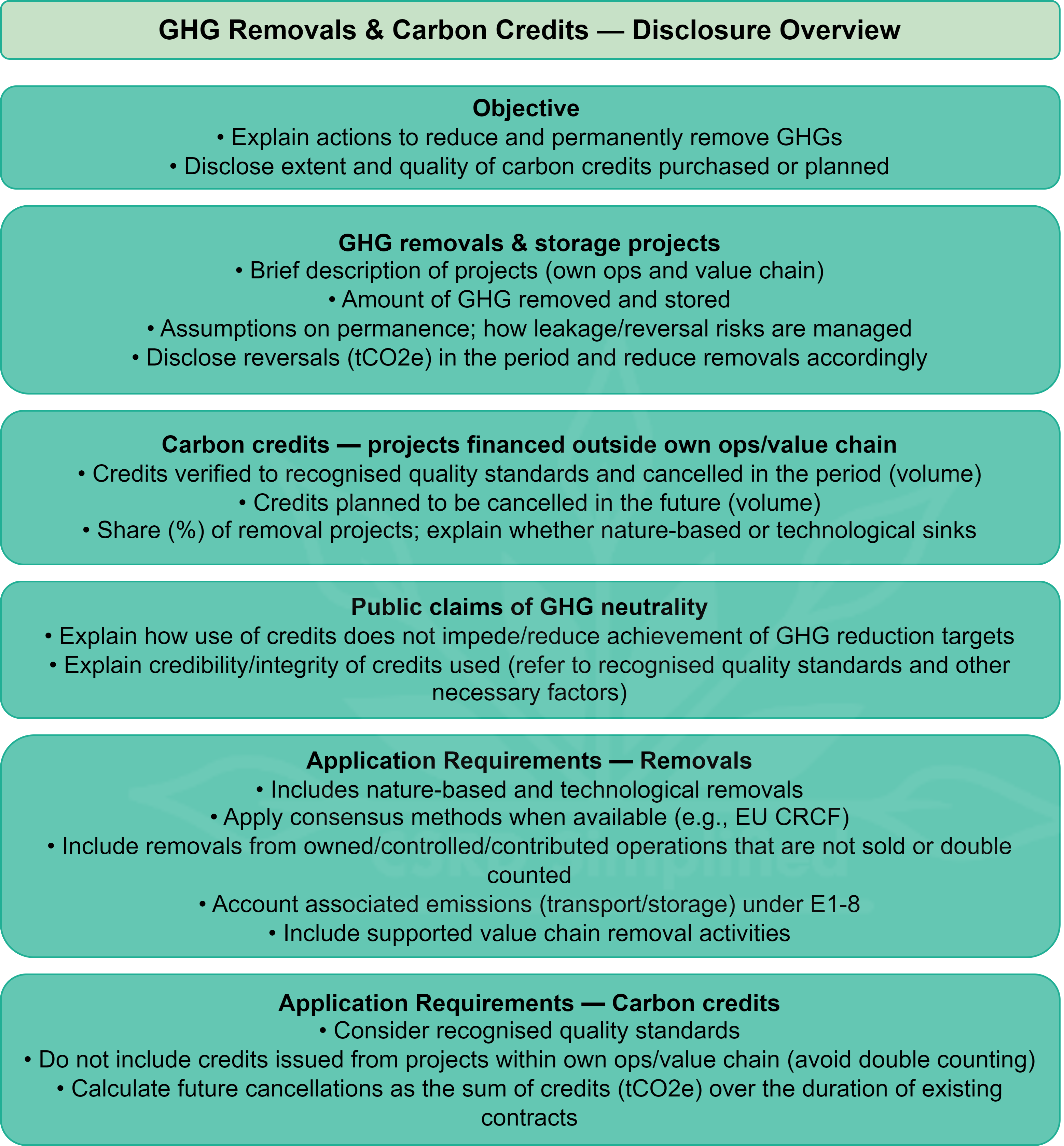
Read more about carbon removals, credits and mitigation (and the differences between them) here:
![[BREAKDOWN] E1-9: Carbon removals, credits & mitigation](https://substackcdn.com/image/fetch/$s_!rTGI!,w_140,h_140,c_fill,f_webp,q_auto:good,fl_progressive:steep,g_auto/https%3A%2F%2Fsubstack-post-media.s3.amazonaws.com%2Fpublic%2Fimages%2F20657086-78d5-4c2d-948b-8af47f39625e_2048x2048.jpeg)
4. How E1-9 links to the rest of ESRS E1
E1-8 (GHG emissions) shows your total footprint.
E1-9 (removals and credits) shows how much is taken back out of the atmosphere or financed externally.
E1-6 (targets) and E1-1 (transition plan) explain how these removals fit (or don’t) into your long-term decarbonisation pathway.
This ensures transparency between genuine emission reductions and compensatory mechanisms like carbon credits.
5. Bottom line
E1-9 helps separate real emission cuts from offsetting activities. To meet the requirements and maintain credibility:
Disclose both removals and purchased credits clearly and separately.
Explain permanence and quality — how reliable are your projects or credits?
Avoid double counting between your own removals and external offsets.
Done well, this disclosure shows stakeholders that your company understands the limits of offsetting and is building a balanced approach: reduce first, remove second, and offset only where unavoidable.