


1. Introduction
Behind every credible climate strategy are the policies that turn intent into daily action. E1-4 asks companies to describe those policies — the official rules, principles, and commitments that guide how they deal with climate change.
This disclosure is short but important: it connects your overall sustainability governance (ESRS 2) to your climate-specific actions (E1-5) and targets (E1-6).
I will briefly explain the requirements for companies to disclose their policies in relation to climate change.
More elaborate articles are available, which can be found below.

2. What is a climate policy?
A climate policy is a statement of how your company intends to manage and reduce its greenhouse gas (GHG) emissions, adapt to climate risks, and align its business with the goals of the Paris Agreement.
Typical examples include:
Internal policies to cut GHG emissions or improve energy efficiency
Rules for sourcing renewable energy or sustainable materials
Policies on business travel, fleet management, or product design
Supplier or investment criteria linked to climate performance
Commitments to phase out or transform carbon-intensive activities
The policy should show how climate considerations are built into your decision-making, not treated as an add-on.
The ESRS defines a policy as follows:
“A set or framework of general objectives and management principles that the undertaking uses for decision-making. A policy implements the undertaking’s strategy or management decisions related to a material sustainability topic. Each policy is under the responsibility of defined person(s), specifies its perimeter of application, and includes one or more objectives (linked when applicable to measurable targets). A policy is validated and reviewed following the undertakings’ applicable governance rules. A policy is implemented through actions or action plans.”
3. ESRS E1-4 at a glance
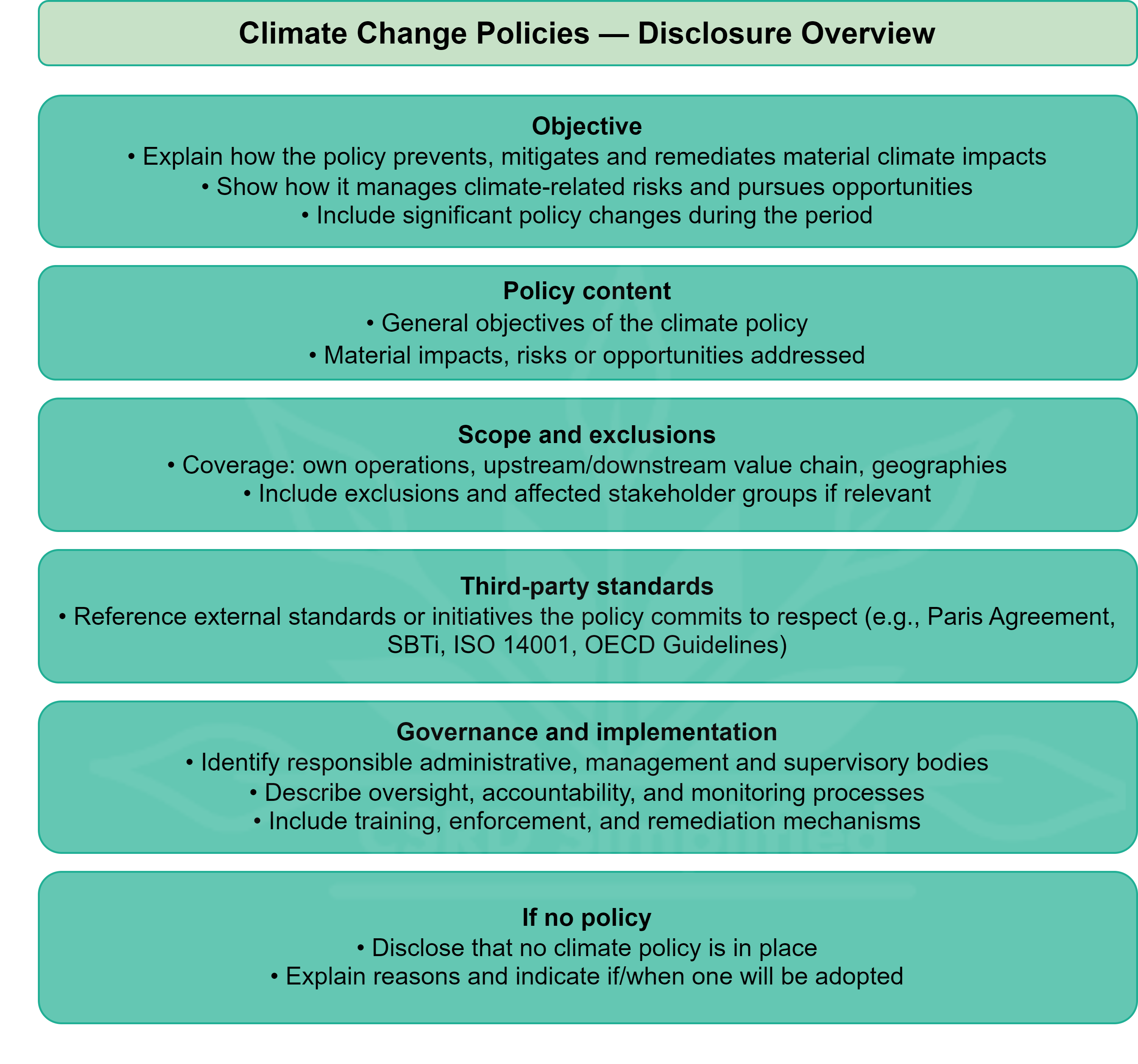
E1-4 requires companies to disclose their climate change policies in line with the general rule for policies in ESRS 2 GDR-P
Read about who owns the climate policy in the C-suite here:
More articles coming soon!
![[BREAKDOWN] E1-4: Who owns climate policy in the C-suite? CFO, CSO, or CEO?](https://substackcdn.com/image/fetch/$s_!rTGI!,w_140,h_140,c_fill,f_webp,q_auto:good,fl_progressive:steep,g_auto/https%3A%2F%2Fsubstack-post-media.s3.amazonaws.com%2Fpublic%2Fimages%2F20657086-78d5-4c2d-948b-8af47f39625e_2048x2048.jpeg)
4. How E1-4 links to the rest of ESRS E1
E1-4 (policies) sets out your rules and commitments.
E1-5 (actions and resources) shows how you carry them out.
E1-6 (targets) defines what success looks like.
E1-1 (transition plan) brings all of these elements together in a strategic roadmap.
Together, they give readers confidence that your climate strategy is backed by clear governance and policies applied consistently across the business.
5. Bottom line
E1-4 is your opportunity to show that climate responsibility is built into company policy. To comply and communicate well:
Write or update a clear climate policy with defined goals, scope, and references to credible standards.
Show alignment with your transition plan, actions, and targets.
Be transparent about what’s covered, what isn’t, and what’s changing.
A strong, well-defined climate policy transforms your climate strategy from words into a functioning system that investors, employees, and regulators can trust.