


1. Introduction
Climate change brings risks to companies today. Floods, heatwaves, supply chain disruptions, and stricter climate rules all affect business operations and financial performance.
E1-2 requires companies to explain how they identify, assess and analyse these climate-related risks. The idea is simple: investors, regulators and other stakeholders need to know how vulnerable your business is, and what tools you use to test your resilience under different possible futures.
I will briefly explain the requirements for companies to disclose their climate-related risks and scenario analysis.
More elaborate articles are available, which can be found below.

2. What are climate-related risks?
Risks fall into two main groups:
Physical risks: harm caused by climate hazards like storms, floods, heatwaves, sea-level rise or drought.
Transition risks: changes linked to the shift towards a climate-neutral economy — for example, stricter emissions regulations, carbon pricing, shifting customer demand, or rapid technology change.
E1-2 asks you to show how you classify your risks into these categories and what methods you use to assess them.
The ESRS defines these risks as follows:
“Climate-related physical risk
Risks resulting from climate change that can be event-driven (acute) or from longer-term shifts (chronic) in climate patterns. Acute physical risks arise from particular hazards, especially weather-related events such as storms, floods, fires or heatwaves. Chronic physical risks arise from longer-term changes in the climate, such as temperature changes, and their effects on rising sea levels, reduced water availability, biodiversity loss and changes in land and soil productivity.Climate-related transition risk
Risks that arise from the transition to a low-carbon and climate-resilient economy. They typically include policy risks, legal risks, technology risks, market risks and reputational risks.”
3. What is scenario analysis?
Scenario analysis is a tool to explore “what if” futures. Instead of predicting one outcome, you test your business against different plausible climate and policy scenarios. Examples:
A 1.5°C scenario (Paris Agreement-aligned) with rapid decarbonisation.
A high-emissions scenario with little global action, leading to severe physical impacts.
By applying scenarios, companies can show how their assets, supply chains and financial results would hold up under both best- and worst-case conditions.
The ESRS defines scenario analysis as follows:
“A process for identifying and assessing a potential range of outcomes of future events under conditions of uncertainty.”
4. ESRS E1-2 at a glance
Under E1-2 you must disclose:
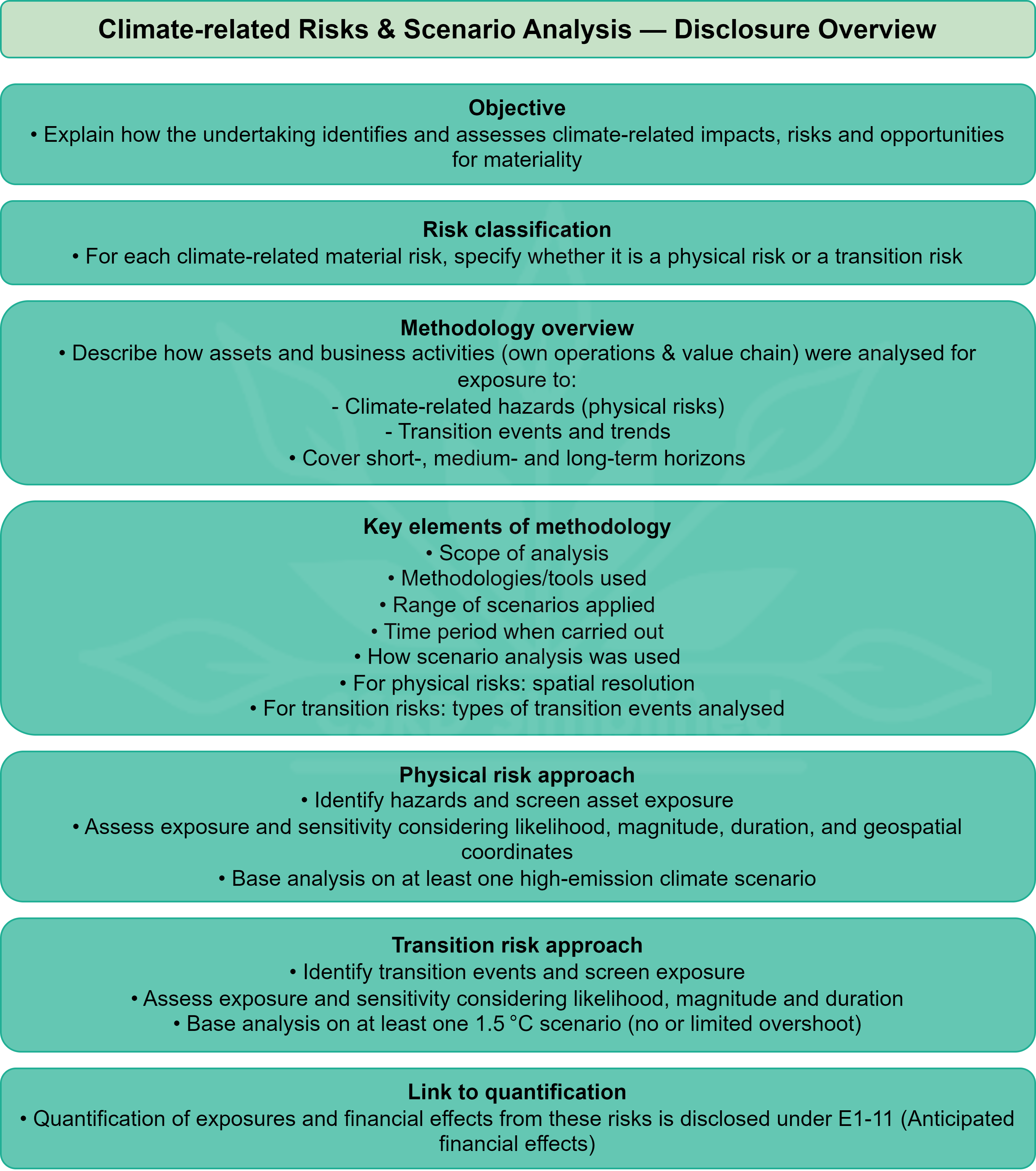
Read what climate scenarios are here:
Read about scenario analysis with the TCFD here:
![[BREAKDOWN] E1-2: What are climate scenarios?](https://substackcdn.com/image/fetch/$s_!rTGI!,w_140,h_140,c_fill,f_webp,q_auto:good,fl_progressive:steep,g_auto/https%3A%2F%2Fsubstack-post-media.s3.amazonaws.com%2Fpublic%2Fimages%2F20657086-78d5-4c2d-948b-8af47f39625e_2048x2048.jpeg)
5. How E1-2 links to the rest of ESRS E1
The results of E1-2 feed directly into E1-3 (resilience), which asks how prepared your strategy is for these risks.
They also connect to E1-11 (financial effects), where you must quantify how risks and opportunities affect your balance sheet and revenue.
Together with E1-1 (transition plan), these disclosures show whether your strategy is credible, resilient, and financially sound.
6. Bottom line
E1-2 pushes companies to move from general statements about climate risk to transparent, structured analysis. To comply, focus on:
Naming your key physical and transition risks clearly.
Explaining how you assessed them — including the scenarios and tools used.
Showing time horizons and geographic detail where relevant.
If done well, this disclosure shows investors and regulators that your company isn’t just aware of climate risks, but is actively preparing for a range of possible futures.