


1. Introduction
Materiality assessment is the foundation of sustainability reporting under the European Sustainability Reporting Standards (ESRS). Understanding what to disclose is important for companies to align with these standards. In this article we will explain how you can determine what to disclose once you have performed your materiality assessment. How to perform the materiality assessment is covered in another article.

2. What to disclose?
The flowchart provides a step-by-step guide for companies on how to determine what information they need to disclose under the ESRS.
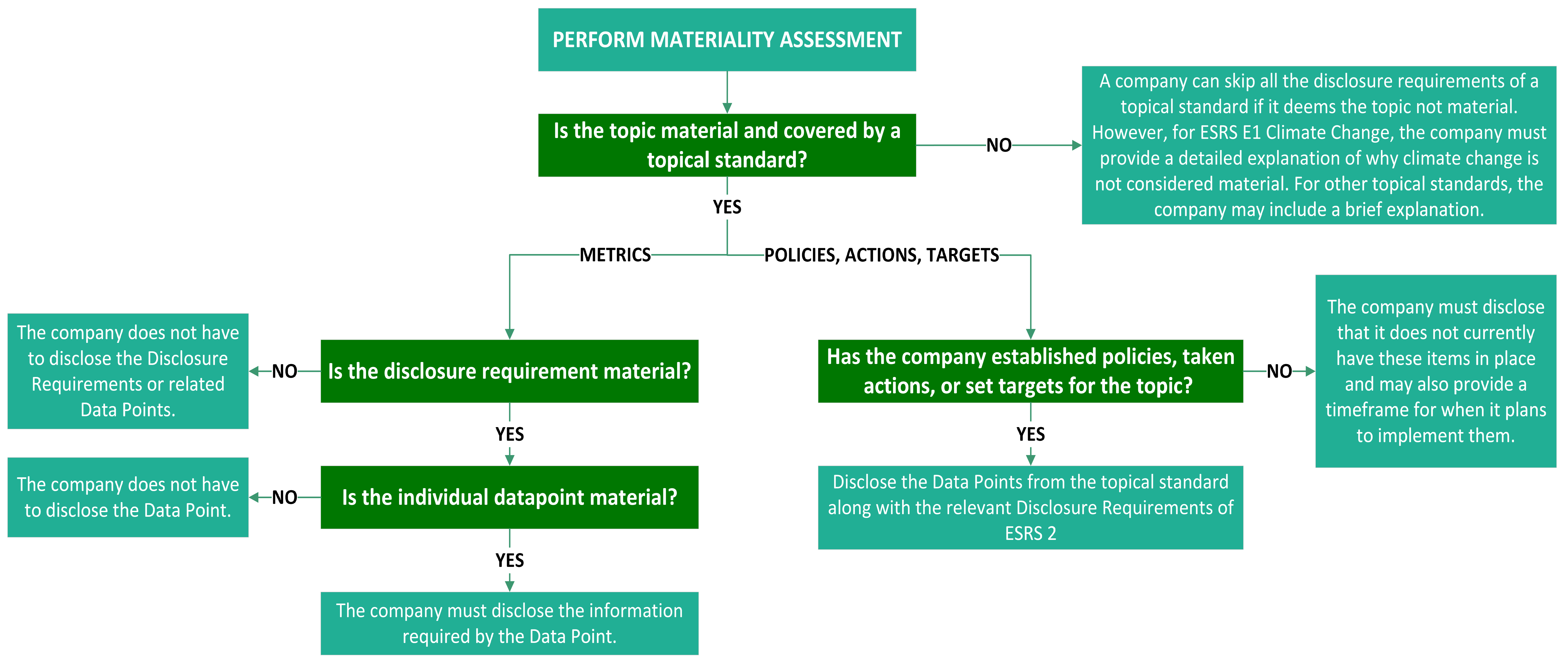
Here's a breakdown of the flowchart:
Perform materiality assessment: The first step is to perform a materiality assessment. This process helps the company determine which sustainability topics are material (important or significant) to their business.
Is the topic material and covered by a topical standard?
Yes: If the topic is material and covered by a topical standard, the company moves forward to assess the specific disclosure requirements related to metrics, policies, actions, and targets.
No: If the topic is not material or not covered by a topical standard, the company can skip all the disclosure requirements for that topic. However, if the topic is climate change (under ESRS E1), the company must provide a detailed explanation of why it deems climate change as not material. For other topics, the company may include a brief explanation of why the topic is not material.
Has the company established policies, taken actions, or set targets for the topic?:
Yes: If the company has established policies, taken actions, or set targets for the topic, it should disclose the Data Points from the topical standard along with the relevant Disclosure Requirements of ESRS 2 (as referenced in ESRS 2 Appendix C).
No: If the company has not established policies, taken actions, or set targets, it must disclose that it does not currently have these items in place. Additionally, the company may also provide a timeframe indicating when it plans to implement them.
Is the disclosure requirement material?:
Yes: If the specific disclosure requirement is material, the company proceeds to the next step.
No: If the specific disclosure requirement is not material, the company does not have to disclose the Disclosure Requirements (DRs) or the related Data Points (DPs).
Is the individual data point material?:
Yes: If the individual data point is material, the company must disclose the information required by the Data Point (DP).
No: If the individual data point is not material, the company does not have to disclose the Data Point.
This flowchart guides companies through the decision-making process regarding what sustainability information needs to be disclosed.
3. Conclusion
Navigating the disclosure requirements under the ESRS can seem daunting, but understanding the materiality assessment process and the corresponding disclosure obligations is the first step. By following the guidelines outlined in this article, you know what and what not to disclose. Be aware, the goal is not just compliance but also to provide meaningful insights into how your company addresses sustainability issues, thereby enhancing transparency and accountability.
Relevant Standards
ESRS 1
Appendix E: Flowchart for determining disclosures under ESRS
Materiality assessment is the starting point for sustainability reporting under ESRS. This appendix provides a non-binding illustration of the impact- and financial materiality assessment outlined in chapter 3. IRO-1 in section 4.1 of ESRS 2 includes general disclosure requirements (DR) about the undertaking’s process to identify impacts, risks and opportunities and assess their materiality. SBM-3 of ESRS 2 provides general disclosures requirements on the material impact, risks and opportunities resulting from the undertaking’s materiality assessment. The undertaking can omit all disclosure requirements in a topical standard if it assessed that the topic in question is not material. In that case it may disclose a brief explanation of the conclusions of the materiality assessment for that topic but shall disclose a detailed explanation in the case of ESRS E1 climate change (IRO-2 ESRS 2). ESRS set disclosure requirements, not behavioral requirements. Disclosure requirements in relation to action plans, targets, policies, scenario analysis and transition plans are proportionate because they are contingent on the undertaking having these, which may depend on the size, capacity, resources, and skills of the undertaking. Note: The flowchart below does not cover the situation in which the undertaking assesses a sustainability matter as material but it is not covered by a topical standard, in which case the undertaking shall make additional entity specific disclosures (ESRS 1 (30 (b)).