1. Introduction
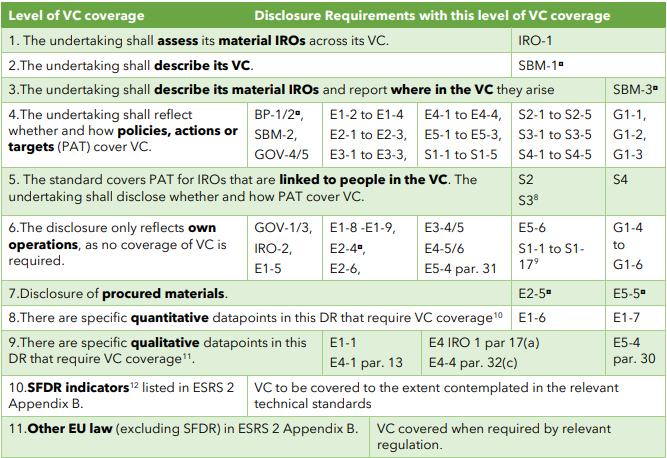
Companies are mandated to provide a comprehensive view of their sustainability impacts. This requirement includes not only direct operations but also the entire value chain. The rationale is that significant environmental, social, and governance (ESG) impacts often occur outside a company’s direct operations, in areas such as supplier practices or product disposal. In the context of the ESRS, the value chain is used to assess and report on all material impacts, risks, and opportunities (IROs). This approach makes sure that companies are accountable for their entire footprint.
A value chain consists of all the activities and processes involved in creating a product or service, from sourcing raw materials to delivering the final product to the customer. It includes upstream activities like procurement and production, and downstream activities such as distribution and sales. Essentially, the value chain represents the journey of a product or service through various stages and stakeholders.
In this article we will explore the requirements and boundaries of the value chain.

2. Requirements
The ESRS does not provide a standard format for value chains. It even indicates that one company might have multiple value chains. What it does provide however, are guidelines and requirements on what a value chain should contain, which will be discussed in this section.
What Components are Required in a Value Chain?
To comply with ESRS, a value chain must cover among others:
Upstream activities: These include processes involved in sourcing raw materials and components, including suppliers’ practices and the environmental and social impacts associated with them.
Own activities: This consists of the company’s own production and manufacturing processes, such as energy use, waste management, and labor practices.
Downstream activities: These involve the distribution, sale, use, and disposal of the product or service, such as the impacts on customers and end-users.
So, when thinking about the value chain one might think of many nodes linked with each other to create value:
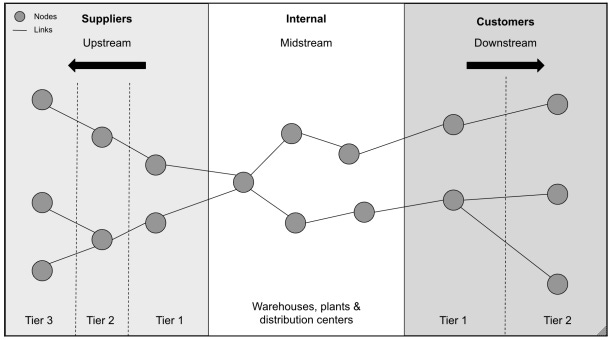
But, a value chain in the context of the ESRS is not limited to its activities. It also includes resources and relationships the company uses to create its products or services. For example, a company might have a relationship with a bank in case it needs a loan. Therefore, it is important to map the different stakeholders a company has to the value chain.
Besides, the activities and stakeholders it is essential to understand the broader contexts in which the business operates. These contexts include the financing, geographical, geopolitical, and regulatory environments.
Financing Environment
The financing environment consists of the financial systems and conditions that affect how a company accesses and manages capital. This can include interest rates, availability of credit, investor sentiment, and overall economic stability. For example:
Capital access: The ease with which a company can obtain financing affects its ability to invest in sustainable practices and technologies.
Cost of capital: Interest rates and investor expectations influence the cost of borrowing and the availability of funds for sustainability projects.
Financial stability: Economic conditions can impact consumer spending and investment, which in turn can affect the entire value chain.
Geographical Environment
The geographical environment refers to the physical location and natural characteristics of the areas where a company operates. This can include climate, topography, natural resources, and local ecosystems. For example:
Resource availability: Natural resources are essential for production processes, and their availability can vary significantly by location.
Environmental risks: Natural disasters and climate change can disrupt operations and supply chains, posing risks to the value chain.
Geopolitical Environment
The geopolitical environment includes the political and international relations dynamics that affect business operations. This includes trade policies, political stability, international conflicts, and diplomatic relations. For example:
Trade regulations: Tariffs, trade agreements, and import/export restrictions can affect the cost and availability of materials and products.
Political stability: Political unrest or instability can disrupt operations, supply chains, and market access.
International relations: Diplomatic relationships between countries can influence market opportunities and risks.
Regulatory Environment
The regulatory environment consists of the laws, regulations, and standards that govern business practices. This can include environmental regulations, labor laws, health and safety standards, and industry-specific regulations. For example:
Compliance requirements: Companies must adhere to various regulations, which can dictate operational practices and reporting standards.
Legal risks: Non-compliance can result in fines, legal actions, and reputational damage.
All these components together are important because they provide a full picture of a company. By having this full picture, companies can identify and address significant IROs that occur not only inside, but also outside their immediate control.
The ESRS does not mandate a specific value chain format.. However, it requires covering upstream activities, own activities, and downstream activities, as well as including resources, relationships, and broader contexts like financing, geographical, geopolitical, and regulatory environments.
3. Boundaries
When starting to work on the value chain, one might get overwhelmed. A company might have dozens of suppliers, customers, and stakeholders. Therefore, it is important to make the value chain not too detailed. But, at the same time it is essentail to not omit any important information in the value chain. To effectively set the boundaries of your value chain, engage with various employees and optionally also stakeholders.
Supply chain managers can help to understand sourcing practices and supplier impacts. Production managers can give insights into manufacturing processes and resource use. Sales and distribution teams can provide information about product distribution and customers. Legal team members can inform about the regulatory environment. Chief Financial Officer can give information about the financing environment. And so on.
Together with employees and stakeholders the key activities can be identified by mapping out all stages from raw material sourcing to end-user disposal. Afterwards, suppliers, production processes, and clients can be grouped into different categories. Of these categories the most important can be included in the value chain:
Include: All stages and activities that have significant ESG impacts, whether direct or indirect. This typically covers major suppliers, key production processes, and significant distribution and sales channels.
Exclude: Activities and stages with negligible impacts or those outside the company's influence, provided these exclusions do not omit significant IROs. It’s important to justify any exclusions transparently.
4. Conclusion
Creating a value chain for ESRS compliance is important for capturing the full scope of a company's sustainability impacts. This involves mapping upstream, own, and downstream activities and considering broader contexts such as financing, geographical, geopolitical, and regulatory environments. Engaging key employees helps set accurate boundaries and identify significant impacts. While the ESRS does not mandate a specific format, it requires a comprehensive value chain.
In an upcoming article, we will explore how companies can create a value chain. Subscribe to stay updated.