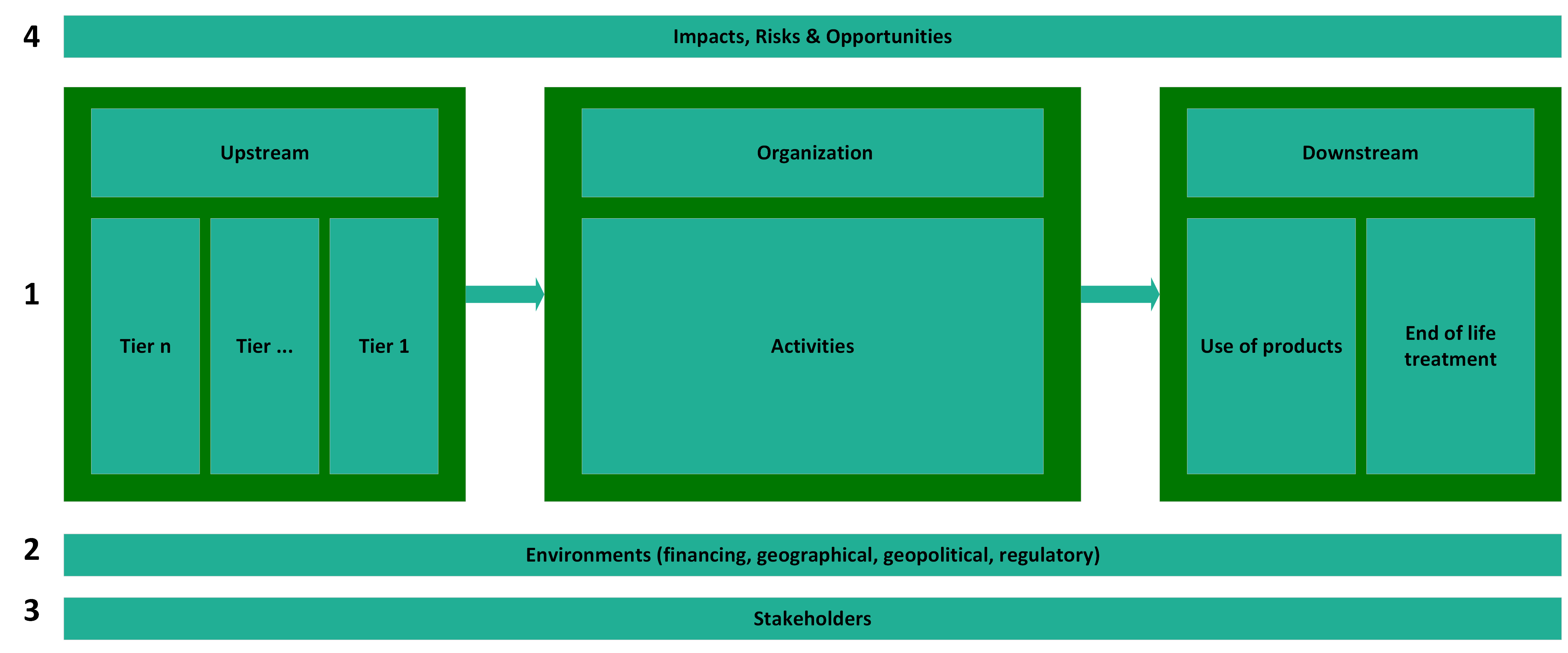
Creating a value chain should be the first step in understanding and reporting your company's environmental, social, and governance (ESG) impacts. In a previous article we explained what the value chain is (click here for the article). This guide will walk you through the process of making a comprehensive value chain covering:
your organization, upstream and downstream activities,
relevant environments,
stakeholders,
and important impacts, risks, and opportunities.
In this article we will create a value chain by using the example of a car manufacturing company.
2. Value Chain
The first step in creating a value chain focuses on own organization, upstream and downstream activities. This information will be used as a foundation for the following steps.
Own organization
While information about upstream and downstream activities can be collected in parallel, it is best first to map out the activities within your organization. This provides a clear picture that will inform the subsequent mapping of upstream and downstream activities.
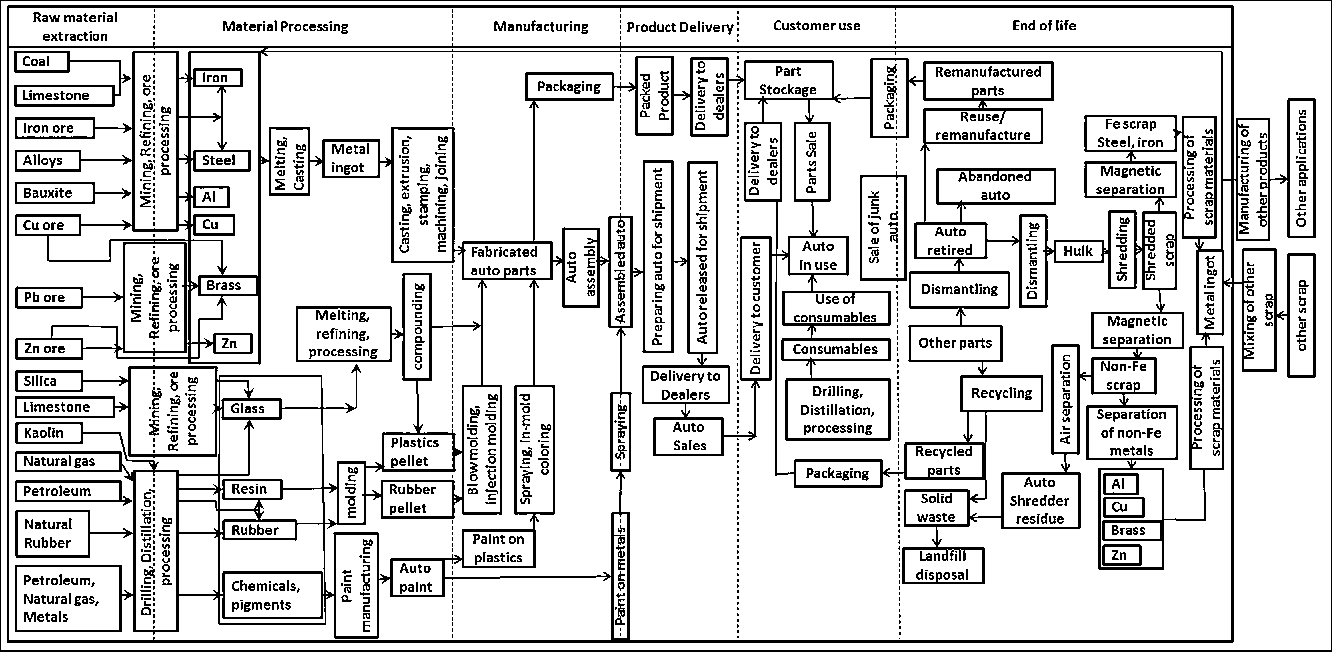
For the activities of your company, you can choose from a detailed mapping to a high-level overview. Each approach has its pros and cons. A detailed mapping offers deep insights into specific processes. But, making one is time-consuming and can result in a complex, less intuitive value chain that is harder to understand:
An overview that is high level is easier to understand and quicker to create. But, may overlook important details and nuances critical to identifying significant impacts, risks, and opportunities:
For an effective value chain, strike a balance between detail and simplicity to ensure it is both comprehensive and understandable. Keep in mind that you should be able to extract information about environments, stakeholders, and IRO from the value chain.
To map out the activities of your own organization effectively, engage with employees who have extensive knowledge of various operations, such as production managers. Then, try to make a value chain with 1-5 the activities with 3 - 8 steps.
Example car manufacturer
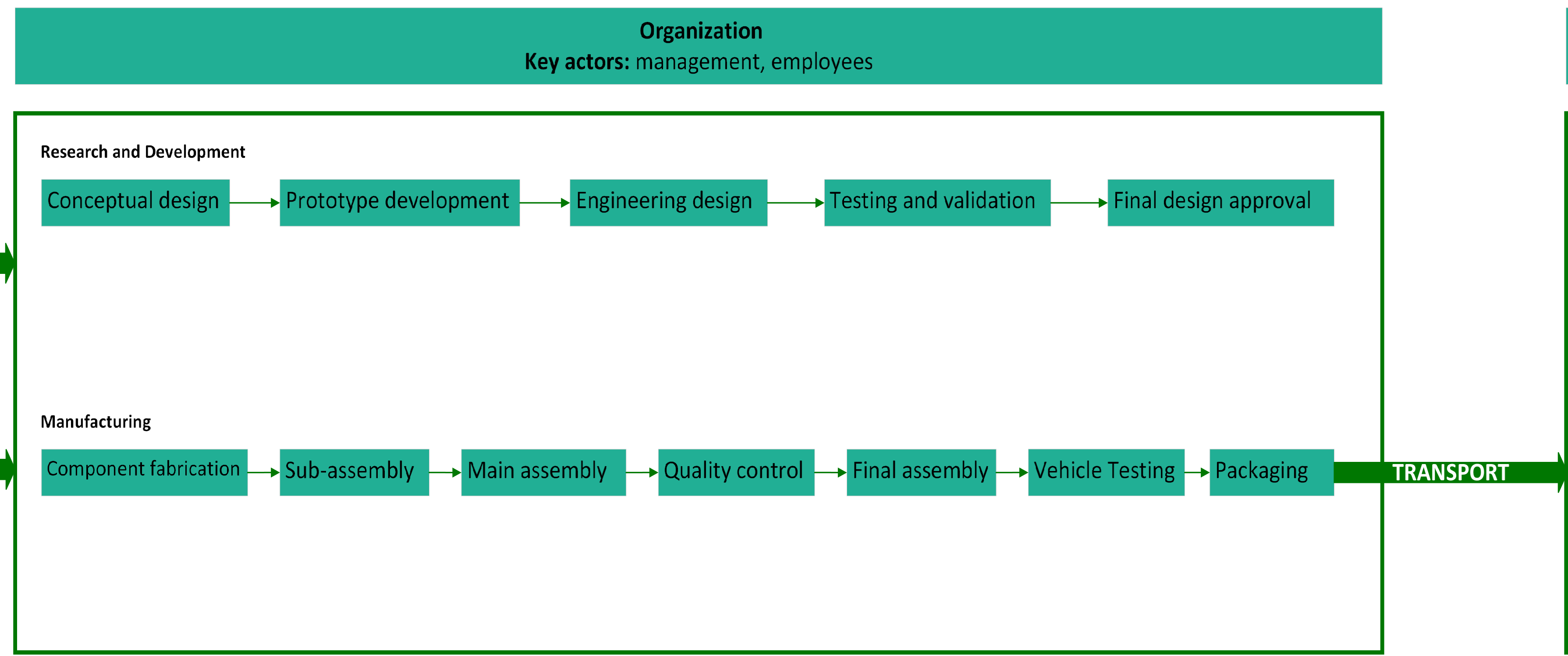
While a car company might have more activities, such as logistics and after-sales services. We will look into the following activities:
Research and Development (R&D):
Designing and developing new car models.
Innovating in automotive technology.
Manufacturing:
Assembling car components in plants.
Conducting quality control and testing.
Upstream
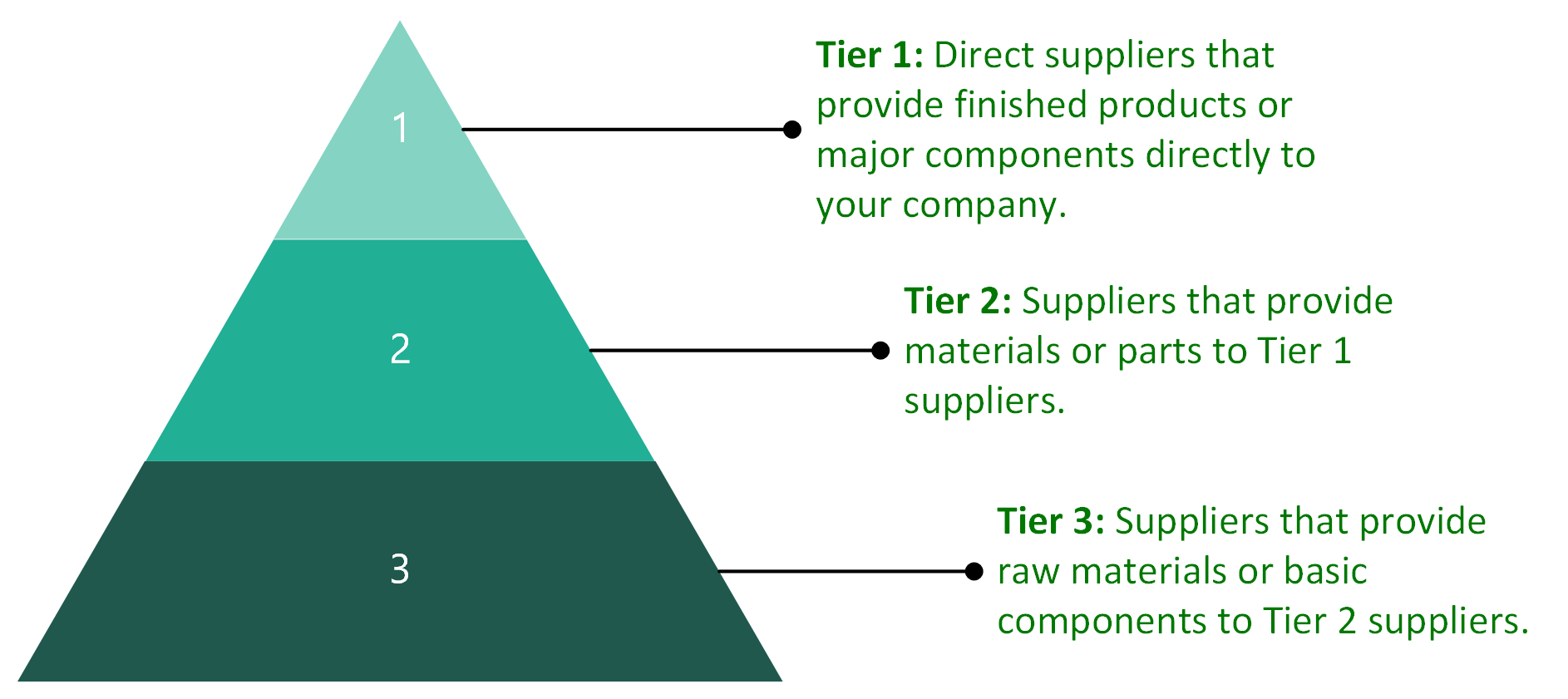
When talking about the upstream, or your suppliers, a common framework is to regard the supply chain from the perspective of tiers:
While you might have more than three tiers of suppliers, it is advisable to limit the supply chain to two or three tiers. More than three tiers can lead to loss of oversight and increased complexity. However, avoid excluding suppliers with important impacts, risks, or opportunities (IROs).
To map out the upstream, you should identify the 5-10 main materials that are supplied to your company (i.e. in terms of costs). Pay special attention to materials that might have significant IROs associated with them, such as substances of very high concern. Add these materials to the value chain, even if these materials do not belong to the 5-10 main materials.
If you work with a large variety of materials, you can categorize them. For instance, a car manufacturer dealing with numerous types of metals might categorize them as steel, aluminum, and other alloys, simplifying the mapping process and maintaining clarity.
Example car manufacturer
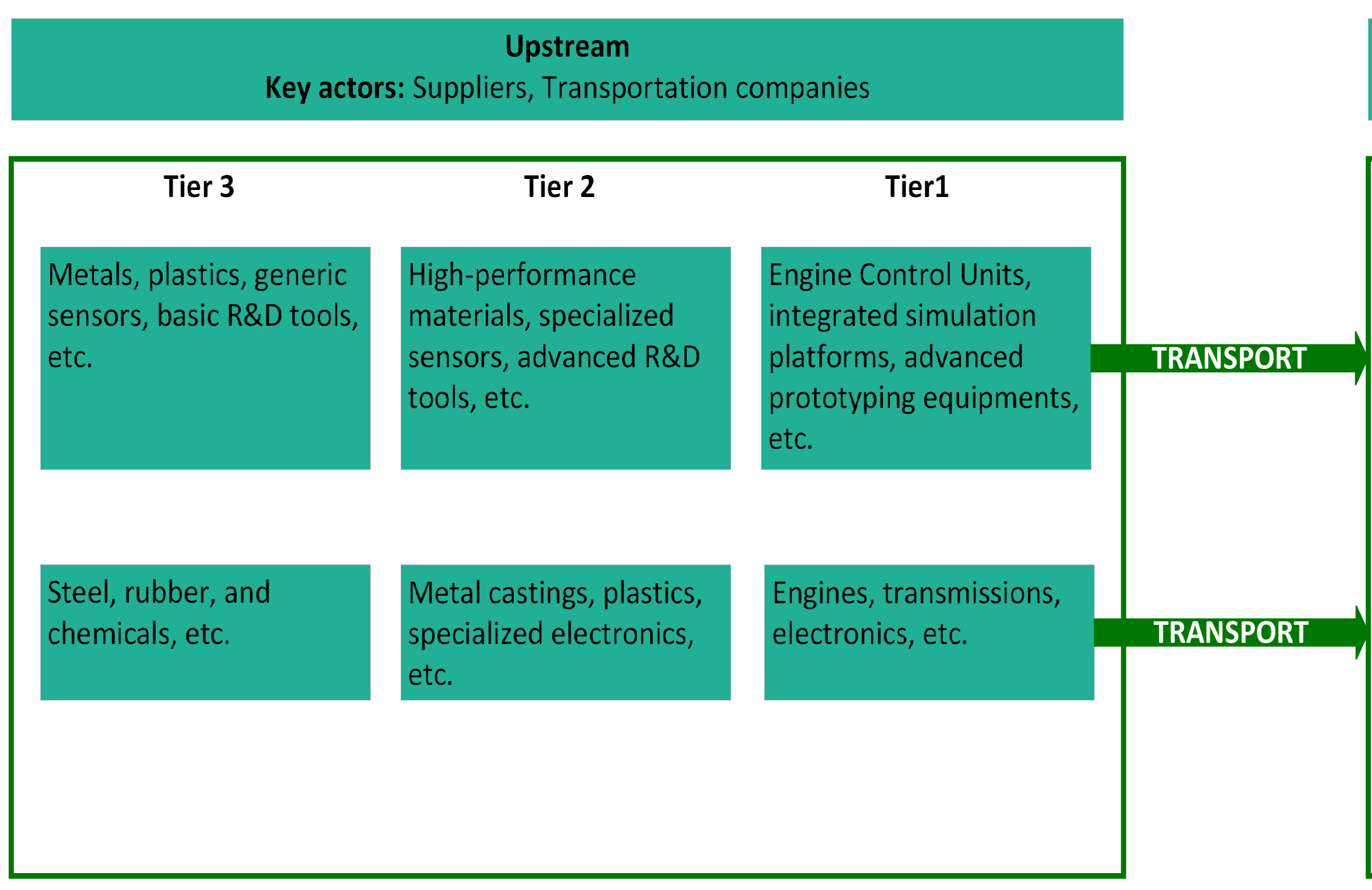
For a car manufacturer, mapping the upstream value chain might look as follows:
Tier 1 suppliers: Direct suppliers providing major components like engines and electronics.
Tier 2 suppliers: Suppliers who provide sub-components or raw materials to Tier 1 suppliers, such as metal castings, plastics, and specialized electronics.
Tier 3 suppliers: Suppliers of raw materials or basic components used by Tier 2 suppliers, such as steel, rubber, and chemicals.
Downstream
Once materials and components from the upstream value chain go through your company's activities, they are transformed into finished products (or services). These products will go to different customers and might end up into different markets.
To create the downstream part of the value chain, the next step is to identify the main uses of your product. Understanding the markets into which the product is sold will provide insights into the product's usage. Ask yourself:
Who are our primary customers?
Which regions or industries do we primarily serve?
What are the main uses of our products in these markets?
After identifying the main uses, the next step is to determine the end-of-life treatment of your products. This involves understanding what happens to your products after their useful life. Consider:
How are the products disposed of or recycled?
Are there components that can be reused or repurposed?
For some products, determining the end-of-life phase is straightforward. For example, a beverage company might know that its bottles are typically recycled. However, for products with numerous components, like cars, this process can be more complex. Here are a few tips for handling complexity:
Component analysis: Break down the product into its main components and trace each component’s end-of-life path.
Industry standards: Refer to industry standards and practices for end-of-life management.
Customer feedback: Gather information from customers about how they dispose of or recycle your products.
Example car manufacturer
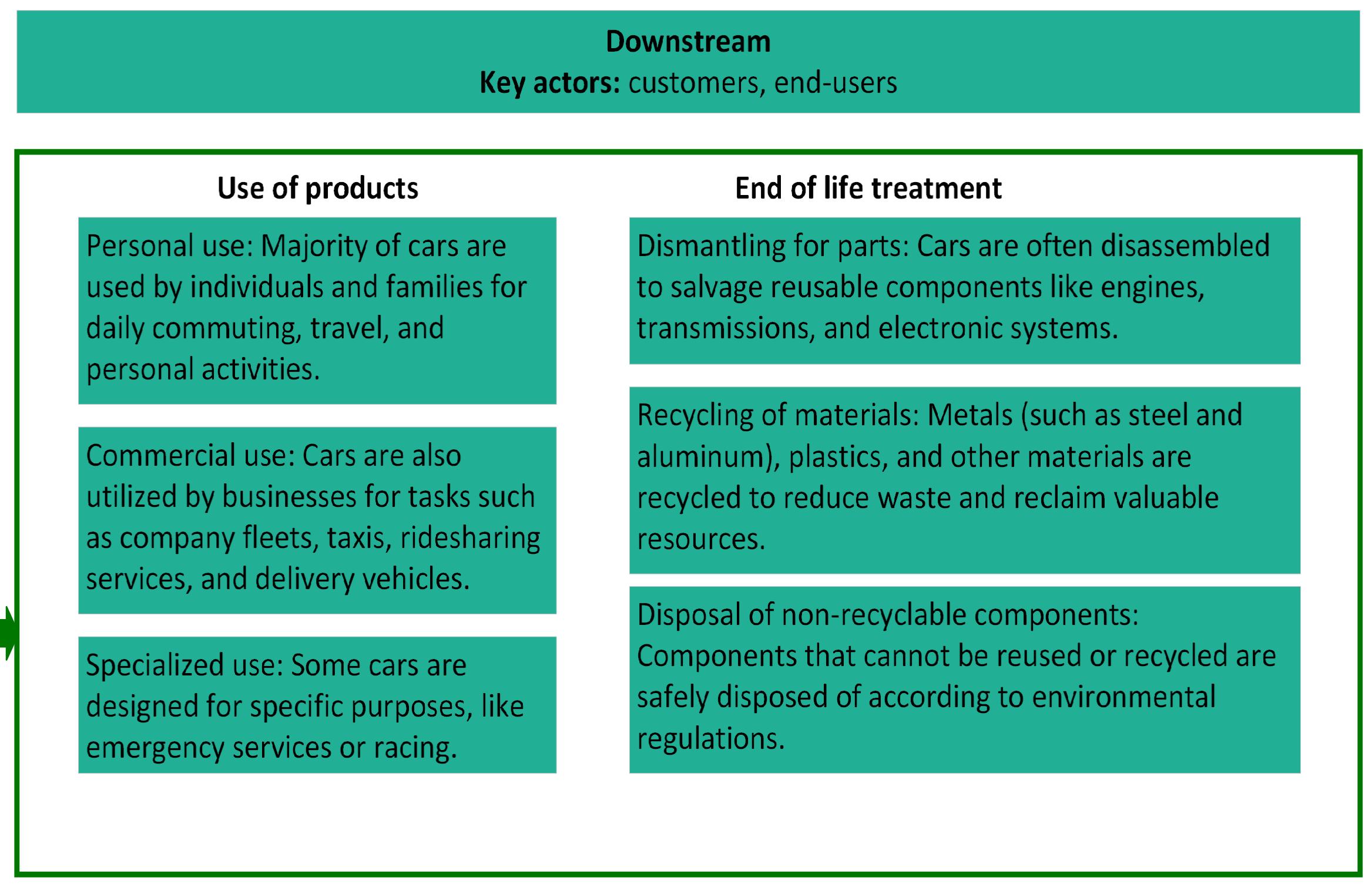
For a car manufacturer, mapping the downstream value chain would involve:
Identifying key markets such as North America, Europe, and Asia.
Understanding the primary uses of cars in these markets (e.g., personal or commercial use).
Investigating the end-of-life process for cars, which might include dismantling for parts, recycling of metals, and disposal of non-recyclable components.
Keep reading with a 7-day free trial
Subscribe to Sustainability Simplified (publisher of CSRD Simplified) to keep reading this post and get 7 days of free access to the full post archives.