

1. Introduction
Understanding how much water a company uses is crucial for managing its environmental impact, especially in areas where water is scarce. Companies need to be transparent about their water consumption, including details on how they use, recycle, and store water. This article will break down these disclosure requirements to help you understand what companies need to report.
How companies can effectively disclose this information will be covered in another article.

2. Water Consumption
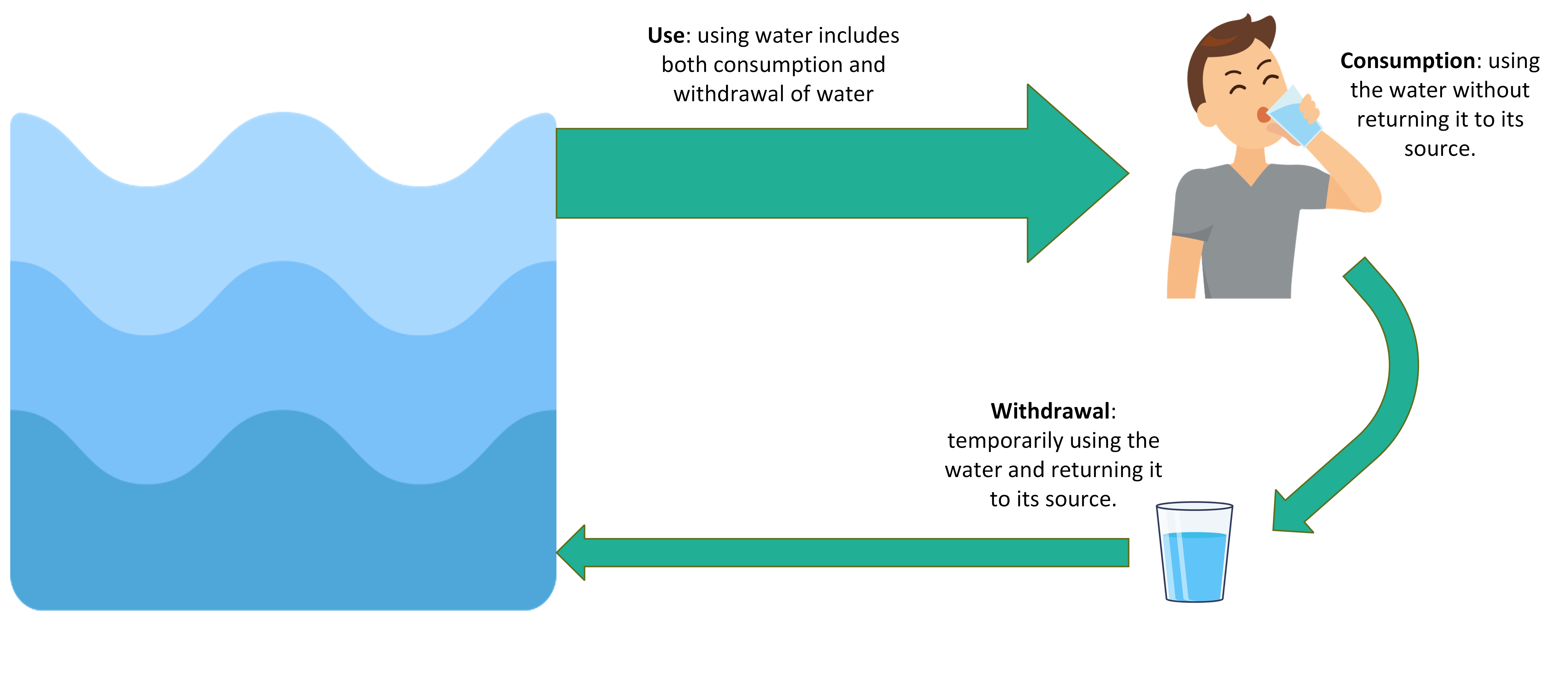
Companies must disclose detailed information about their water usage. When talking about water, you might encounter the terms water use, withdrawal and consumption. This illustration explains these terms:
Here's what companies need to report:
Total water consumption: Companies must provide the total amount of water they consume, measured in cubic meters (m³).
Water consumption in high-risk areas: They must also disclose how much of this water is used in areas that are at risk of water scarcity or high-water stress.
Water recycling and reuse: Companies should report the total amount of water they recycle and reuse, which helps reduce their overall water consumption.
Water storage: Information on how much water is stored and any changes in storage levels must be provided.
Contextual information: Companies need to give context for these figures, such as the quality and quantity of the water in the basins they use, how the data was collected (whether it was measured directly or estimated), and any standards or methods they followed.
Additionally, companies must report their water intensity, which is the total water consumed per million euros of net revenue. This metric helps to understand how efficiently a company uses water relative to its financial performance.
Companies must report detailed information about their water use, including total consumption, usage in high-risk areas, and amounts recycled or stored. They also need to disclose water intensity, showing how efficiently they use water relative to their revenue.
3. Conclusion
By disclosing their water consumption, companies provide valuable insights into their environmental impact and how they are managing resources in both low-risk and high-risk areas. This transparency not only helps track their progress toward sustainability goals but also allows stakeholders to hold them accountable for their water use. Understanding these figures is key to ensuring that businesses contribute positively to the sustainable management of water resources.
In an upcoming article, we will explore how companies can report on these disclosures. Subscribe to stay updated.
Want to ask questions?
Relevant Standards
ESRS E3
Disclosure Requirement E3-4 – Water consumption
26. The undertaking shall disclose information on its water consumption performance related to its material impacts, risks and opportunities.
27. The objective of this Disclosure Requirement is to provide an understanding of the undertaking’s water consumption and any progress by the undertaking in relation to its targets.
28. The disclosure required by paragraph 26 relates to own operations and shall include:
(a) total water consumption in m3;
(b) total water consumption in m3 in areas at water risk, including areas of high-water stress;
(c) total water recycled and reused in m3;
(d) total water stored and changes in storage in m3; and
(e) any contextual information necessary regarding points (a) to (d), including the water basins’ water quality and quantity, how the data have been compiled, such as any standards, methodologies, and assumptions used, including whether the information is calculated, estimated, modelled, or sourced from direct measurements, and the approach taken for this, such as the use of any sector-specific factors.
29. The undertaking shall provide information on its water intensity: total water consumption in its own operations in m3 per million EUR net revenue.