Last updated: 08-08-2025
1. Introduction
Scope 2 greenhouse gas (GHG) emissions come from the electricity, heat, steam, or cooling that a company purchases. These are indirect emissions — created by the energy generation you rely on, but that happen outside your direct operations.
Under the Corporate Sustainability Reporting Directive (CSRD) and European Sustainability Reporting Standard E1 (ESRS E1), companies must report Scope 2 emissions in two ways:
Location-based (reflecting the carbon intensity of the grid where you operate)
Market-based (reflecting the specific energy contracts you have)
Reporting both gives a complete picture, one shows your exposure to the regional grid mix, the other shows the impact of your renewable energy sourcing choices.
In this article you will learn:
✅What location-based emissions reporting is
✅What market-based emissions reporting is
✅When to use each method
✅What the CSRD requires
✅Using the methods in practice

2. What is location-based emissions reporting?
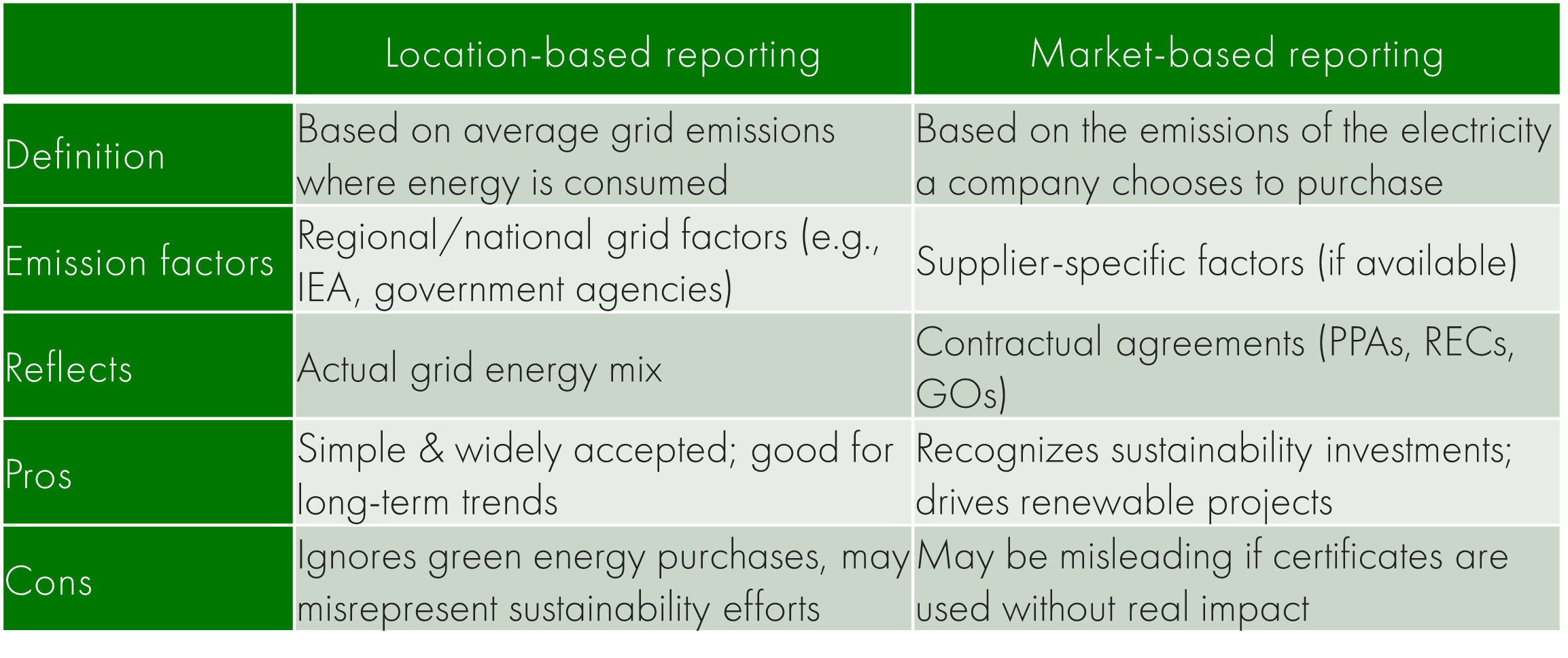
The location-based method calculates emissions based on the average carbon intensity of the electricity grid where energy consumption occurs. It reflects the broader energy mix in a given region, incorporating fossil fuels, renewables, and other energy sources. Location-based emissions reporting:
Uses regional or national grid emissions factors provided by government agencies or organizations like the International Energy Agency (IEA).
Shows the actual energy use in a location without factoring in specific electricity purchases or contracts.
Highlights the impact of local grid decarbonization efforts.
Pros & cons:
✅ Simpler to calculate and widely accepted for regulatory reporting.
✅ Useful for assessing long-term grid decarbonization trends.
❌ Does not account for a company’s renewable energy purchases.
❌ Can make sustainability efforts seem ineffective if a company sources green power in a carbon-intensive grid.
3. What is market-based emissions reporting?
The market-based approach, in contrast, calculates emissions based on the electricity a company actively chooses to purchase, rather than what is physically supplied by the grid. This method incorporates power purchase agreements (PPAs), renewable energy certificates (RECs), and supplier-specific emissions factors. Market-based emissions reporting:
Reflects contractual agreements and voluntary sustainability choices.
Uses supplier-specific emissions factors if available.
Accounts for mechanisms like Guarantees of Origin (GOs) in Europe and Renewable Energy Certificates (RECs) in the U.S.
Pros & cons:
✅ Recognizes corporate sustainability investments in clean energy.
✅ Encourages the development of renewable energy projects.
❌ Requires procurement data, which may not always be accessible.
❌ Can be misleading if companies buy certificates without directly reducing fossil fuel consumption.