


1. Introduction
In the race to reduce greenhouse gas (GHG) emissions, businesses, policymakers, and sustainability professionals rely on emission factors—the standardized coefficients that quantify the emissions produced per unit of activity. Emission factors allow us to translate activities into measurable carbon footprints. However, finding the right emission factor can be a challenge. Different methodologies, data sources, and regulatory requirements add layers of complexity.
This article explores what emission factors are, how they work, where to find them, and how they fit into the Corporate Sustainability Reporting Directive (CSRD). We’ll also break down the different life cycle boundaries and explain how Scope 1, 2, and 3 emissions should be reported using appropriate emission factors. By the end, you’ll have a clearer understanding of how to apply emission factors effectively in carbon accounting and sustainability reporting.

2. What are emission factors and where to find them?
An emission factor is a coefficient that quantifies the amount of greenhouse gases emitted per unit of activity. It’s a method to translate everyday actions such as driving a car, heating a building, or producing a ton of steel into measurable emissions.
How do emission factors work?
Emission factors are derived from a combination of scientific research, industry data, and government reporting. They’re typically expressed as kgCO2 per unit and used in calculations like this:

Here’s how it works in practice:
Activity Data: This is the measurable action or process that generates emissions. For example:
Kilometers driven by a vehicle.
Energy consumed by a building.
Tons of waste sent to a landfill.
Emission Factor: This is the multiplier that converts the activity into emissions. For instance:
Driving 100 kilometers in a car that emits 0.404 kg CO₂ per kilometer results in 40.4 kg of CO₂.
Using 1,000 kWh of electricity with an emission factor of 0.5 kg CO₂/kWh results in 500 kg of CO₂.
Total Emissions: Multiply the activity data by the emission factor, and you’ve got your total emissions for that activity.
Where can you find emission factors?
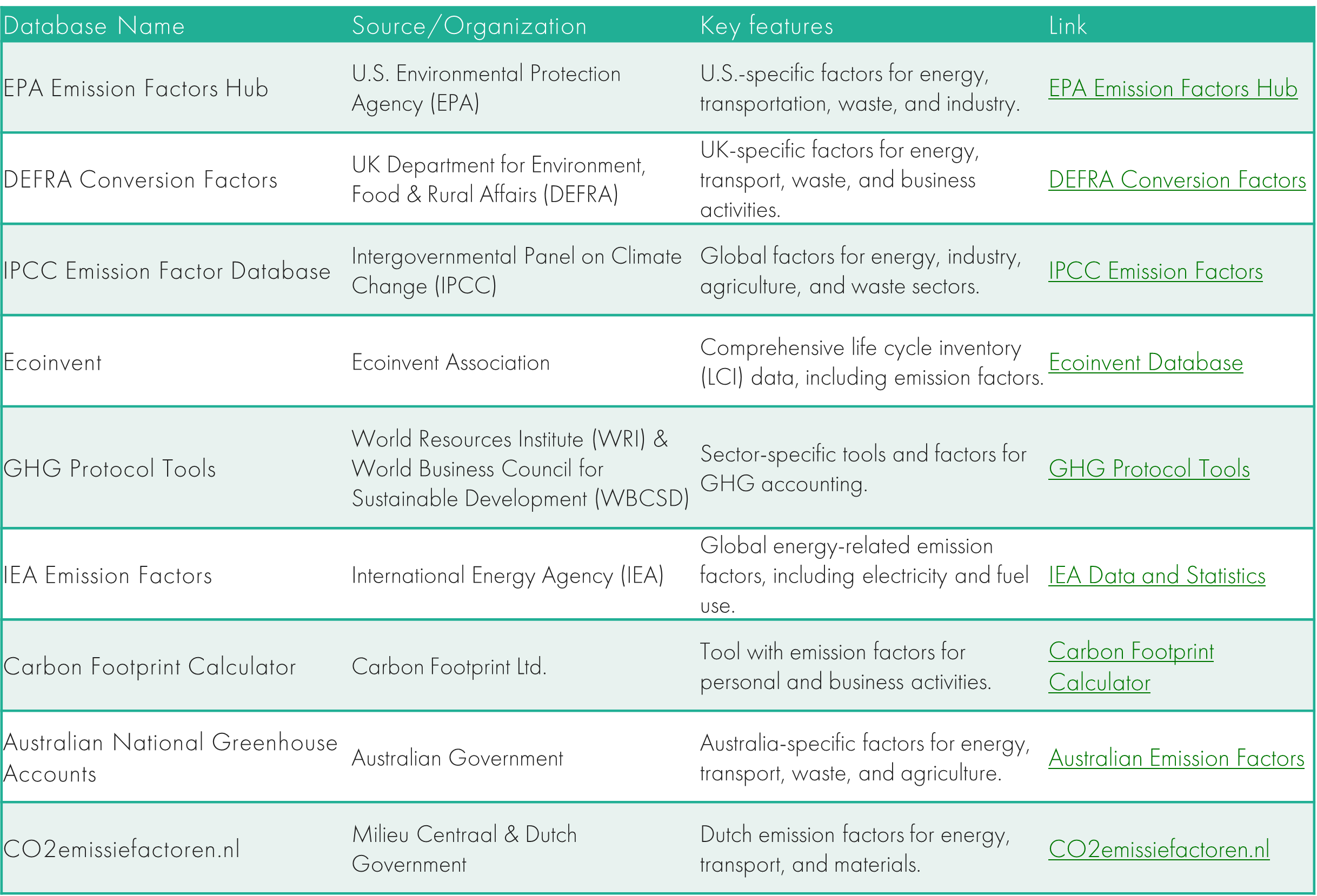
Finding the right emission factor is difficult if you do not know where to look, but there are several trusted sources to turn to:
Government agencies:
EPA (U.S. Environmental Protection Agency): The EPA’s Emission Factors Hub provides factors for everything from energy use to waste management.
DEFRA (UK Department for Environment, Food & Rural Affairs): DEFRA’s emission conversion factors are widely used in the UK and beyond.
IPCC (Intergovernmental Panel on Climate Change): The IPCC publishes global emission factors for various sectors, including energy, industry, and agriculture.
Industry databases:
Ecoinvent: A comprehensive database of life cycle assessment (LCA) data, including emission factors for thousands of products and processes.
GHG Protocol: Developed by the World Resources Institute (WRI) and the World Business Council for Sustainable Development (WBCSD), the GHG Protocol provides tools and guidance for calculating emissions.
Corporate tools: Many online calculators use emission factors to estimate personal or organizational emissions. There also exist LCA and carbon accounting software that includes emission factors for a wide range of activities.
Academic research: Peer-reviewed studies often publish emission factors for specific industries or regions.
Challenges and limitations
While working with emission factors it is good to keep the following challenges and limiations in mind:
Generalization: Many factors are averages, which may not account for regional variations, technological differences, or specific conditions.
Updates: Emission factors evolve as technology and practices change, so it’s important to use the most recent data.
Accuracy: Factors are estimates, not precise measurements. For highly accurate results, direct monitoring is best.