


1. Introduction
In the ongoing battle against climate change, understanding the potential future scenarios that our world may face is crucial for informed decision-making. As climate science has evolved, so too have the tools and frameworks used to predict and analyze the possible outcomes of global climate policies. Among these tools are Representative Concentration Pathways (RCPs) and Shared Socioeconomic Pathways (SSPs), both of which offer distinct but complementary views of our possible futures. Together, they form a comprehensive picture of how different levels of greenhouse gas emissions, socioeconomic developments, and policy decisions could shape the global climate by the end of the century. This article explores the RCPs, SSPs, and their combined usage in climate modeling, along with insights from the International Energy Agency's (IEA) scenarios, providing a clear understanding of the diverse pathways that lie ahead.

2. Representative Concentration Pathways (RCPs)
RCPs are a set of greenhouse gas concentration trajectories adopted by the Intergovernmental Panel on Climate Change (IPCC) for its Fifth Assessment Report (AR5). These pathways describe different climate futures, all based on varying levels of greenhouse gas emissions. The primary function of RCPs is to serve as inputs for climate models to predict potential outcomes of climate change, including global temperature rise, sea level changes, and other impacts.
The Four RCPs
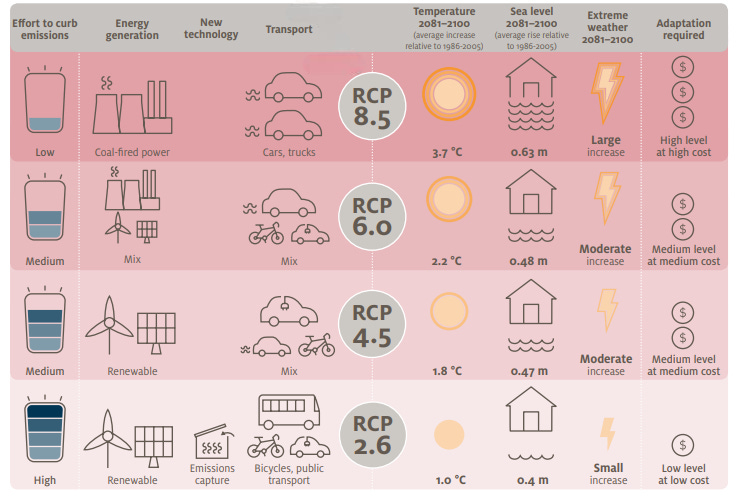
The RCPs are labeled according to the amount of radiative forcing they are expected to produce by the year 2100. Radiative forcing refers to the change in energy flux in the atmosphere due to greenhouse gases, measured in Watts per square meter (W/m²). The four main RCPs are:
RCP2.6: This is the most ambitious pathway, which requires immediate and aggressive measures to reduce emissions. It assumes that global emissions peak around 2020 and then decline sharply. The goal is to limit radiative forcing to 2.6 W/m² by 2100, keeping the increase in global average temperature below 2°C relative to pre-industrial levels. Atmospheric CO₂ concentrations under RCP2.6 are expected to be around 421 ppm by 2100.
RCP4.5: This scenario represents an intermediate pathway where emissions stabilize by mid-century. Radiative forcing in this scenario is expected to reach 4.5 W/m² by 2100. The expected temperature increase ranges between 1.7°C to 3.2°C, and CO₂ concentrations could stabilize around 538 ppm.
RCP6.0: Another stabilization scenario, RCP6.0 assumes that global emissions peak around 2080 and then decline. The radiative forcing is expected to reach 6.0 W/m² by 2100. The associated temperature rise is between 2.0°C to 3.7°C, with CO₂ concentrations expected to stabilize around 670 ppm.
RCP8.5: Often referred to as the “business-as-usual” scenario, RCP8.5 assumes that emissions continue to rise throughout the 21st century without any significant policy interventions. This scenario leads to a radiative forcing of 8.5 W/m² by 2100, with potential temperature increases between 3.2°C to 5.4°C and atmospheric CO₂ levels reaching 936 ppm. This pathway represents the most severe impacts of climate change, including the highest risk of catastrophic environmental disruptions.
Why RCPs Matter
By using RCPs, climate models can project how different emission scenarios will affect the climate system, helping to inform mitigation and adaptation strategies.
For instance, the RCP2.6 scenario illustrates what is needed to meet the goals of the Paris Agreement, which aims to keep global temperature rise well below 2°C. On the other hand, RCP8.5 serves as a stark warning of the consequences of inaction, showing the severe risks associated with continued high emissions.
3. Shares Socioeconomic Pathways (SSPs)
Shared Socioeconomic Pathways, or SSPs, are scenarios that describe possible future worlds based on varying levels of socioeconomic development. Unlike the earlier Representative Concentration Pathways (RCPs), which focused solely on greenhouse gas concentrations, SSPs consider a broader range of factors including economic growth, population trends, technological progress, and social factors like education and inequality.
The SSPs are typically paired with RCPs to create a comprehensive picture of potential future climates. While the RCPs describe the physical trajectory of greenhouse gases in the atmosphere, the SSPs describe the socioeconomic conditions under which these trajectories might occur.
The Five SSP Narratives
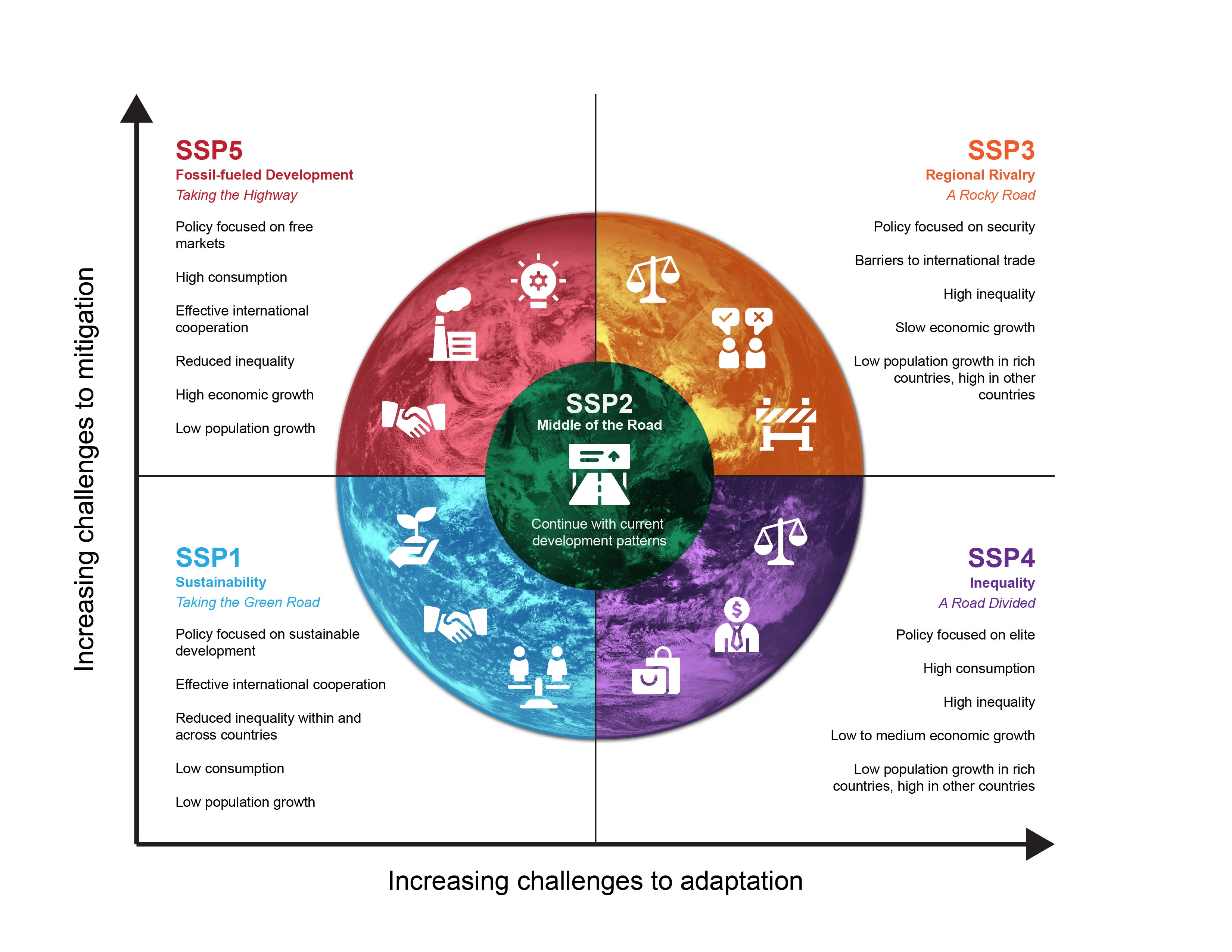
The SSP framework includes five distinct narratives, each representing a different vision of the future:
SSP1: Sustainability (Taking the Green Road)
In this scenario, the world shifts towards sustainability, with a strong focus on achieving the United Nations’ Sustainable Development Goals (SDGs). There is a concerted effort to reduce inequality, promote education, and manage resources sustainably.
Climate impact: This pathway is consistent with lower levels of warming, especially when paired with lower RCP scenarios like RCP2.6.
SSP2: Middle of the Road
The world follows a path of moderate development. Trends continue along historical lines, with neither extreme environmental degradation nor rapid improvement. Economic growth is uneven, and social inequalities persist but do not worsen dramatically.
Climate impact: This is considered a "middle-ground" scenario, leading to moderate climate impacts.
SSP3: Regional Rivalry (A Rocky Road)
In this future, countries focus on their own national interests, leading to a fragmented world. Cooperation is low, economic growth is slow, and technological progress stagnates. This scenario sees high levels of inequality and low investment in education and health.
Climate impact: This pathway is associated with higher levels of warming due to the lack of global cooperation and sustainability efforts.
SSP4: Inequality (A Road Divided)
This scenario envisions a world with stark divisions between a global elite and the rest of the population. There is high inequality both within and between countries, leading to disparities in access to resources and technology.
Climate impact: This pathway could lead to varied climate outcomes, depending on the actions of the wealthy elite, but generally, it would exacerbate the impacts of climate change on vulnerable populations.
SSP5: Fossil-fueled Development (Taking the Highway)
Economic growth is the primary focus in this scenario, with rapid development driven by the continued use of fossil fuels. Technological progress is strong, but there is little regard for environmental sustainability.
Climate impact: This scenario leads to high levels of greenhouse gas emissions and, consequently, higher levels of global warming, especially when paired with higher RCPs like RCP8.5.
The Role of SSPs in Climate Policy
By considering a broad range of factors beyond just emissions, SSPs offer a more comprehensive view of potential futures. This can help policymakers understand the trade-offs between different development paths and the long-term impacts of their decisions on climate change.
For example, an SSP1 world, with its focus on sustainability and equity, might avoid the worst impacts of climate change even under moderately high emissions scenarios, due to the global commitment to adaptation and mitigation. On the other hand, an SSP5 world could see severe climate impacts even if technological advances are made, due to the relentless focus on fossil-fuel-driven growth.
4. RCP and SSP combined
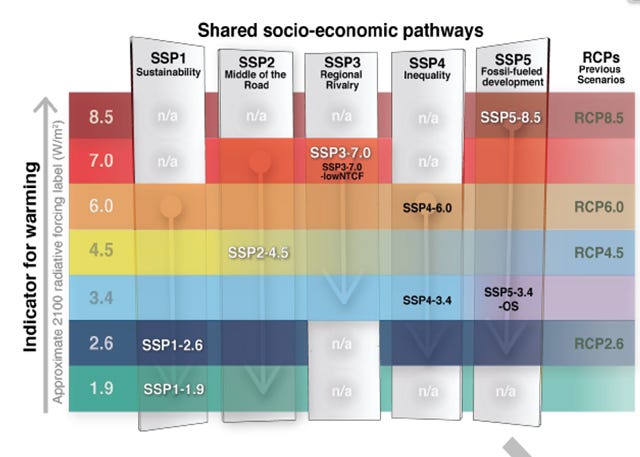
While SSPs provide context on how human society might evolve, RCPs describe the physical climate outcomes of these developments. By combining an SSP with an RCP, scientists can explore a wide range of possible futures. This approach allows for more detailed climate modeling, capturing both the societal drivers and the environmental consequences of climate change.
For example, you might pair the Sustainability scenario (SSP1) with the low-emission RCP2.6 to explore a world where global society prioritizes sustainable development, leading to lower emissions and less severe climate impacts. Alternatively, you could combine the Fossil-fueled Development scenario (SSP5) with RCP8.5 to model a future where economic growth is driven by heavy fossil fuel use, resulting in severe climate change.
Key SSP-RCP Combinations
Here are a few examples of how different SSP-RCP combinations could unfold:
SSP1 + RCP2.6: SSP1-2.6
Socioeconomic context: A world focused on sustainability, global cooperation, and equity.
Climate outcome: With strong global commitments to reducing emissions, this combination is likely to result in the least severe climate impacts, with temperature rises kept below 2°C and limited sea level rise.
SSP2 + RCP4.5: SSP2-4.5
Socioeconomic context: A future where development continues along current trajectories without dramatic shifts towards either sustainability or high fossil fuel dependence.
Climate outcome: Moderate climate impacts, with temperatures likely rising between 2.1°C and 3.5°C by 2100. This scenario represents a world where we manage to curb emissions to some extent but still face significant environmental challenges.
SSP3 + RCP7.0: SSP3-7.0
Socioeconomic context: A fragmented world with regional rivalries, low global cooperation, and uneven economic growth.
Climate outcome: Higher emissions and more severe climate impacts, with temperature increases likely rising between 2.8°C and 4.6°C by 2100. This combination highlights the dangers of a divided global response to climate change.
SSP5 + RCP8.5: SSP5-8.5
Socioeconomic context: Rapid economic growth fueled by fossil energy, with little regard for environmental consequences.
Climate outcome: The most extreme climate scenario, with temperatures rising by as much as 5.7°C by 2100. This combination represents a world on the path to severe climate disruptions, including extreme weather, substantial sea level rise, and widespread ecological damage.
The Importance of These Combinations
Understanding the intersection of SSPs and RCPs is critical because it emphasizes that our climate future is not predetermined. Instead, it will be shaped by the choices we make today about how we govern, grow, and cooperate globally. The SSP-RCP framework allows policymakers and researchers to visualize the potential outcomes of different pathways, helping to identify strategies that can mitigate the most severe impacts of climate change.
For instance, even in a world that continues to develop rapidly (like in SSP5), if we pair it with an aggressive emission reduction strategy (like RCP2.6), we could avoid the worst climate impacts. Conversely, if we fail to curb emissions and continue down a path of inequality and fragmented governance (as in SSP3 and RCP8.5), we could face devastating climate outcomes.
5. IEA Scenarios
The IEA develops several scenarios to explore different pathways for the future of energy. These scenarios are not predictions but are instead designed to help policymakers, investors, and other stakeholders understand the potential impacts of various decisions. Each scenario represents a different trajectory for global energy emissions and warming, driven by varying levels of commitment and action from governments and industries around the world. The IEA’s scenarios are particularly useful for assessing the feasibility of different climate targets and understanding the broader implications of energy policies.
The IEA presents three primary scenarios:
Net Zero Emissions by 2050 (NZE)
Announced Pledges Scenario (APS)
Stated Policies Scenario (STEPS)
The Three IEA Scenarios
1. Net Zero Emissions by 2050 (NZE)
The NZE scenario outlines a rigorous pathway to limit global warming to 1.5°C above pre-industrial levels, consistent with the most ambitious goals of the Paris Agreement. This scenario envisions the world reaching net zero emissions by 2050, meaning that any remaining greenhouse gas emissions would be balanced by removals, such as through carbon capture and storage or natural carbon sinks.
Key characteristics of the NZE scenario include:
Aggressive decarbonization: Rapid and widespread adoption of clean energy technologies, including renewables, electric vehicles, and energy efficiency measures.
Energy access: Achieving universal access to energy by 2030, ensuring that all people have reliable and affordable energy services.
Air quality improvements: Significant reductions in air pollution due to lower fossil fuel use, leading to major health benefits globally.
This scenario reflects the level of transformation needed to stabilize the climate at a relatively safe level, but it requires unprecedented cooperation and action across all sectors of society.
2. Announced Pledges Scenario (APS)
The APS assumes that governments will fully implement all their climate-related commitments, including net zero targets and nationally determined contributions (NDCs) under the Paris Agreement. This scenario is built on the assumption that all announced pledges are met, even if they are not yet supported by detailed policies or measures.
Key points of the APS include:
Commitment-driven action: This scenario captures the potential outcomes if all current climate pledges and targets are fully realized.
Temperature increase: Global temperatures are projected to rise by 1.7°C by 2100, which is higher than the NZE scenario but still within the Paris Agreement’s broader goal of limiting warming to well below 2°C.
Implementation gaps: The APS highlights the gap between announced pledges and the actual policies in place, underscoring the need for concrete action to turn commitments into reality.
While the APS represents a significant improvement over current trends, it still falls short of achieving the most ambitious climate goals, demonstrating the importance of moving from pledges to tangible action.
3. Stated Policies Scenario (STEPS)
The STEPS scenario takes a more conservative approach, focusing on the policies and measures that are currently in place or are under development. Rather than assuming that all announced pledges will be met, STEPS offers a realistic view of where the global energy system might head if no additional policies are introduced.
Key features of STEPS include:
Policy-driven projections: STEPS is grounded in the current policy landscape, examining the likely outcomes of existing policies without assuming new or more ambitious measures.
Moderate warming: Under STEPS, global temperatures are projected to rise by around 2.5°C by 2100. This level of warming would have serious implications for ecosystems, economies, and human health.
Incremental progress: This scenario illustrates the potential risks of insufficient action, where incremental progress may lead to significant climate impacts.
STEPS serves as a cautionary tale, showing that without additional policies and stronger commitments, the world is on track for substantial warming and its associated risks.
The Role of Different IEA Scenarios
The IEA scenarios are essential tools for anyone involved in shaping energy policies, investing in energy infrastructure, or planning for future energy needs. Depending on the focus of your work or the questions you are trying to answer, different scenarios may be more relevant:
NZE Scenario is ideal for exploring the implications of aggressive climate action and the pathway to a net-zero future.
APS Scenario provides insights into the potential impact of current government pledges and the importance of policy implementation.
STEPS Scenario is useful for understanding the outcomes of the current policy trajectory and the risks of inaction.
6. Conclusion
RCPs, SSPs, and IEA scenarios provide a valuable toolkit for understanding and planning our climate future. These pathways show that our climate outcomes depend heavily on the decisions we make today—whether it’s reducing emissions, advancing technology, or improving global cooperation. By combining RCPs, which focus on greenhouse gas emissions, with SSPs, which consider broader socioeconomic factors, we can get a clearer picture of the potential challenges and opportunities ahead. The IEA scenarios add another layer by exploring the specific impacts of energy policies on climate outcomes.
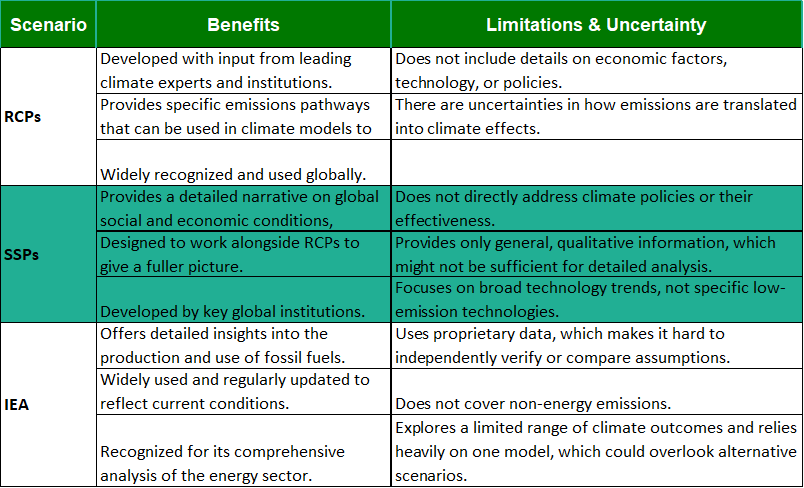
As you consider the benefits and limitations of these frameworks (as detailed in the table provided), it's clear that each offers unique insights, but also comes with uncertainties.
With informed decisions and coordinated global action, we can steer toward a more sustainable and equitable world, avoiding the worst impacts of climate change.
Subscribe to stay updated.
Want to ask questions?