


Last updated: 08-08-2025
1. Introduction
Climate change poses important challenges, affecting ecosystems, economies, and communities worldwide. The Corporate Sustainability Reporting Directive (CSRD) provides a robust framework for addressing climate-related risks and opportunities through its disclosure requirements. In this article, we will explain climate change adaptation and mitigation and highlight some disclosure requirements for each category under the CSRD.

2. Understanding climate change adaptation and mitigation
Adaptation
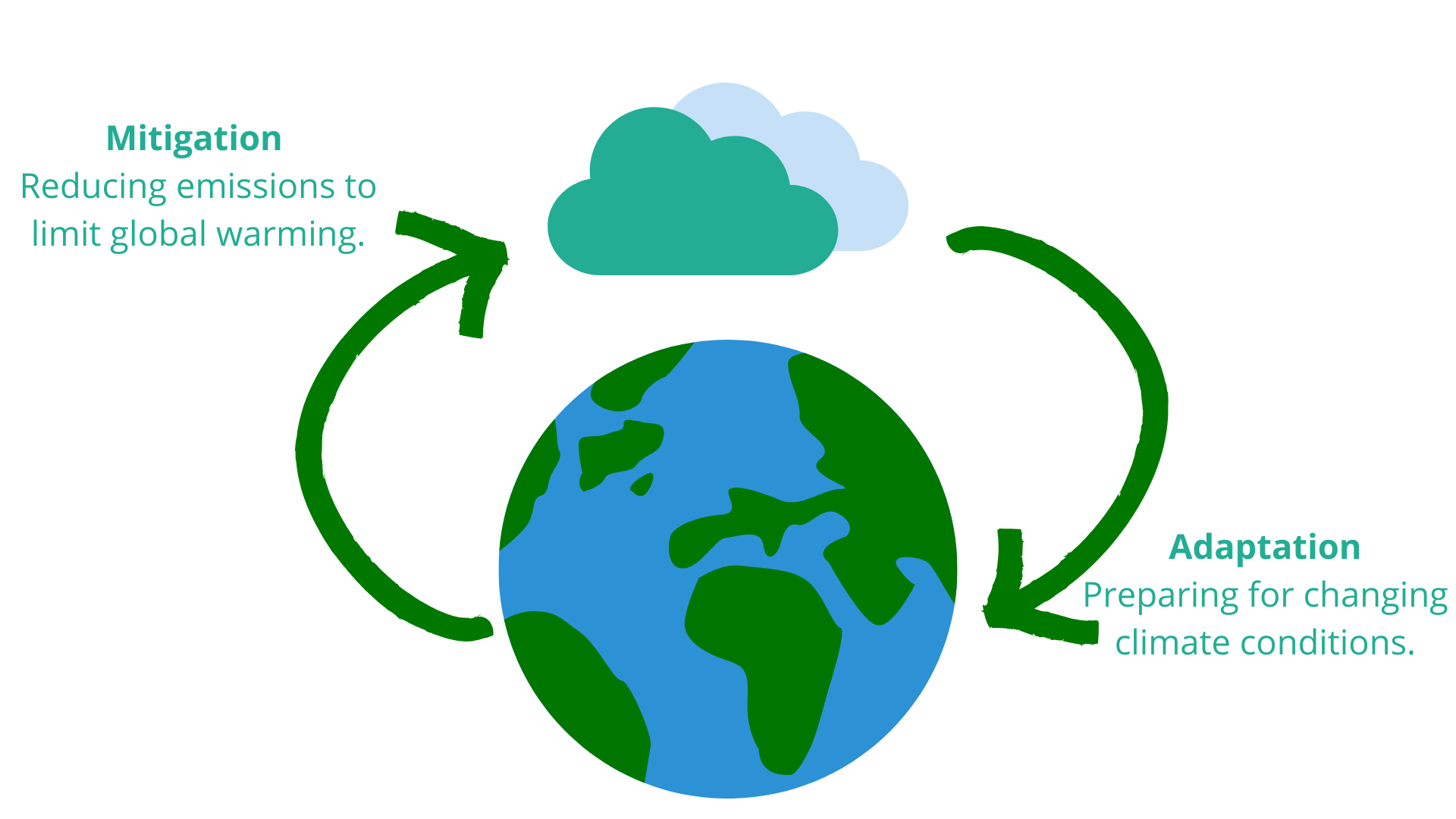
Adaptation means making changes in natural, social, and economic systems to deal with the impacts of climate change, whether they are happening now or are expected in the future. It is about finding ways to live with these changes, reducing risks, and building resilience. Examples of adaptation actions include:
Building seawalls and levees to protect against higher sea levels.
Growing crops that can survive in drought conditions to ensure enough food.
Improving water management to handle changes in rainfall patterns.
Adaptation is usually a reaction to specific needs or risks. It involves understanding vulnerabilities and applying solutions tailored to the situation.
Mitigation
Mitigation addresses the root causes of climate change by reducing greenhouse gas (GHG) emissions or increasing the ability of natural systems to absorb carbon. It is a proactive effort to slow or reverse the progression of climate change. Common mitigation strategies include:
Transitioning to renewable energy sources such as solar and wind.
Making industries and homes more energy efficient.
Planting more trees to remove carbon dioxide from the air.
Mitigation requires planning for the long term and creating systemic changes to stabilize the Earth’s climate.
Adaptation and mitigation synergies
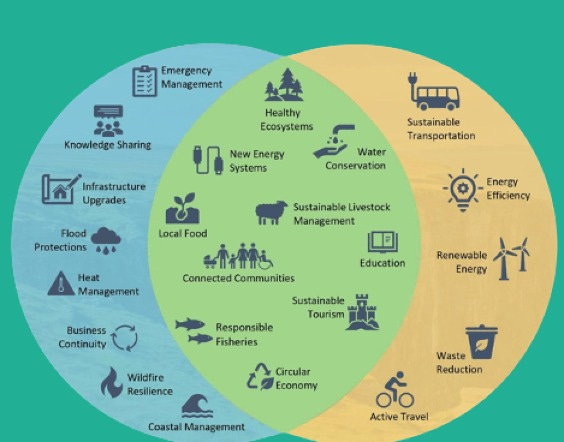
While adaptation and mitigation are different, they can overlap in practice. For example, renewable energy projects can cut emissions while also helping communities become more resilient to energy supply issues, which is a form of adaptation. Similarly, planting trees absorbs carbon and also helps control floods and protect biodiversity, addressing both goals.
Combining adaptation and mitigation strategies creates benefits and uses resources more efficiently. To do this, it’s important to:
Coordinate policies: Make sure adaptation and mitigation efforts support each other.
Work across sectors: Involve people from areas like agriculture, energy, and city planning to create hollistic solutions.
Focus on fairness: Ensure that actions benefit vulnerable populations, who often face the worst effects of climate change while contributing the least to the problem.
3. Adaptation and mitigation under the CSRD
Adaptation
Under the CSRD, organisations must disclose information on how they adjust to actual and expected climate change. This involves identifying and managing physical climate risks and implementing actions to reduce those risks. Such as:
Climate-related risks and scenario analysis (E1-2) – Adaptation and Mitigation
Identify material climate-related risks and classify them as physical (acute events like extreme storms; chronic trends like rising sea levels) or transition (policy, market, or technology shifts).
For physical risks (adaptation focus), assess how assets, operations, and the value chain may be exposed to hazards over short, medium, and long term, using at least one high-emission climate scenario.
For transition risks (mitigation focus), assess exposure using at least one 1.5°C-aligned scenario.
Resilience in relation to climate change (E1-3) – Adaptation
Present the results of resilience analysis, explaining how your strategy and business model would need to respond to risks identified in E1-2.
Show how adaptation actions (E1-5) strengthen resilience and how they interact with any mitigation actions or the transition plan (E1-1).
Disclose significant uncertainties in the resilience assessment and your capacity to adjust over short, medium, and long term.
Adaptation actions and resources (E1-5) – Adaptation
Disclose key adaptation actions, such as nature-based solutions, infrastructure reinforcement, or process changes, and the resources allocated to them.
Provide quantitative CapEx/OpEx figures (short- and medium-term) and anticipated long-term ranges where possible.
Link these actions to the reduction of identified physical risks and show how they address the exposures identified in E1-2.
Adaptation disclosures focus on actively addressing climate risks and encourage organizations to include these efforts in their long-term plans for sustainability.
Mitigation
Mitigation disclosures focus on limiting global temperature rise to 1.5°C by reducing greenhouse gas (GHG) emissions and shifting towards low-carbon operations, in line with the Paris Agreement and EU Climate Law.
Transition plan for climate change mitigation (E1-1) – Mitigation
Describe how your strategy and business model align with climate neutrality by 2050 and a 1.5°C pathway.
Include GHG targets (see E1-6), decarbonisation levers, key actions, and financial/investment planning.
Disclose dependencies (e.g., reliance on specific technologies or markets) and qualitatively assess locked-in GHG emissions from key assets/products.
Report progress and, if no plan exists, whether and when one will be adopted.
Targets related to climate change (E1-6) – Mitigation
Disclose absolute GHG reduction targets for Scopes 1, 2, and 3 (separately or combined, with scope shares).
State whether targets are science-based and 1.5°C-compatible, and outline the methodology and critical assumptions (e.g., demand changes, technology adoption).
Use gross targets only—no offsets, carbon credits, or avoided emissions counted toward the target.
GHG emissions inventory (E1-8) – Mitigation
Report gross Scope 1, Scope 2 (location- and market-based), and significant Scope 3 emissions (total and by category).
For Scope 1, disclose the % covered by emissions trading schemes.
Show biogenic CO₂ separately and apply the financial-control boundary, with operational-control disclosure if relevant.
Mitigation actions and resources (E1-5) – Mitigation
Present key mitigation actions (by decarbonisation lever), expected and achieved GHG reductions, and associated CapEx/OpEx.
Examples: energy efficiency improvements, fuel switching, renewable energy projects, product/service portfolio shifts.
4. Conclusion
Addressing climate change is not just about taking action but also about reflecting on the steps we take. Businesses, in particular, need to continuously evaluate their adaptation and mitigation efforts to ensure they stay effective, relevant, and fair. By encouraging open conversations, investing in new ideas, and finding innovative solutions, companies can create adaptable strategies that respond to current and future challenges. Businesses that integrate adaptation and mitigation strategies can build resilience and meet sustainability goals.
Subscribe to stay updated.