


1. Introduction
If policies set the governance rules, actions and resources represent the operational execution. Without dedicated budgets and operational projects, corporate biodiversity commitments remain unverified promises.
ESRS E4-3 requires companies to disclose the concrete operational actions taken or planned to protect biodiversity, along with the financial resources allocated to implement them. It demands clear evidence on project timelines, dedicated CapEx and OpEx investments, strict quality standards for biodiversity offsets, and respect for indigenous peoples’ land rights.
I will briefly explain the requirements for disclosing biodiversity and ecosystems actions and resources.
More elaborate articles are, or will become available, which can be found on: Sustainability Simplified.

2. What are biodiversity and ecosystems actions?
Biodiversity actions are concrete operational initiatives, physical engineering adjustments, and capital deployments designed to halt nature degradation, restore damaged habitats, or transition supply chains.
Because nature loss occurs at specific geographic coordinates, effective actions must deploy resources directly to physical locations. Companies cannot satisfy ESRS E4-3 with generic corporate programs; they must show tangible work across operational sites, river basins, and upstream sourcing nodes.
Examples of operational biodiversity actions include:
Satellite farm monitoring: Deploy €2.5M in CapEx to install real-time satellite tracking and on-the-ground verification systems across 12,000 supplier farms in high-risk deforestation basins.
Wetland habitat restoration: Allocate €800k in annual OpEx to re-flood 450 hectares of drained peatlands adjacent to manufacturing facilities to restore natural hydrological buffer capacity.
Regenerative transition subsidies: Provide €1.2M in direct agronomic co-funding to contract growers who eliminate synthetic fertilizers and plant multi-species cover crops.
Aquatic passage construction: Invest €1.5M in CapEx to construct fish ladders and acoustic deflection screens at hydroelectric turbine intakes.
ESRS 2 GDR-A governs how companies report sustainability actions and resources. E4-3 applies this standard directly to biodiversity and ecosystems. It requires companies to disclose concrete operational projects, implementation timelines, and dedicated CapEx or OpEx.
To ensure regulatory alignment, corporate actions and allocated capital must deliver tangible interventions on the ground. Key reference frameworks include the Kunming-Montreal Global Biodiversity Framework (GBF), the EU Nature Restoration Law, the Mitigation Hierarchy (Avoid ➔ Minimise ➔ Restore ➔ Offset), and the UN Declaration on the Rights of Indigenous Peoples (UNDRIP).
The ESRS standard formally defines an action as:
“Actions refer to: (a) actions and action plans (including transition plans) that are undertaken to ensure that the undertaking delivers against targets set and through which the undertaking seeks to address material impacts, risks and opportunities; and (b) decisions to support these with financial, human or technological resources. Actions can be individual actions, taken only by the undertaking, or collective actions, that is, collaborative efforts by a group of stakeholders — such as undertakings, governments, civil society, or communities — to address shared challenges or achieve common goals, particularly when those goals cannot be effectively achieved by any single actor working alone.”
Source: ESRS 2, Annex II Glossary.
3. ESRS E4-3 at a glance
ESRS E4-3 specifically requires companies to disclose the concrete operational projects and capital allocations they commit to biodiversity. The standard focuses on two core operational priorities: execution timelines with dedicated financial resources and strict verification standards for biodiversity offsets.
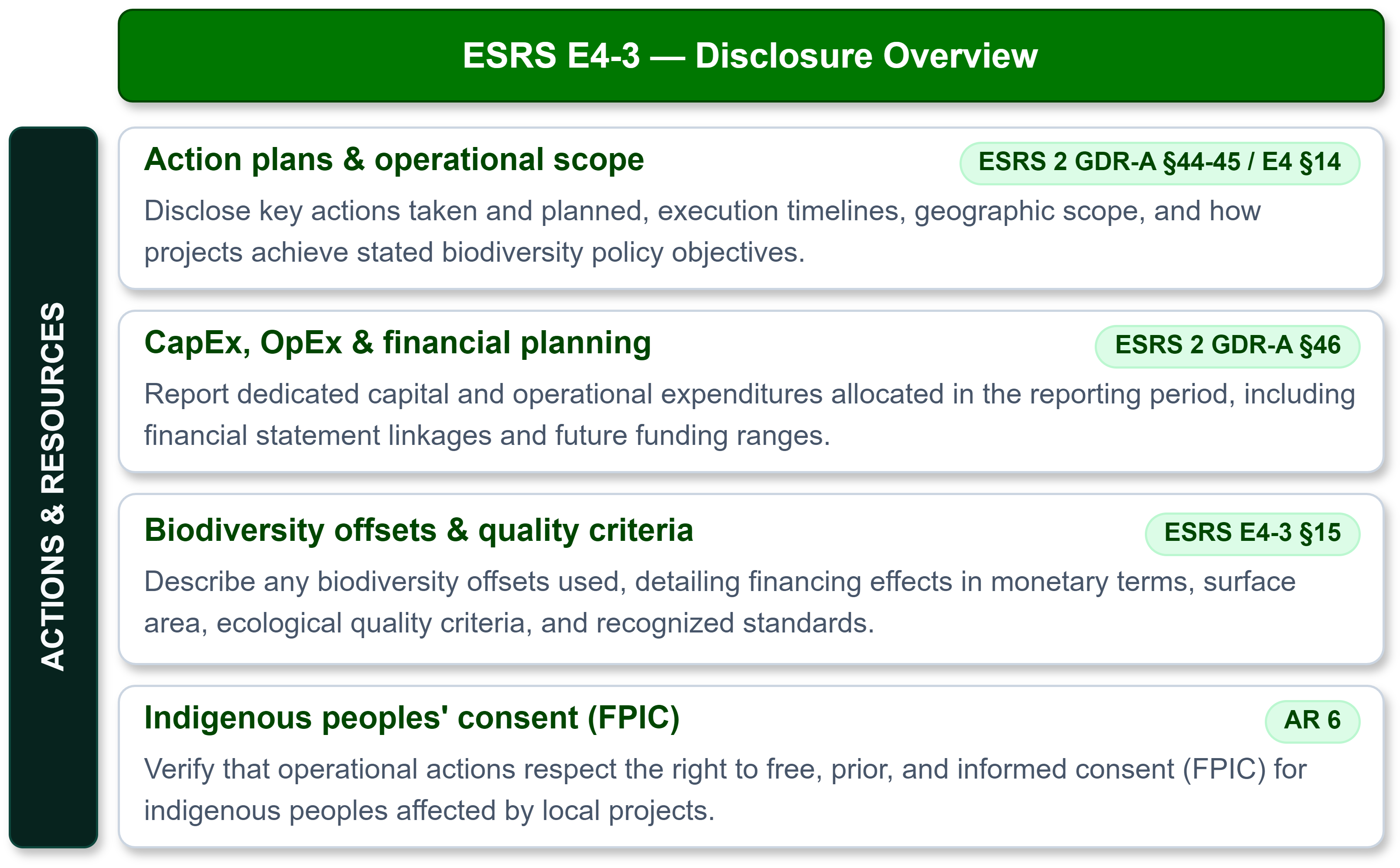
To comply with ESRS E4-3 (aligned with the 2026 Revised Standards), the disclosure checklist requires:
Disclose key actions taken during the reporting year and planned for future periods, with clear implementation milestones.
Explain the geographic and operational scope of each key action plan.
Report dedicated CapEx and OpEx amounts allocated to biodiversity actions, and link expenditures to specific line items in financial statements.
Disclose an indicative range of future financial resources committed to execute planned actions.
Describe any biodiversity offsets used, detailing their financing cost, physical surface area, ecological quality criteria, and compliance standards.
Confirm whether actions consider the right to free, prior, and informed consent (FPIC) for affected indigenous peoples.
Non-adoption / PAT rule: If the company has determined biodiversity to be a material topic but has not adopted biodiversity-related policies, it must explicitly disclose this fact, explain the reasons for non-adoption, and specify whether and when it intends to adopt one (in accordance with ESRS 2 §39).
4. How E4-3 links to the rest of ESRS E4
This disclosure represents the execution engine of the 5-part topical governance chain: Transition Plan (E4-1) → Policy (E4-2) → Action (E4-3) → Target (E4-4) → Metric (E4-5). While policies establish commitments, actions deploy the capital and human labor required to deliver measurable environmental progress.
Consider a corporate example:
A food retailer operating near ecologically sensitive regions adopts a biodiversity transition plan to align its business model with the Global Biodiversity Framework [E4-1].
Under this plan, it adopts a mandatory sustainable sourcing policy banning deforestation-linked commodities and establishing buffer zones near sensitive wetlands [E4-2].
To execute the policy, it invests €3M in satellite supply-chain monitoring, supplier audits, and regenerative farming assistance [E4-3].
It sets a target to achieve 100% certified deforestation-free sourcing by 2028 [E4-4].
Finally, it reports monthly metrics on the percentage of verified spend and hectares screened for biodiversity risk [E4-5].
Sustainability assurance providers focus heavily on the financial linkage in E4-3. Disclosing ambitious biodiversity targets without disclosing CapEx or OpEx in E4-3 triggers audit inquiries regarding the credibility of the sustainability statement.
5. Bottom line
Connect budget to ambition: Always disclose the specific CapEx and OpEx amounts committed to biodiversity actions, cross-referencing notes in your financial statements.
Apply the mitigation hierarchy: Prioritize avoidance and minimization before relying on restoration; treat biodiversity offsets strictly as a last resort.
Validate offset integrity: If using biodiversity offsets, document verifiable quality criteria, ecological equivalence, and accredited standard compliance.
Secure indigenous consent: Embed free, prior, and informed consent (FPIC) protocols into all project plans that intersect with indigenous lands.
Rigorous action disclosures demonstrate that corporate sustainability policies are backed by capital and operational accountability.