


1. Introduction
A circular economy is needed for reducing waste, conserving resources, and minimizing environmental impact. However, while frame works and regulations such as the Corporate Sustainability Reporting Directive (CSRD), CTI Framework and ISO 59020 require companies to report on circularity metrics, these metrics often provide only a partial view of true circularity. The current framework focuses heavily on weight-based measurements, such as total materials used or waste generated, but fails to capture the full spectrum of circular strategies—such as designing for durability, enabling reuse, or extending product lifespans.
In this article, we introduce a more comprehensive approach to measuring and achieving circularity. By leveraging the R-ladder framework, a structured model that prioritizes circular strategies, and outlining practical indicators companies can use to move beyond recycling and waste management toward more circular practices. From rethinking business models to recovering energy from waste.

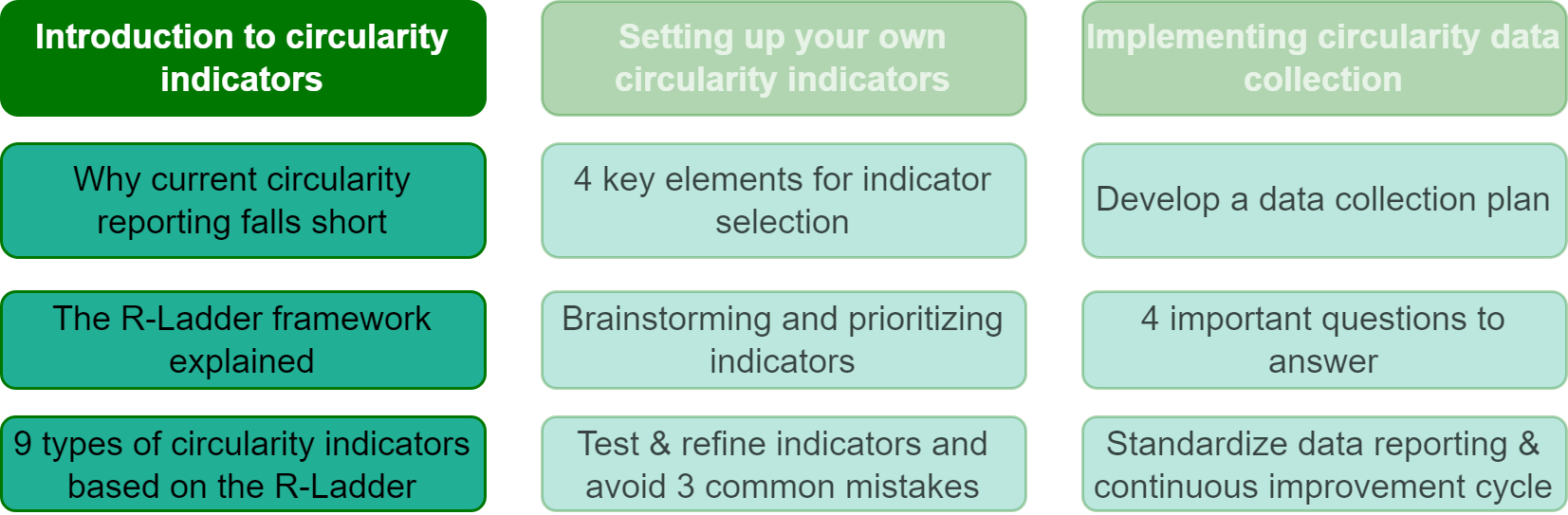
You are reading part 1 of this series:
2. Why current circularity reporting falls short
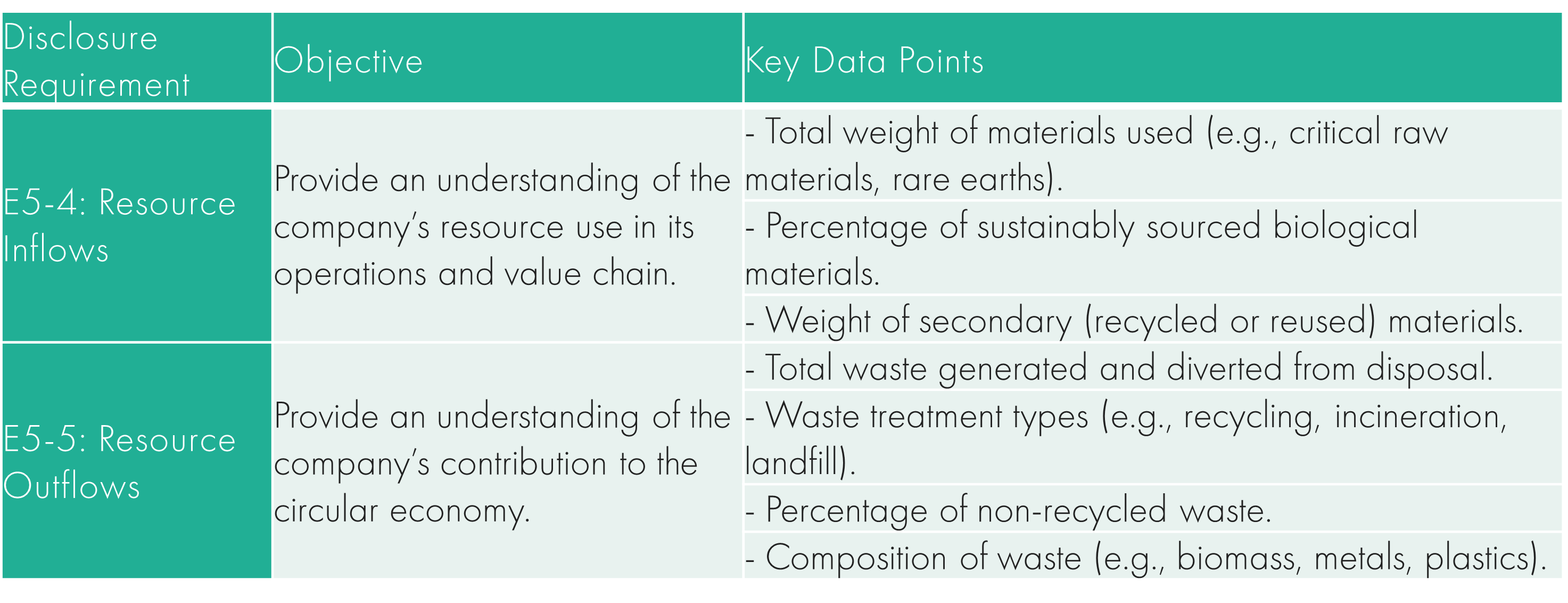
Under the current circularity reporting frameworks, companies are required to report on several metrics related to circularity. While these metrics provide an understanding of resource use and waste management, they offer a limited view of true circularity. For example, the focus on weight-based measurements (e.g., total materials used or waste generated) does not account for the environmental impact, quality, or longevity of materials. Additionally, the metrics do not reflect strategies such as designing for durability, extending product lifespans, or enabling reuse and refurbishment. For example, under the CSRD, ESRS E5 requires reporting on:
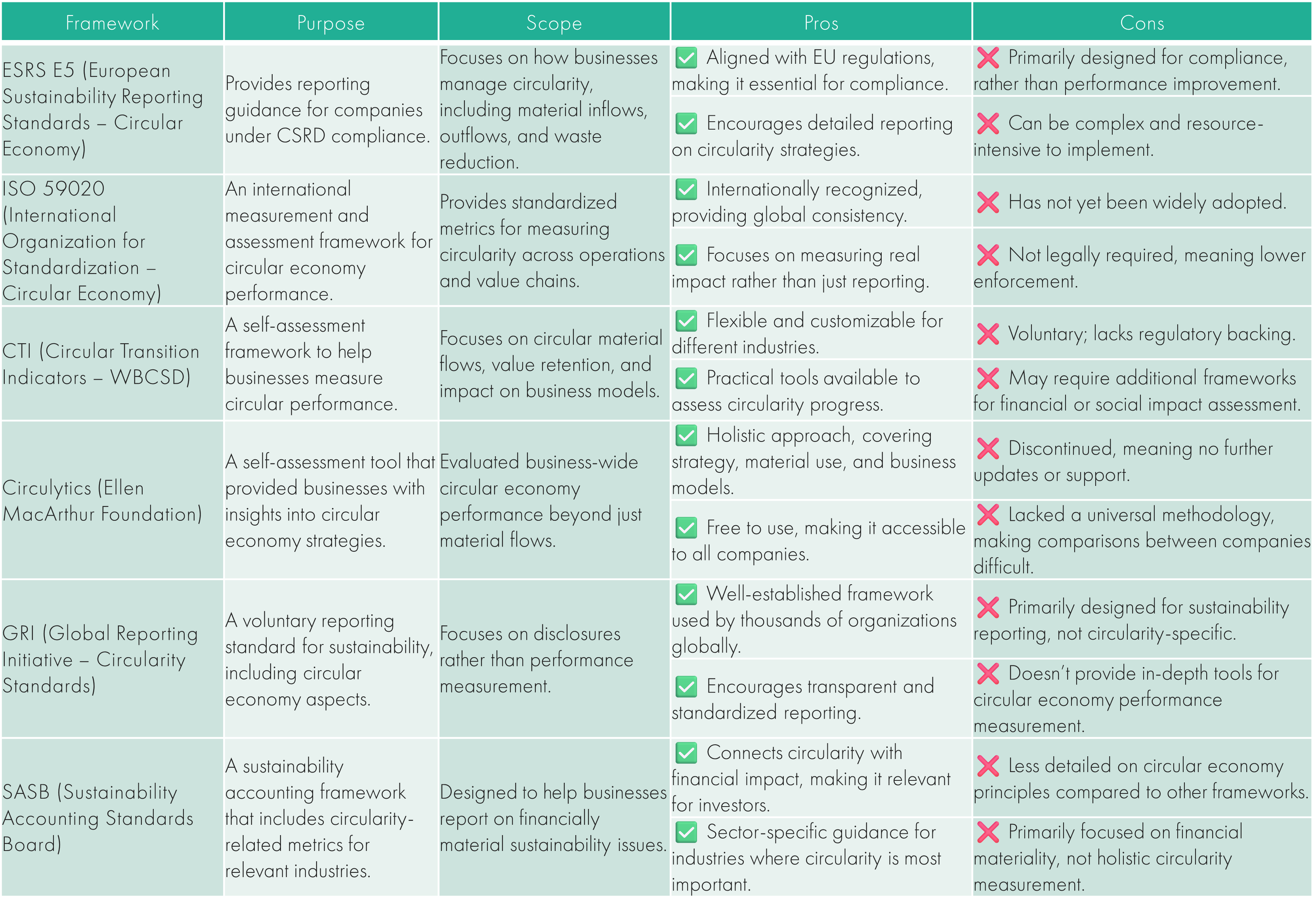
An overview of the available frameworks with their purpose, scope, pros and cons:
In the following sections, we will dive deeper into practical steps to achieve greater circularity and explore additional indicators that can provide a more comprehensive picture then by using these frameworks.
3. The R-Ladder explained
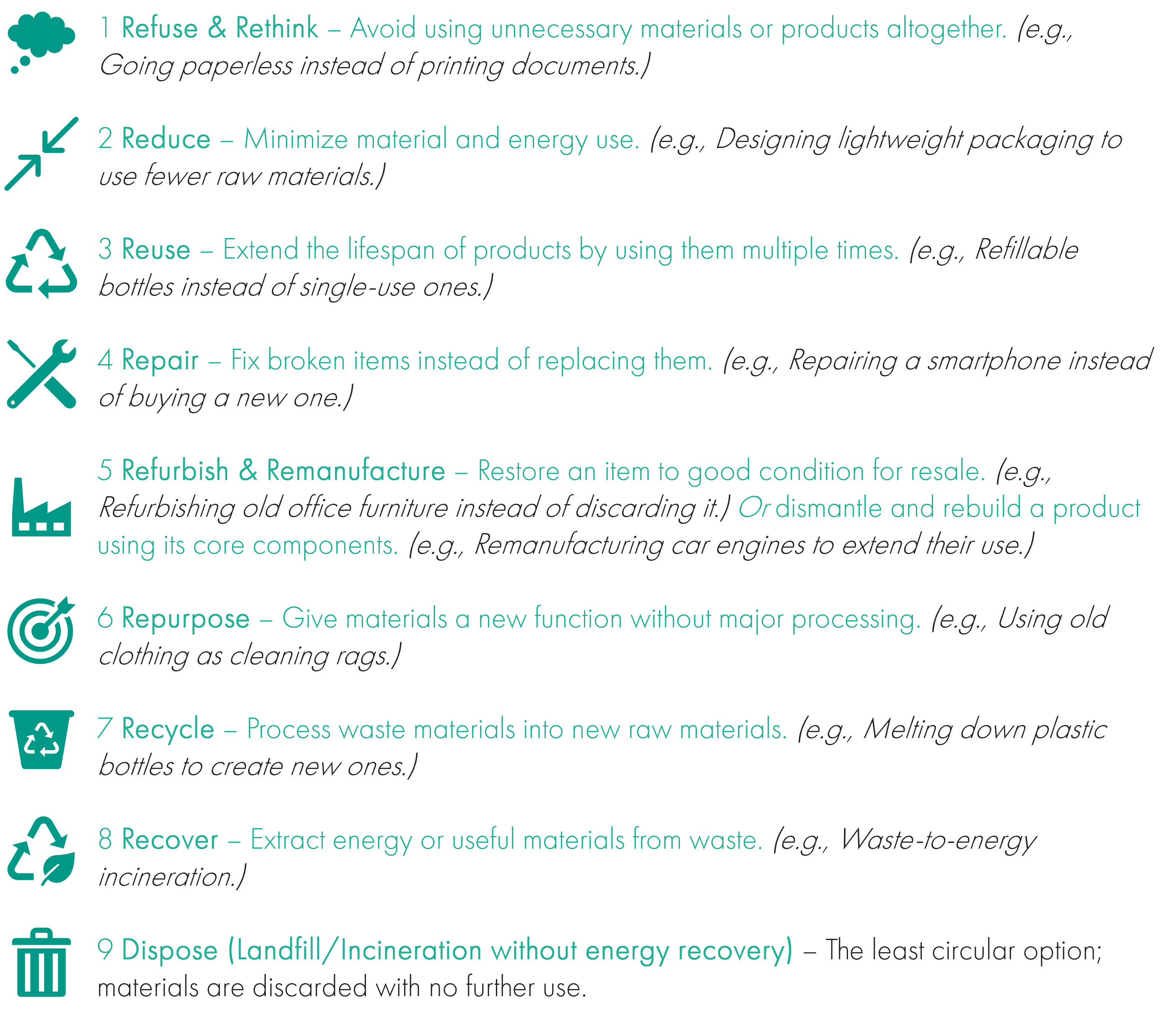
A great way to structure the transition to a circular economy is by following the R-ladder, a framework that prioritizes circular strategies. The higher up the ladder, the more impact a company can achieve. The number of R’s can vary depending on the model (some use 3, others go up to 10+), but a common version includes:
4. Using indicators to become more circular
Becoming more circular starts with understanding where you are today and setting clear goals for improvement. This section breaks down different ways to become more circular and the indicators you can use to measure progress.
(1/9) Refuse & Rethink: Transform business models for circularity
At the core of a circular economy is a fundamental shift in how businesses create value. Instead of optimizing existing processes, companies should redesign their entire approach to resource use. And avoid unnecessary resource use altogether.
Shift from product sales to services – Instead of selling products, offer them as a subscription, lease, or sharing model. Companies like Philips lease lighting instead of selling bulbs, ensuring materials stay in use.
Rethink supply chains – Focus on local sourcing, closed-loop material flows, and regenerative production methods.
Design for circularity – Products should be built for repair, reuse, and recycling right from the start.
Ban unsustainable materials – Avoid materials that are difficult to recycle or harmful to the environment. The EU is already phasing out single-use plastics.
How to measure it:

(2/9) Reduce: Minimize resource consumption
If eliminating materials isn’t possible, the next best step is to reduce how much is used. This applies to energy, raw materials, water, and waste.
Optimize production efficiency – Companies can redesign products to use fewer raw materials without sacrificing quality.
Lightweighting – Many industries, from automotive to packaging, are using design innovations to reduce material weight and waste.
Lower energy and water consumption – Smart monitoring systems can cut down on excess energy and water use in manufacturing.
How to measure it:

In this article we introduce a framework to reduce resource use called Lean Six Sigma:

(3/9) Reuse: Keep products and materials in circulation
Instead of making new products from scratch, companies can design them to be used multiple times without major processing.
Switch to reusable components – Some industries, like automotive and electronics, are building modular components that can be swapped instead of replacing an entire product.
Introduce take-back programs – Brands like Patagonia and IKEA now offer programs where customers can return old products for resale or refurbishment.
Adopt rental and sharing models – Many industries (clothing, construction, tech) are shifting toward rental services instead of ownership.
How to measure it:

(4/9) Repair: Extend the life of products
Encouraging repair instead of replacement keeps products in use longer. Yet, many products today are designed to be difficult or impossible to fix—something that is starting to change.
Make repairability a priority – France has already introduced a repairability index for electronics, and companies worldwide are adopting similar practices.
Offer repair services – Companies like Apple and Samsung now provide official repair programs to extend product lifespans.
Standardize spare parts – Designing products with easily replaceable parts makes repair more affordable and accessible.
How to measure it:

(5/9) Refurbish & remanufacture: Restore products to like-new condition
When products reach the end of their first life cycle, they don’t have to be scrapped. Refurbishing and remanufacturing are ways to restore them to working condition and resell them, reducing demand for new raw materials.
Refurbish electronics and machinery – Companies like Dell and Caterpillar already do this at scale.
Remanufacture industrial equipment – The automotive and aerospace industries save billions by remanufacturing engines and machinery instead of making new ones.
Scale up resale platforms – Brands like Nike and The North Face are expanding certified pre-owned programs.
How to measure it:

(6/9) Repurpose: Find new uses for old materials
Not everything can be reused in its original form, but materials can often be repurposed into new applications.
Upcycle materials – Old clothing can be turned into insulation, and scrap metal can be used for new construction.
Repurpose industrial waste – Some industries turn food waste into biofuel or plastic waste into building materials.
Sell byproducts – Breweries sell spent grain to farms as animal feed instead of discarding it.
How to measure it:

(7/9) Recycle: Convert materials back into raw resources
Recycling is often mistaken as the best solution, but it should be a last resort before disposal. Still, for non-reusable materials, high-quality recycling is important.
Improve recyclability in product design – Many products today contain mixed materials, making them hard to recycle properly.
Invest in closed-loop recycling – Some companies, like Interface (carpet tiles) and Adidas (shoes), design products that can be fully recycled into new versions of themselves.
Use digital tracking tools – RFID and blockchain solutions can improve transparency in material flows.
How to measure it:

Read more about RFID in this article:
(8/9) Recover: Extract energy or materials from waste
If all other strategies fail, the final step before landfill is energy recovery (such as converting waste into biofuels or heat). This is not a circular solution but is preferable to landfill.
Waste-to-energy incineration – Some countries convert non-recyclable waste into electricity or heating.
Anaerobic digestion – Organic waste can be broken down into biogas and fertilizers.
Material extraction – New technologies allow the recovery of valuable metals from e-waste.
How to measure it:

(9/9) Dispose: Landfill/Incineration without energy recovery
The least circular option, materials are discarded with no further use. Easy: do not do this.
5. What is next?
Now that you have an overview of what’s possible and the indicators you can use at each step of the ladder, the next step is to define your own indicators and start collecting data. In this follow-up article, we’ll guide you through how to set up your circularity indicators:

Relevant Standards & Sources
Sources
Integral Circular Economy Report 2023. Assessment for the Netherlands
Standards
ESRS E5
Disclosure Requirement E5-4 – Resource inflows
The undertaking shall disclose information on its resource inflows related to its material impacts, risks and opportunities.
The objective of this Disclosure Requirement is to enable an understanding of the resource use in the undertaking’s own operations and its upstream value chain.
The disclosure required by paragraph 28 shall include a description of its resource inflows where material: products (including packaging ) and materials (specifying critical raw materials and rare earths), water and property, plant and equipment used in the undertaking’s own operations and along its upstream value chain.
When an undertaking assesses that resource inflows is a material sustainability matter, it shall disclose the following information about the materials used to manufacture the undertaking’s products and services during the reporting period, in tonnes or kilogrammes:
(a) the overall total weight of products and technical and biological materials used during the reporting period;
(b) the percentage of biological materials (and biofuels used for non-energy purposes) used to manufacture the undertaking’s products and services (including packaging ) that is sustainably sourced, with the information on the certification scheme used and on the application of the cascading principle; and
(c) the weight in both absolute value and percentage, of secondary reused or recycled components, secondary intermediary products and secondary materials used to manufacture the undertaking’s products and services (including packaging).
The undertaking shall provide information on the methodologies used to calculate the data. It shall specify whether the data is sourced from direct measurement or estimations, and disclose the key assumptions used.
Disclosure Requirement E5-5 – Resource outflows
The undertaking shall disclose information on its resource outflows, including waste, related to its material impacts, risks and opportunities.
The objective of this Disclosure Requirement is to provide an understanding of:
(a) how the undertaking contributes to the circular economy by i) designing products and materials in line with circular economy principles and ii) increasing or maximising the extent to which products, materials and waste processing are recirculated in practice after first use; and
(b) the undertaking’s waste reduction and waste management strategy, the extent to which the undertaking knows how its pre-consumer waste is managed in its own activities.
Products and materials
The undertaking shall provide a description of the key products and materials that come out of the undertaking’s production process and that are designed along circular principles, including durability , reusability, repairability, disassembly, remanufacturing, refurbishment, recycling , recirculation by the biological cycle, or optimisation of the use of the product or material through other circular business models.
Undertakings for which outflows are material shall disclose:
(a) The expected durability of the products placed on the market by the undertaking, in relation to the industry average for each product group;
(b) The reparability of products, using an established rating system, where possible;
(c) The rates of recyclable content in products and their packaging .
Waste
The undertaking shall disclose the following information on its total amount of waste from its own operations, in tonnes or kilogrammes:
(a) the total amount of waste generated ;
(b) the total amount by weight diverted from disposal, with a breakdown between hazardous waste and non-hazardous waste and a breakdown by the following recovery operation types:
i. preparation for reuse;
ii. recycling ; and
iii. other recovery operations.
(c) the amount by weight directed to disposal by waste treatment type and the total amount summing all three types, with a breakdown between hazardous waste and non-hazardous waste. The waste treatment types to be disclosed are:
i. incineration ;
ii. landfill; and
iii. other disposal operations;
(d) the total amount and percentage of non-recycled waste ( 91 ) .
When disclosing the composition of the waste , the undertaking shall specify:
(a) the waste streams relevant to its sector or activities (e.g. tailings for the undertaking in the mining sector, electronic waste for the undertaking in the consumer electronics sector, or food waste for the undertaking in the agriculture or in the hospitality sector); and;
(b) the materials that are present in the waste (e.g. biomass, metals, non-metallic minerals, plastics, textiles, critical raw materials and rare earths).
The undertaking shall also disclose the total amount of hazardous waste and radioactive waste generated by the undertaking, where radioactive waste is defined in Article 3(7) of Council Directive 2011/70/Euratom ( 92 ) .
The undertaking shall provide contextual information on the methodologies used to calculate the data and in particular the criteria and assumptions used to determine and classify products designed along circular principles under paragraph 35. It shall specify whether the data is sourced from direct measurement or estimations; and disclose the key assumptions used.