


Last updated: 28-09-2025
1. Introduction
Corporate climate plans live or die on the credibility of the actions behind them. Leaders are under pressure to move beyond slogans and show precisely how they will cut emissions—what levers they will pull, in what order, and how those levers differ from adaptation, offsetting, or carbon removal.
Put simply, a decarbonisation lever is an action a company uses to reduce its greenhouse gas (GHG) emissions or remove CO₂ as part of mitigation. This article clarifies that boundary so you can design plans that stand up to scrutiny.
What you’ll learn:
✅ The distinction between mitigation, adaptation, offsetting, and carbon removal
✅ What does not count as a lever
✅ A practical taxonomy of decarbonisation levers: nature-based, technology-based, and operational/value-chain levers
✅ A checklist to stress-test your decarbonisation plan against these boundaries
By the end, you’ll be able to map your actions to defensible levers, avoid misclassification, and communicate progress with confidence.

2. Decarbonisation levers explained
Mitigation vs adaptation.
Mitigation refers to actions that directly reduce greenhouse gas emissions or increase carbon sinks. These are the heart of decarbonisation levers, because they physically lower a company’s footprint. Adaptation, on the other hand, is about adjusting to climate impacts—such as building flood defences or heat-resistant infrastructure. Adaptation strengthens resilience but does not usually lower emissions. Therefore, adaptation measures are not decarbonisation levers, unless they deliver quantifiable mitigation benefits (e.g., restoring mangroves for flood protection and measurable carbon sequestration).
Mitigation vs offsetting.
Offsetting means purchasing carbon credits from projects outside your operations or supply chain. While offsets can complement a climate strategy, they do not reduce emissions in your own footprint. As such, offsets are not counted as decarbonisation levers. Only actions that directly reduce or remove emissions inside your boundary—such as switching to renewables or improving efficiency—qualify. Offsets should be reported separately as compensation, not confused with progress on levers.
Mitigation vs carbon dioxide removal (CDR).
Carbon removal activities (e.g., reforestation, soil carbon improvement, direct air capture, BECCS) do reduce atmospheric CO₂ and can be part of a mitigation strategy. But the link to levers is specific: emission reductions at the source take priority as levers, while removals are typically reserved for residual emissions that cannot be cut otherwise. In practice, reductions like electrification or efficiency are treated as primary levers; removals are supporting levers applied later in the hierarchy.
Insetting vs offsetting.
Insetting describes projects within your own value chain—such as helping suppliers adopt regenerative agriculture—that directly lower emissions linked to your footprint. Because the reductions occur inside your chain, they are valid decarbonisation levers. Offsetting, in contrast, involves buying credits from unrelated projects elsewhere, which does not alter your Scope 1–3 emissions. Offsetting is therefore not a lever in the strict sense.
Avoided emissions (“Scope 4”).
Some companies highlight avoided emissions, for example when a product allows customers to emit less compared to alternatives. These avoided emissions are valuable in a global context, but they do not shrink your own Scope 1–3 inventory. Because levers must show up as actual reductions in your reported footprint, avoided emissions are not counted as decarbonisation levers. They can be communicated as context, but they cannot substitute for internal mitigation.
What does not count as a decarbonisation lever?
Certain actions may be valuable but do not qualify as decarbonisation levers:
Offsets purchased outside your value chain
Adaptation measures without a measurable emissions benefit
Outsourcing or divesting emitting activities (emissions simply move elsewhere)
Generic avoided-emissions claims that do not reduce your own footprint
Low-integrity measures with little or no additional impact
Compliance-only purchases (e.g., taxes, allowances) without underlying abatement
3. A practical taxonomy of decarbonisation levers
When designing a decarbonisation plan, it helps to organise actions into three broad groups.
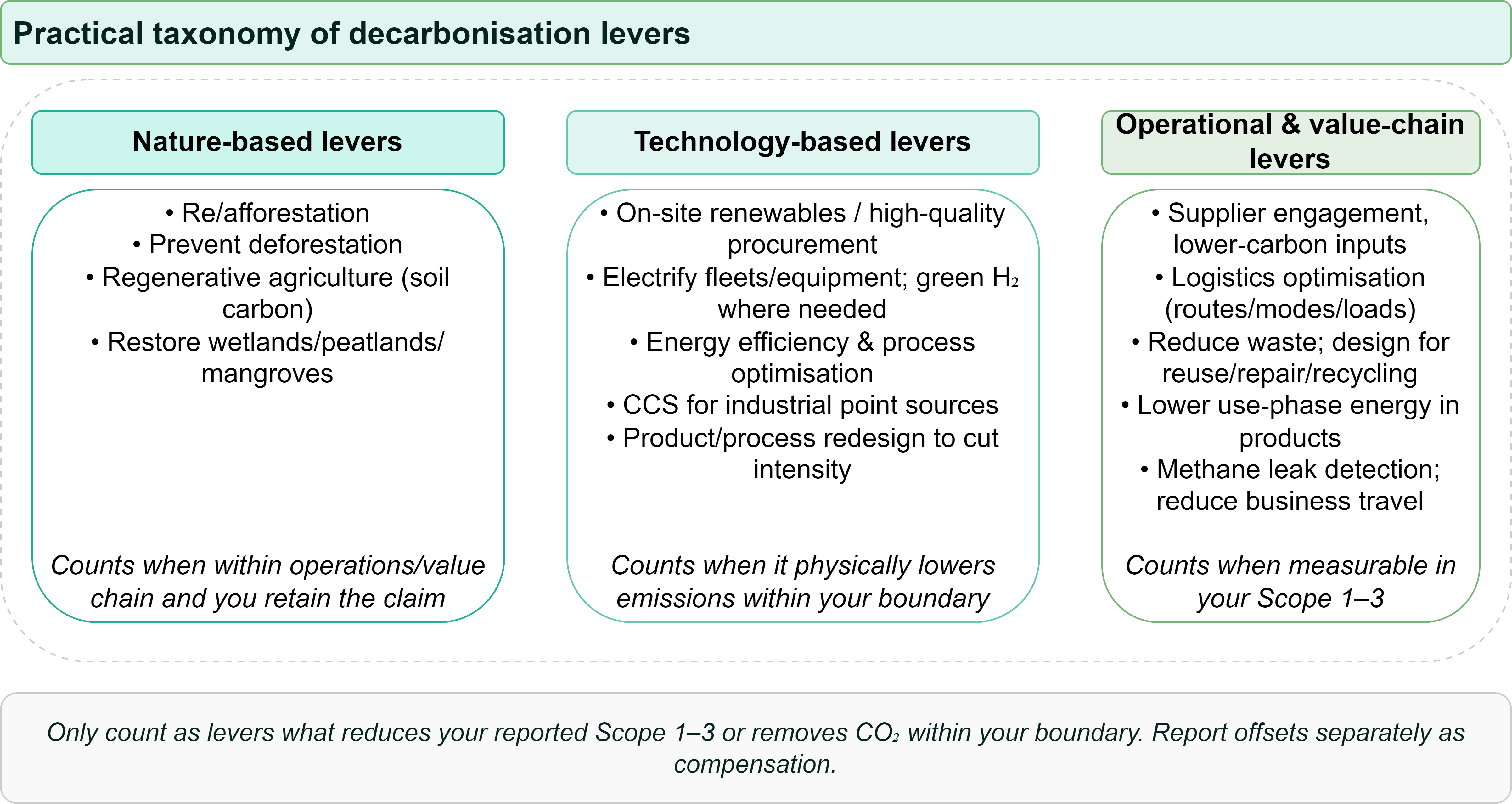
1) Nature-based levers
Mechanism: Harness ecosystems to avoid emissions or capture and store carbon.
Examples:
Re/afforestation to sequester CO₂ over time
Preventing deforestation or land degradation
Regenerative agriculture that builds soil carbon
Restoring wetlands, peatlands, or mangroves
When it counts: Projects within your operations or supply chain, where you retain the claim, can be included as levers. Purchasing credits from unrelated projects falls under offsetting, not decarbonisation.
2) Technology-based levers
Mechanism: Reduce emissions through engineering and energy transition.
Examples:
On-site renewable generation or high-quality procurement to replace fossil power
Electrifying fleets and equipment; switching to clean fuels such as green hydrogen
Process optimisation and energy-efficient systems
Carbon capture and storage for industrial emissions
Product or process redesign to reduce emissions intensity
When it counts: Only when the action physically lowers emissions within your operational or value-chain boundary. In renewable procurement, for instance, quality matters—contracts that add new clean supply carry more weight than certificates with no additional impact.
3) Operational and value-chain levers
Mechanism: Change how you operate, source, transport, and design products.
Examples:
Working with suppliers to cut emissions or switch to lower-carbon inputs
Optimising logistics routes, modes, and loads
Reducing waste and designing for reuse, repair, or recycling
Developing products with lower energy use in the customer phase
Detecting and fixing methane leaks; reducing business travel
When it counts: When reductions are measurable and show up in your reported Scope 1–3 inventory.
4. A quick checklist to stress-test each action
Use this quick test to decide if an action belongs in your decarbonisation lever set:
