


Last updated: 05-09-2025
1. Introduction
Climate strategy has moved from side reports to the center of corporate decision-making. Investors demand credible transition plans, regulators require detailed disclosures, and employees want to work for companies that take climate seriously. Physical risks—from floods to heatwaves—add further urgency.
At stake is a fundamental question of accountability: should the CFO, CSO, or CEO own climate policy? And perhaps more importantly, what actually drives outcomes?
Frameworks like the EU’s CSRD, the ISSB’s IFRS S2, and the TCFD have raised the stakes. They require clear reporting, board oversight, and governance structures that go beyond aspiration.
By reading this piece, you will learn:
✅ How CFO-, CSO-, and CEO-led models work in practice and where each excels
✅ What research says about boards, executives, and climate outcomes
✅ Where incentives, committees, and cross-functional integration strengthen execution

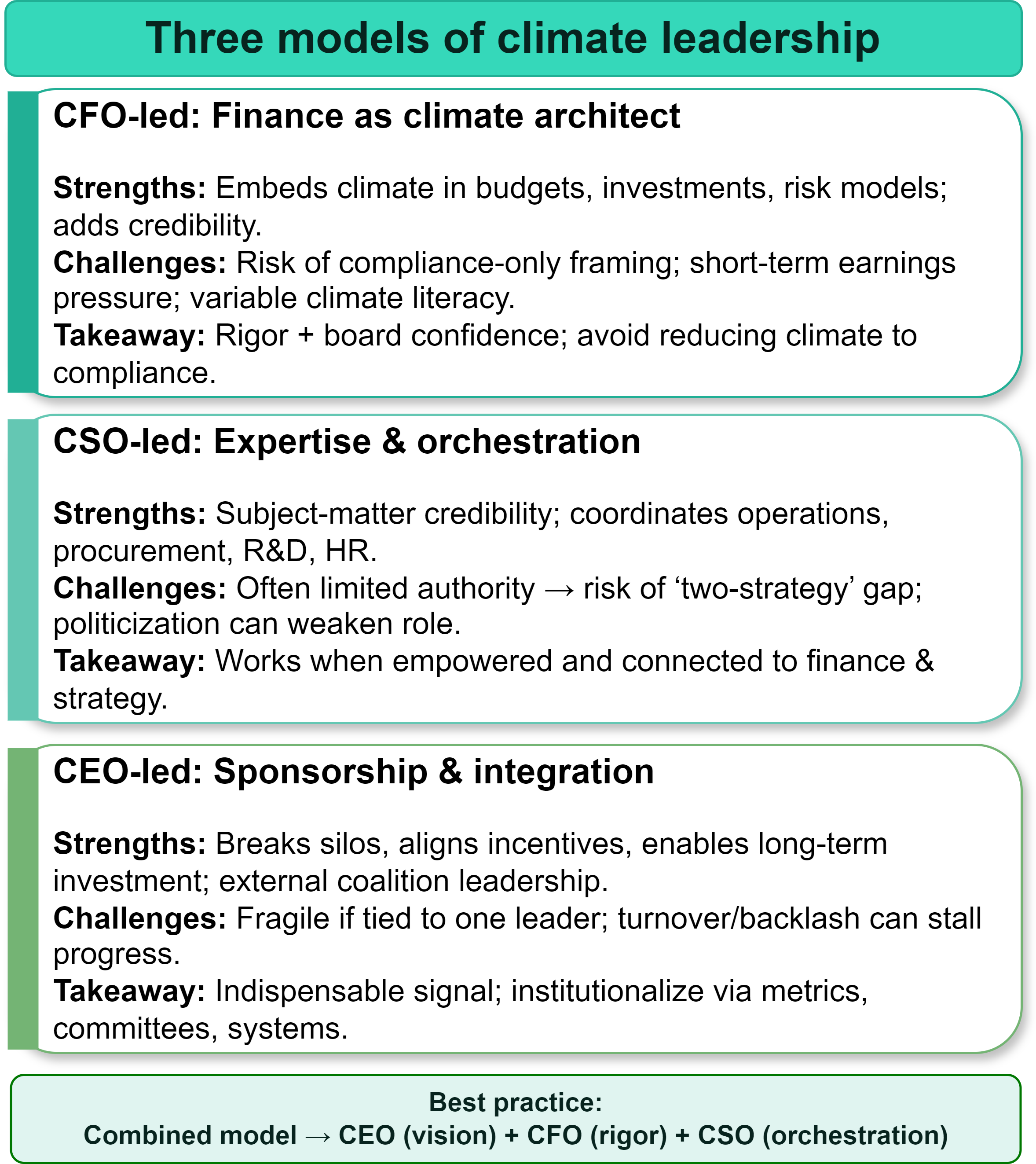
2. Three models of climate leadership
ompanies typically adopt one of three leadership patterns:
CFO-led: Finance integrates climate into capital allocation, disclosure, and risk.
CSO-led: A dedicated executive orchestrates decarbonization across functions.
CEO-led: The chief executive makes climate a core part of corporate vision.
In practice, the most effective firms combine these approaches. The CEO sets direction, the CFO ensures rigor and credibility, and the CSO drives implementation.
3. The CFO-led model: finance as climate architect
CFOs are moving into the spotlight as disclosure frameworks mature. They oversee ESG data accuracy, internal controls, and reporting—often supported by new roles like ESG controllers. When climate policy sits with finance, it stops being an ethical side project and becomes a core financial risk and opportunity.
Strengths
CFOs embed climate into budgets, investment decisions, and risk models. This adds credibility for boards and investors who expect climate information to meet the same standard as financial disclosures. CFOs also bring discipline: they force sustainability initiatives to clear the hurdle of a business case.
Challenges
The risk is narrow framing. If finance leaders treat climate only as compliance, it can limit ambition. CFOs also face pressure to deliver short-term earnings, which can conflict with the long payback periods of decarbonization projects. And many still lack deep literacy in climate science.
Examples
At eBay, the CFO’s office works closely with sustainability and SEC reporting teams so climate risks are treated with the same rigor as revenue recognition. At Asahi Group, the CFO reframes sustainability as “an investment in our future,” quantifying risks like carbon pricing alongside opportunities like low-carbon product growth. Research shows companies with active, engaged CFOs perform better on sustainability, facing less resistance and reducing the risk of greenwashing.
Takeaway: CFOs bring rigor and board confidence. But they must avoid reducing climate to a compliance exercise and embrace it as a driver of resilience and long-term growth.
4. The CSO-led model: expertise and orchestration
The CSO role has transformed from managing reputational risk to coordinating strategy. Most large companies now have one, reflecting the recognition that climate requires expertise at the top table.
Strengths
CSOs provide subject-matter knowledge and credibility with stakeholders. They act as conductors of an orchestra—coordinating procurement, operations, R&D, and HR to embed climate into daily decisions. For employees, having a CSO signals that climate is being managed by someone with real expertise.
Challenges
Authority remains the sticking point. Many CSOs lack the power to hold others accountable. This can lead to a “two-strategy” problem: bold climate goals in glossy reports that are disconnected from capital budgeting or product pipelines. Political backlash against ESG has also led some companies to downgrade CSOs, showing their vulnerability when not backed by strong governance.
Examples
At PepsiCo, the Global Sustainability Office ensures that regional leaders and functional heads align business plans with the company’s Pep+ climate strategy. At Travelers, the CSO chairs a sustainability committee and sits on the disclosure committee, ensuring ESG is tied to risk management and reporting. Research confirms that appointing a CSO alone doesn’t guarantee results; performance improves only when CSOs are embedded in governance and supported by regulation.
Takeaway: CSOs are essential integrators, but they must be empowered by boards and connected to finance and strategy to avoid becoming symbolic roles.
5. The CEO-led model: sponsorship and integration
When the CEO owns climate policy, it signals that sustainability is central to strategy, not a peripheral initiative. Employees see it as part of corporate culture, and external stakeholders see it as credible.
Strengths
CEO sponsorship breaks silos, aligns incentives, and enables long-term investments. CEOs can also represent the company in external coalitions, shaping reputation and stakeholder trust.
Challenges
The model is fragile if climate ambition rests on one leader. CEO turnover or shifting priorities can stall progress, as seen in companies where successors abandoned sustainability agendas. In polarized markets, CEOs may also face backlash for taking strong public stances.
Examples
At Stockland, the CEO led an 18-month process to embed climate into every business unit. At Mahindra & Mahindra, the CEO personally chairs the sustainability council, ensuring climate goals are backed by authority. At Microsoft, the CEO and president anchor the company’s carbon-negative 2030 goal, linking it directly to corporate strategy. Research shows CEOs with sustainability backgrounds drive stronger environmental performance and innovation, but also highlights how leadership changes can undo progress if systems aren’t institutionalized.
Takeaway: CEO sponsorship is indispensable for alignment and culture. But resilience depends on embedding climate in committees, metrics, and systems—not just one leader’s vision.
6. What research tells us
Scientific studies provide evidence on what actually moves emissions, disclosure quality, and firm value.
Boards multiply impact: Companies with directors who have environmental expertise emit less carbon, especially when those directors sit on committees. Board sustainability committees also improve disclosure quality.
CSOs help—when embedded: Appointing a CSO alone can be ineffective. But under strict regulation and strong governance, CSOs drive better performance by improving sustainability practices.
CEOs set tone and continuity: CEO sustainability orientation improves performance and green innovation. Yet leadership changes often reduce environmental responsibility, showing why climate governance must be institutionalized.
Disclosure drives value and innovation: Climate disclosure is generally linked to higher firm value and stimulates green innovation. Adoption of frameworks like TCFD improves the quality of ratings, though market responses can be mixed when climate topics are politicized.
Incentives shape outcomes: Linking executive pay to climate can work, but effectiveness depends on target design, coverage, and board oversight. Weak targets or limited scope often blunt impact.
Implication: No single leader owns climate policy. The best results come from shared accountability—CEO for direction, CFO for rigor, CSO for orchestration—amplified by board expertise and committee oversight.
7. Final thoughts
Operational execution requires shared responsibility. Some firms use a “spiderweb” model where each executive sponsors a part of the climate strategy.
The answer is not a single title, but a system: CEOs provide vision and authority, CFOs connect climate to capital and markets, CSOs bring expertise and coordination, and boards multiply impact through oversight and incentives.
Relevant Sources & Standards
How boards bridge the sustainability ambition-action gap | EY - UK
To green or not to green: The influence of board characteristics on carbon emissions - ScienceDirect
The Sustainability committee and environmental disclosure: International evidence - ScienceDirect